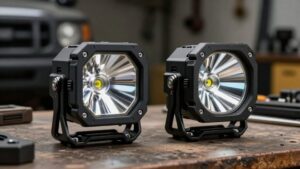
Will an LED Light Bar Drain Your Battery? Real Runtime Numbers
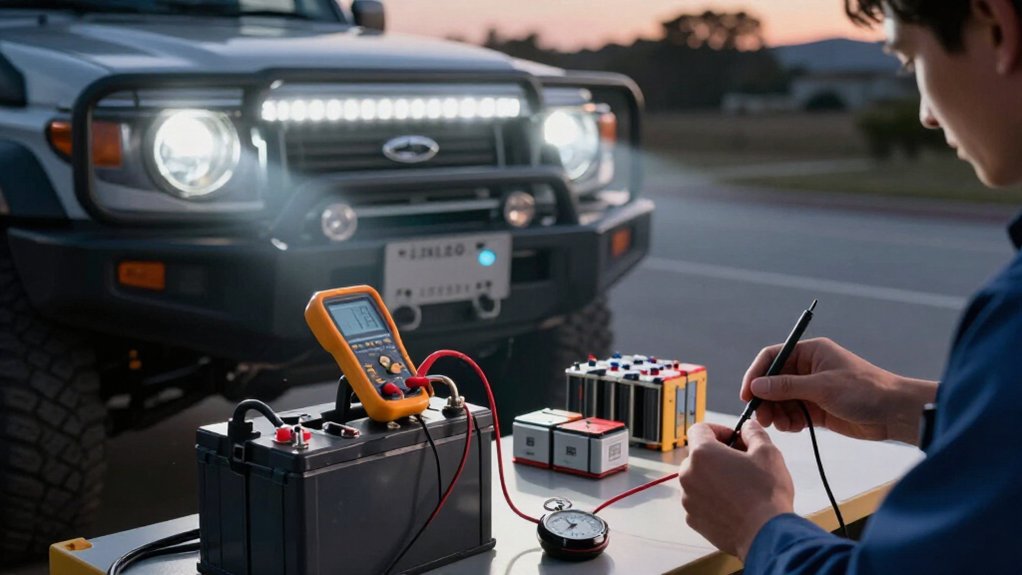
Yes, an LED light bar drains your battery whenever it runs, especially with the engine off.
A typical 100W bar draws about 7–8 amps at 12–13 volts, so a 66Ah battery gives roughly eight hours on paper, not a safe target for a starting battery.
Actual runtime drops with battery age, cold, and other loads.
You’ll find practical runtime comparisons, idle-charging limits, and checks to help protect your battery and avoid a no-start.
Battery Runtime Estimates
You can estimate runtime by dividing battery capacity in amp-hours by the light bar’s current draw: a 66Ah battery powering a 22A bar gives roughly three hours in ideal conditions. A 100W, 150W LED bar at 12-14V often draws 7-12.5A; across different lengths and brightness settings, typical bars may draw 5-15A. Use specified or measured current for a closer estimate.
An aged or sulfated battery may deliver far less than its labeled capacity. With the engine off, the battery supplies the bar, steadily losing charge and reducing current available for a later start. Treat the calculated time as an ideal ceiling, not a safe target.
Plan for less usable runtime, especially when charge is low or temperatures are cold, and stop before starting becomes unreliable in real conditions.
Battery Reserve Capacity
The 66Ah ÷ 22A estimate gives about three hours only if the battery can deliver its rated capacity; age and sulfation can reduce that reserve, while high current can cause voltage sag.
Reserve capacity means the amp-hours you can draw at your load before voltage falls too low for reliable operation. A label reading 66Ah isn’t a guarantee of 66Ah today. If your starting battery is aged or sulfated, its usable reserve may be substantially lower.
With the engine off, the battery is your fuel tank; overnight light use removes stored charge and leaves less margin to crank the engine. Multiple loads add their amp-hours, and driving may not replace everything removed. A weak battery can struggle to start even when the alternator appears normal while running.
Check battery condition and voltage under load, and stop use before voltage approaches the vehicle’s minimum starting requirement. Don’t rely on alternator output as proof that reserve is adequate.
Light Bar Runtime by Wattage
At a nominal 12.6 V, a 100 W light bar draws about 8 A, while a 150 W bar draws about 12 A. A quick estimate divides battery capacity in amp-hours by bar current in amps. For a 66 Ah battery, that means roughly eight hours at 8 A, or five to six hours at 12 A, before real-world losses.
| Bar rating | Approximate runtime (66 Ah) |
|---|---|
| 100 W | ~8 hours |
| 150 W | ~5–6 hours |
Bars draw 5–15 A across 12–14 V, or about 60–210 W, depending on length and brightness. Actual runtime is shorter: age and partial discharge reduce usable capacity, and voltage may sag faster under load. Don’t run the bar until your battery can’t start; preserve starting reserve and monitor voltage closely.
Single-Row vs. Dual-Row Bars
You’ll typically see single-row bars draw 5–10 A (60–120 W at 12 V), while dual-row bars draw 10–15 A (120–180 W). With a 66 Ah battery, that’s about 6.6–13.2 hours for a single-row bar versus 4.4–6.6 hours for a dual-row bar, before real-world voltage and battery limits reduce runtime.
If you run the lights engine-off, account for the higher drain to avoid stranding your vehicle.
Single-Row Power Draw
Because a single-row bar typically draws about 5–15 A at 12–14 V, its load depends on its length and rated power: a 100 W model pulls roughly 8–9 A, while a 150 W model draws about 11–13 A. Use current draw to estimate runtime: a 66 Ah battery divided by a 10 A bar gives about 6.6 hours ideally.
Your usable time may be shorter because an aging or sulfated battery can sag in voltage while the bar continues drawing near rated current. Check battery condition and avoid deep discharge; use a properly fused circuit sized for the bar’s current and wiring. That makes current more useful than wattage when planning an outing.
| Rated power | Approx. draw | Runtime on 66 Ah |
|---|---|---|
| 100 W | 8–9 A | 7.3–8.3 hours |
| 150 W | 11–13 A | 5.1–6 hours |
Dual-Row Power Draw
Although both designs may look similar, a dual-row bar with roughly twice as many LEDs can draw nearly twice the current as a comparable single-row bar at the same brightness. A typical bar uses about 5–15A, but check its rated wattage and operating voltage to estimate your actual load. For example, a 100W bar draws about 8.3A at 12V or 7.1A at 14V.
A 200W dual-row setup draws roughly 14–17A across that voltage range. Add the current from every bar you run: two dual-row bars drawing 15A each demand about 30A total. Use wiring, connectors, switches, and fuses rated for the combined load; undersized components can overheat. Before running bars with the engine off, consider your battery’s condition and charge level.
Runtime Differences
Current draw determines how quickly a light bar depletes a battery: a single-row model typically uses 5–10 A, while a dual-row model often draws 10–15 A. With the simple estimate, runtime equals battery amp-hours divided by bar current.
A 66 Ah battery could power an 8 A single-row bar for about 8.25 hours, versus roughly 4.4 hours for a 15 A dual-row bar, if its rated capacity is usable. At similar lumen output, a dual-row bar may draw nearly twice the current and drain your battery about twice as fast.
Real runtime is shorter when your battery’s aged, sulfated, or at a low state of charge. Cold weather further raises starting-current demands. If you run lights with the engine off, account for reduced runtime and greater voltage drop: an underpowered battery may dim the bar and leave you unable to start your vehicle. Monitor voltage and preserve starting reserve.
Temperature and Battery Age
Cold weather raises battery internal resistance, so your battery can sag more under the same light-bar load and deliver less usable capacity. Heat accelerates battery wear, while age and sulfation reduce usable amp-hours and can deepen voltage drops.
As a result, your light bar may reach a low state of charge sooner, leaving less reserve to start your vehicle.
Cold Weather Capacity
As temperatures fall, a battery can lose roughly 20–50% of its usable capacity, and age-related deterioration can deepen that loss. An older, sulfated battery has amp-hours available, so a light bar’s 5–15 A draw consumes a larger share of its reserve. In freezing weather, that load can cause faster voltage sag and weak cranking, especially if you’ve partly discharged the battery.
A reading near 14.0 V with the engine running doesn’t prove adequate reserve: when you switch on the bar, voltage may drop, and starting may fail after key-off. Check voltage under load and keep the battery charged; don’t rely on its label capacity alone. If cranking slows or voltage collapses, switch off lighting and test the battery before depending on it in conditions.
Heat-Related Battery Wear
Heat accelerates plate corrosion and electrolyte degradation, so an older battery may lose capacity faster under the same LED light-bar load.
Repeated high-temperature operation and cycling can promote sulfation, while resistance at wiring or contacts adds localized I²R heating. A loose connector, undersized wire, or poor fuse or relay contact can also cause voltage drop and leave the system undercharged.
After about 10 minutes at full output, check battery posts, fuse holder, relay, and connectors carefully. Warm-to-hot spots suggest excess resistance; switch off the bar before investigating loose or damaged connections. Don’t touch exposed conductors or work on energized wiring.
Heat-damaged batteries may deliver less current during cold starts, even when resting voltage appears normal. Have a technician test suspect batteries and charging connections.
Age-Reduced Runtime
Even when the light bar draws a steady load, battery age and temperature can shorten runtime: sulfation and lost plate area reduce usable capacity, while cold weather and higher internal resistance cause voltage to sag sooner.
| Condition | Usable effect | What you notice |
|---|---|---|
| Aged, warm | Less real Ah | Bar quits earlier |
| Aged, freezing | Faster voltage sag | Dark arrives sooner |
At 22 A, a 66 Ah battery suggests three hours by Ah÷A, assuming full capacity.
An older, sulfated battery may deliver a fraction before voltage falls too low. Cold and age-raised resistance worsen sag during current spikes, so your bar can stop sooner despite wiring. Check battery health before prolonged use; if voltage drops, switch off to avoid being stranded.
Campsite Lighting Scenarios
At camp, running an LED light bar with the engine off draws directly from your starting battery: a 5-15 A bar uses about 15-45 Ah in three hours. A common 100 W bar at 12.8 V draws roughly 7-8 A; six hours uses 42-48 Ah. That can leave an older or sulfated battery unable to crank reliably.
Five bars near full output draw far more; accidental overnight use can deplete your starting battery. LEDs save energy only at correct voltage and current; time-on with the engine off still drains the battery. The longer you leave them on, the less reserve remains, and a depleted battery may deliver less peak starting current. Set a cutoff time and monitor battery voltage. Keep a separate light for campsite use.
Alternator Output at Idle
How much current your alternator supplies at idle depends on the vehicle, belt speed, and temperature: although many are rated for 60–150 A, output at idle may be only tens of amps.
| Item | Typical figure | Idle effect |
|---|---|---|
| Alternator rating | 60–150 A | Not guaranteed at idle |
| Light bar | 100–150 W | 8–12.5 A at 12 V |
| Voltage | ~14.0 V initially | May fall under load |
| Battery | Supplies deficit | Discharge risk |
Your bar’s 8–12.5 A draw can consume idle headroom after fans, lights, and climate controls take their share. If alternator output falls short, battery current makes up the gap; voltage may drop below roughly 14.0 V when you switch the bar on.
Check voltage and charging performance under your actual accessory load, not just the alternator’s nameplate rating alone.
Backlit Switch Parasitic Draw
A light bar can stop drawing power while its backlit switch continues to drain the battery. If its control circuit uses an always-on feed, the switch may draw a few milliamps to tens of milliamps with the lamps off. That modest load can leave a marginal battery unable to start your vehicle by morning.
- You may see a faint glow long after parking.
- Intermittent illumination can quietly consume your starting reserve.
- An overnight no-start can follow a seemingly harmless indicator.
- Don’t assume the light bar LEDs caused the loss.
The reliable check is a key-off, locked-vehicle test after modules sleep; wait minutes, then measure with a multimeter or clamp meter. Route the relay trigger through ACC/ignition power so the coil de-energizes with the key.
Check Your Wiring Connections
Trace the circuit from battery positive through a fuse mounted near the battery, the relay, and the light bar, then verify the return wire has a clean, solid ground. Your high-current path should follow that sequence; a poor ground can cause flicker and extra current. Use waterproof crimp or snap connectors, and avoid splices in the main run: corrosion or loose joints can create voltage drop that looks like battery drain.
Feed the switch and relay coil from an ignition/accessory source or designed trigger, so the circuit opens when your vehicle sleeps. A wiring error can leave the bar powered with the switch off or key removed.
Measure battery and light-bar voltage while operating. A drop greater than a few tenths of a volt suggests undersized wiring or bad connections.
Conclusion
An LED light bar can drain your battery if you run it with the engine off, but reserve capacity and measured current—not wattage alone—tell you how long. Check your wiring connections, fuse rating, and switch draw, and don’t assume an idling alternator will cover the load. Track voltage, account for cold or aging batteries, and shut the bar off before starting becomes uncertain.
When in doubt, use a dedicated auxiliary battery for lighting.