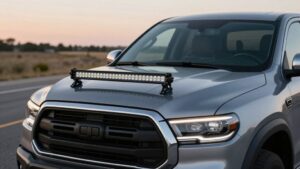
How Far Does a Spot Beam Light Bar Really Reach? Ratings vs Reality
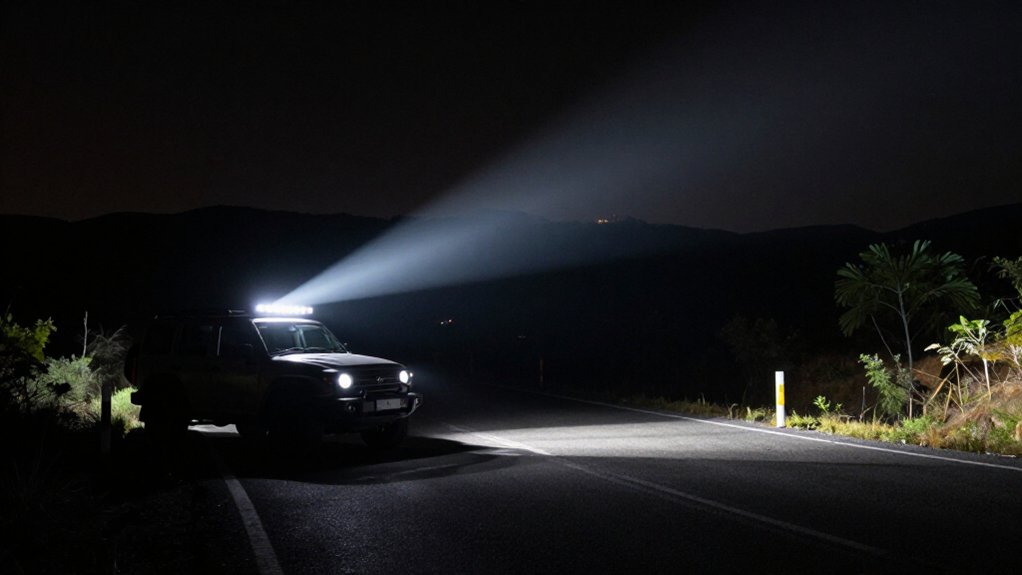
A spot beam light bar can put a center hotspot 300–500 meters away, but that rated reach isn’t the same as usable trail visibility.
Ratings usually reflect peak candela, often 50–100+ lux at 100 meters, not even illumination; an 8–10° beam may reveal distant bends while leaving nearby rocks and trail edges dim.
Dust, haze, aiming, and wiring voltage drop reduce real-world performance.
You’ll learn more by comparing beam patterns, test conditions, and road-use limits.
Rated Versus Usable Distance
A spot beam’s rated reach can exceed 300–500 m in ideal conditions, but that figure often reflects brightness at the beam’s center, such as 50–100 lux at 100 m, not how clearly you can read the full trail.
On the trail, a narrow 8–10° pattern can put a bright hot spot far ahead while leaving nearby ground and the trail’s edges dim. You may see a distant landmark yet miss a rock or animal close to your vehicle.
Candela Behind Distance Ratings
Behind a spot beam’s distance rating is candela: the measure of how strongly it concentrates light in a given direction. Manufacturers typically derive throw claims from candela or intensity measured under standardized lab aiming, so a lamp may claim 300–500 meters or more. That figure describes peak intensity, not guaranteed visibility on your route.
A spot beam confines much of that intensity to a narrow, roughly 8–10° cone. Test results may show 50–100-plus lux at 100 meters, yet the beam can cover only about 1.4 meters in width at 10 meters. You’ll get concentrated light far ahead, not broad coverage nearby.
Alignment, mounting height, terrain contrast, fog, and dust affect usable reach. Compare beam tests showing candela across distance, not lumens alone; a lux threshold defines recognition more usefully than peak intensity.
Seeing a Trail Bend Early
How early can you read a trail bend? A true spot beam’s 8–10° pencil cone can keep useful illumination on the trail roughly 300–500 m or farther; published figures may reach 50–100+ lx at 100 m. That concentrated light can preserve contrast down the trail, helping you detect a bend sooner than a broad flood bar, which may lose useful reach beyond about 30–100 m.
Range isn’t the whole picture. A spot leaves near and side areas darker, so you might see the bend opening yet miss rocks beside your front tires. Aim the bar along the trail: too high wastes light and can increase dust glare; too low delays the reveal. For both distance and nearby edges, a spot-center, flood-side combo adds close-range awareness without giving up long throw.
TIR Versus Reflector Optics
TIR optics use internal reflections within a lens to shape the beam, while precision reflectors direct light into a narrower, typically 8–10° cone. Though either design can produce a spot beam, reflector optics often control spread more tightly, helping deliver higher lux at distance. So, compare beam angle and measured lux—not lumens alone—when judging a bar’s practical reach.
TIR Optics Explained
Although both TIR and reflector optics can produce long-range spot beams, they shape light differently. A TIR optic uses a molded lens to bend LED light outward through internal reflection. It creates a tighter, more controlled beam than a bare LED, making it useful when you need a defined spot pattern.
Its beam edge tends to look smoother and more uniform, with less hot-spot spattering. That can improve on-axis clarity at long throw distances. Yet an advertised spread of 8–10° alone won’t establish reach: your bar must use spot-pattern optics, rather than generic wide-lens dispersion. Well-focused spots commonly reach 300–500 meters or more, with 50–100 lux or higher at 100 meters. Wide floods often deliver 30–100 meters and 5–15 lux at 100 meters.
Reflector Optics Explained
When choosing a spot beam, compare its optics, not just its lumen rating: precision reflectors can focus light into a narrower, more controlled cone than many TIR designs, increasing illuminance at distance. A tight 8–10° cone can support long-throw claims, but the optic determines how efficiently light reaches a target.
A good spot bar may deliver useful illumination at 300–500 m or farther; cited readings near 50–100+ lx at 100 m depend on design and aim.
| Feature | Optical effect |
|---|---|
| Reflector | Precision surface concentrates LED output |
| TIR comparison | Often different cutoff and edge behavior |
| Same lumens | Wider pattern can lower distant lux |
Don’t treat lumens as a reach guarantee: compare measured intensity and beam profile. Reflectors can favor distance; edge shape affects nearby visibility in practice.
Reach and Beam Control
Reflector and TIR optics can both produce a tightly controlled spot beam, but their beam edges and long-term performance may differ. Your choice of optic shapes how that reach looks on the road. Reflector-style designs concentrate LED output into a pencil beam, while a TIR lens can also collimate it; cutoff sharpness and heat-related aging may differ.
A typical spot spans about 8–10 degrees, supporting quoted effective ranges near 300–500 meters or more. A 100-meter reading of roughly 50–100-plus lux reflects that concentration, not guaranteed visibility. At 10 meters, a spot may cover only 1.4 meters, versus 5.8–11.5 meters for a flood.
You gain distance but sacrifice foreground and side coverage, creating tunnel vision; pair the spot with wider lighting when hazards matter to you.
Dust and Atmospheric Haze
Dust scatters a spot beam back toward you, creating glare and reducing contrast at distance. In haze, the beam’s stated 300–500 m reach won’t guarantee readable detail because visibility depends on atmospheric conditions.
Adjust your speed and expectations to the air quality, not just the light’s rating.
Dust Scatters Light
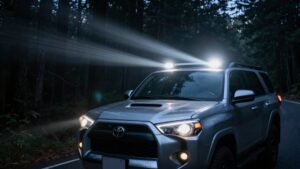
In dusty or hazy air, suspended particles scatter a spot beam’s concentrated light, weakening its long-throw advantage and making the beam appear less defined at distance. Your bar may still produce high on-axis lux while dust scatters light toward you. That forward-scatter can create glare and reduce distant target contrast, even when a nominal 300–500m+ rating suggests reach.
| Condition | Practical effect |
|---|---|
| Clean air | Defined throw |
| Dusty air | Scattered beam |
| Heavy dust | Glare; weaker target separation |
| Combo beam | Close and edge awareness |
An amber flood’s wider, diffuse pattern produces less backscatter than a tight spot, so you can favor it in dirty conditions. A combo setup adds close and edge illumination; its spot reaches outward, but cues remain available when dust erases far contrast.
Haze Reduces Visibility
Haze and suspended dust can sharply reduce a spot beam’s usable reach, even when its rated range is 300–500 meters or more in open air. In haze, particles scatter and absorb the concentrated light as it travels, weakening illumination at distance. The narrow beam can appear as a glowing mass, while distant objects lose contrast and look washed out.
High output doesn’t prevent this loss: more light may also increase backscatter near the vehicle. A flood beam often produces less intense glare in dusty or foggy air because it distributes light across a wider angle. On dusty trails, you may see brightness nearby while useful visibility fades beyond a short-to-medium distance, closer to the 30–100-meter range associated with flood lighting than the spot’s open-air rating.
Adjust for Conditions
When dust or atmospheric haze reduces visibility, adjust your spot beam rather than relying on its clear-air rating. A typical 8–10° spot beam may reach 300–500 m or more in clear air, with published output often reported as 50–100+ lx at 100 m.
In suspended particles, scattering cuts intensity faster, shortens apparent range, and softens road detail. Because the narrow cone concentrates light, dust and fog can backscatter more than they do with a wide flood pattern. Aim slightly lower on dusty trails to limit glare, and don’t expect clear-night distance.
For haze, an amber wide flood often provides a more practical option; keep your spot as supplemental lighting, not your reduced-visibility solution. Use both according to conditions and visibility ahead on road.
Spot Beam on Desert Roads
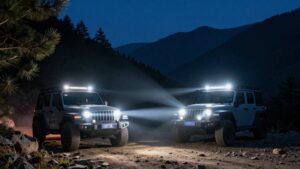
Across open desert roads, a spot beam’s narrow 8–10° pattern can project useful light roughly 300–500 m or farther, helping you detect obstacles, animals, and trail markers ahead. That reach suits clear, fast lanes, where distant hazards matter; concentrated output can make the road appear illuminated much farther than a flood beam. At about 100 m, a spot may deliver roughly 50–100+ lux, compared with about 5–15 lux from a flood, though actual readings depend on optics and measurement conditions.
Published lux and range figures are lab-based estimates: weak beam-shaping or poor aiming can reduce throw. Dust causes forward scatter and glare, lowering contrast.
A spot also leaves shoulders and nearby areas dim, so wider coverage helps prevent tunnel vision and missed hazards there.
Legal Road-Use Restrictions
That 300–500 m reach is intended for off-road use, not automatically permitted on public roads. You must check your jurisdiction’s rules and the bar’s approval before fitting or switching it on. Many spot bars lack SAE J581 or ECE R112 certification, standards associated with road-legal driving beams.
Their concentrated output often lacks the cutoff and aiming control needed to limit glare toward oncoming drivers. That glare can reduce another driver’s visibility, creating a safety hazard and a basis for restrictions on beam type, mounting, or use. Fog, rain, and snow can further impair performance as backscatter increases glare.
For public-road use, choose approved auxiliary driving lights with controlled beam patterns, and aim them as required. Treat a spot or flood bar as off-road equipment.
Misreading Lux at One Meter
A lux rating measured at 1 meter can make a light bar look exceptionally powerful, but it does not show how well the beam illuminates objects 100-300 meters away. Instead, compare published measurements at 100 meters or inspect photometric plots; a one-meter figure can’t establish distant throw. At that distance, spot bars often deliver roughly 50-100+ lux, while flood bars typically produce 5-15 lux. Your result depends on beam focus, not lumens alone: a tight 8-10° optic concentrates light into a narrow cone.
- A focused spot can retain intensity farther downrange.
- Flood spreads output broadly, reducing distant illuminance.
- Spot ranges are often quoted around 300-500m+.
- Those figures depend on tested beam patterns.
- Seek lux data at 50 or 100 meters before judging reach carefully.
Check Wiring Voltage Drop
Even a tightly focused 8 to 10° spot beam can fall short of its quoted 300–500m+ reach if undersized wiring causes voltage drop.
Check the path from battery or relay to the bar while it runs; unloaded readings won’t reveal resistance losses. If you’re losing more than a few tenths of a volt under load, the LEDs may receive less drive voltage and produce less output.
Use a relay and fused feed sized for the bar’s current draw, especially with 240W–783W kits. Long, small-gauge cable increases drop as current rises. Keep ground runs short, and secure metal-to-metal connections; poor grounding adds resistance too.
Finally, measure voltage at the light’s connector with it switched on. Feed it near full system voltage to preserve its reach.
Conclusion
Your spot beam’s advertised distance isn’t a promise of usable vision: ratings often mark a threshold at one lux, while candela, beam shape, mounting, and your eyes determine what you can detect.
You’ll see a trail bend earlier only when light reaches it with enough intensity and contrast; dust and haze can erase that advantage. Compare optics and measured lux, check wiring voltage drop, and confirm road-use rules before you rely on a light bar.