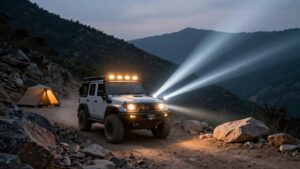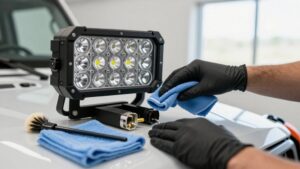
Rigid vs Baja Designs Light Bars: Optics, Build and Warranty Compared
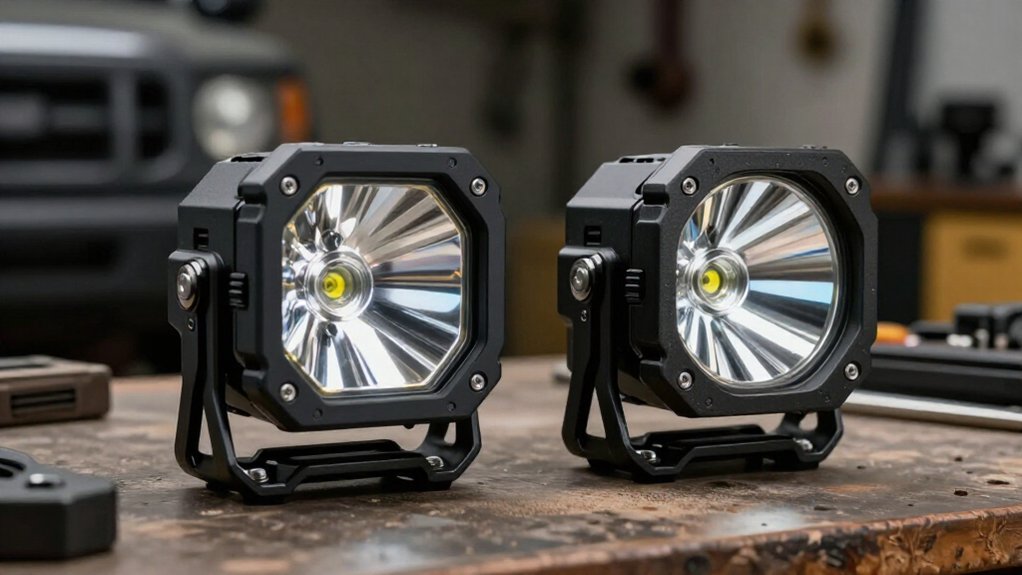
When you compare Rigid and Baja Designs light bars, prioritize beam pattern, fitment, and warranty over headline output.
Baja Designs OnX6 offers selectable spot, driving/combo, and wide-cornering optics; Rigid’s Specter optics emphasize a focused, blended beam, while Adapt models adjust coverage with speed.
Both brands offer limited lifetime coverage against manufacturing defects, but Baja Designs adds a 30-day satisfaction guarantee and repair services.
Your terrain, mounting space, and circuit capacity help determine the better match; the details below clarify those trade-offs.
Brand-Specific Beam Optics
How does each bar shape light for off-road use? You’ll find that beam geometry determines reach and peripheral visibility.
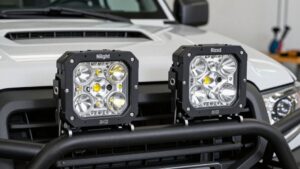
OnX6’s precision lenses and high-efficiency reflectors support selectable driving/combo, spot, and wide cornering patterns. MoistureBlock™ helps protect optics from moisture and dust, supporting consistent output. Rigid’s Specter optics shape a more focused beam; hybrid configurations blend spot and flood coverage.
Thermal design helps maintain stable performance during sustained operation. Choose according to whether you need tailored distance coverage or blended illumination across changing terrain.
| Brand | Optics | Trail effect |
|---|---|---|
| OnX6 | Precision lenses, reflectors | Selectable beam patterns |
| Rigid | Specter optics | Focused, blended spot/flood beam |
| Either | Pattern choice | Match your terrain |
Your terrain, mounting position, and desired throw should guide the pattern you select, not brightness claims alone.
Product Line Comparison
Beyond beam shape, each brand’s lineup targets a different mix of range, control, and price. Choose the OnX6 Laser for extreme long-distance illumination in high-speed desert racing; its roughly $1,500, $3,000 price marks the highest initial investment.
- OnX6 Laser prioritizes reach for distant horizons, not a low entry price.
- For a compact footprint, Squadron Sport/Pro bars offer multiple patterns and up to about 4,900 lumens.
- Rigid Adapt shifts beam focus with vehicle speed, pairing automated control with typical $1,000, $2,000 pricing.
- Radiance starts near $400; E-Series options broaden Rigid’s coverage choices.
Match output and beam behavior to terrain: reserve Baja’s flagship for fast routes, or choose Rigid’s broader price ladder when adaptive control or lower-cost coverage better fits your build.
Warranty Coverage Comparison
When you compare warranty coverage, Baja Designs’ OnX6 and Rigid Industries’ E-Series both offer a Limited Lifetime Warranty against manufacturing defects, extending defect protection beyond Feniex’s five-year term for the Fusion-S GPL Exterior.
For you, the distinction is in service access and additional recourse: Baja Designs adds a 30-day satisfaction guarantee and offers repair services for damaged units, while Rigid routes service support through its broader dealer network.
Both warranties target manufacturing defects, so neither stated term should be read as unconditional coverage for every failure. Feniex’s five-year manufacturer warranty and authorized-dealer support give you a defined coverage window, but less protection over long ownership. If you prioritize maximum-duration defect coverage and protection for long-lived lighting hardware, OnX6 and E-Series tie at the top. Compare each brand’s current claim terms before purchase, since actual warranty service depends on the applicable policy.
Installation Steps and Tools
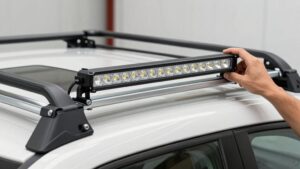
For accurate beam placement, start with vehicle-specific Baja Designs or Rigid brackets and the matching harness or adapter if needed. A socket set, torque wrench, tools, and a level help you control fit, alignment, and connections.
- Lay out brackets, supplied hardware, and tools; mount the bar on its intended surface, adding track components when provided.
- Leave bolts loose for adjustment, then torque mounts to specification once the beam is aligned.
- Route correctly gauged power and ground wires away from heat, moving parts, and sharp edges; secure strain relief and connect your switch or controller.
- On level ground, select driving, combo, or spot optics as applicable; check cutoff and spread before final tightening.
Follow the maker’s installation guidance; consider a professional for sealing-sensitive, rated equipment.
Roof Rack Clearance Checks
Before tightening the mounts, measure the rack, crossbars, and bracket height to confirm the bar’s outer edge clears the cab and roof accessories. Compare bar length with usable rack space; Baja OnX6 options typically reach 50 inches, so check radar units, roof rails, and storage before choosing.
Confirm vertical tilt and bracket travel preserve clearance through suspension flex; adjustable OnX6 positioning and Rigid E-Series mounts can create different contact points. Route the harness clear of rack hardware, and avoid compressing seals to maintain OnX6’s IP69K protection. Then recheck with cargo loaded and at full steering lock, confirming no bar or bracket contact with rack components or roof-mounted accessories. These checks keep the beam unobstructed by gear.
Replacement Beam Performance Comparison
With rack clearance confirmed, compare replacement bars by beam shape and how each handles changing speeds.
- OnX6 driving/combo gives you a blended lane: a defined central reach with useful lateral spill for open desert.
- Choose spot when you need concentrated distance; wide cornering options spread light across tight turns, matching pattern to terrain.
- Baja Designs prioritizes peak throw. Its OnX6/Laser line advertises claims up to 350% farther than standard LEDs, a marketed figure, not a measured guarantee.
- Rigid E-Series favors rugged, consistent coverage and durability over OnX6’s manual pattern tuning. Adapt narrows the beam as speed rises and widens it as speed falls, changing focus without swaps.
For replacements, choose Baja for peak throw and pattern choice; Rigid for steady coverage or speed-responsive beam shaping.
Auxiliary Circuit Load
Your light bar’s auxiliary-circuit load is the current it draws through the vehicle’s switch and wiring, so check the circuit’s amp rating before installation. That rating governs whether the bar can run without overloading wiring or compromising stable output. OnX6 models deliver high output and typically need heavier-gauge leads plus a dedicated relay harness; confirm the specific unit’s draw rather than assuming one circuit fits every setup.
Rigid E-Series demand varies with bar length and LED count, so use its spec-sheet amperage. Feniex Fusion-S GPL pairs strong brightness-to-price with warranty coverage, but its published current draw should set your wire and fuse choices to limit voltage drop and overheating. Check amperage, estimate I = voltage ÷ (watts ÷ efficiency), and size harness and fuse above expected current.
Lens Color Options
When you compare lens colors, match your goal—dust and fog contrast or maximum general illumination—to the beam pattern you’ll use.
Baja Designs offers amber options for conditions like haze, dust, and light fog, while OnX6 lens choices also let you tailor contrast to terrain. Rigid E-Series lens color mainly changes the beam’s appearance on the ground; its sealed housing and thermal management define durability.
Lens Color Choices
Lens color changes how a light bar’s beam performs in real conditions: clear lenses preserve neutral output for general driving and long-distance viewing, while amber lenses can reduce perceived glare and improve contrast in haze, fog, or dust. Both brands offer clear and amber lens options, but the right choice depends on where you drive, not a brightness claim alone.
- On clean highway pavement, clear glass keeps distant signs and road edges easy to assess.
- In dusty tracks, amber can soften veiling glare around particles suspended ahead.
- Through fog, judge the beam’s hotspot and spread; lens tint interacts with the optic.
- When comparing E-Series with OnX6, match tint to dominant conditions, then verify the pattern at night.
Your driving-versus-cornering impression may shift in use.
Color Performance Differences
Although tint doesn’t change a bar’s beam pattern, it affects how that beam appears in poor visibility: clear or white lenses preserve a neutral, daylight-like character for long-range viewing, while amber can reduce perceived glare and improve contrast in haze or dust.
When you compare Rigid and Baja Designs options, choose color for conditions, not as a substitute for beam geometry. Rigid commonly offers clear/white and amber outputs, depending on model, so you can prioritize neutral color or weather-related contrast. Baja Designs also offers amber configurations suited to dusty or foggy terrain, where clear light may appear washed out.
Its lens and casing choices aim to retain off-road visibility, including the long-distance beam styles of the OnX6 line. For road-use color accuracy and white long-range visibility, you generally want clear lenses from either brand. In haze or dust, amber may make obstacles easier to distinguish by lowering perceived glare and improving contrast. Match tint to your terrain and viewing priorities; compare model output and beam pattern.
Dusty Trail Visibility
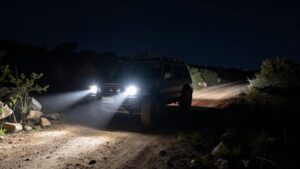
On dusty trails, you’ll want a beam pattern that balances reach with edge definition: a spot beam typically carries farther, while a combo or wide-cornering pattern can reveal more of the trail.
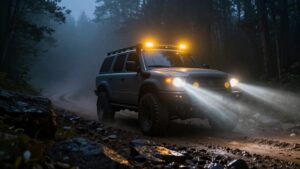
Because airborne particles scatter light back toward you, beam control can help limit distracting backscatter and preserve usable contrast. Compare each light’s optics and output to judge how clearly you’ll see downrange as dust density changes.
Beam Pattern in Dust
When dust fills the trail, a narrow hotspot can scatter back toward you and turn distance illumination into glare. Choose a wide-cornering flood or driving-combo pattern to distribute illumination across the haze, not just down the centerline. That spread helps you read trail edges, bends, and drifting dust clouds without relying on one intense forward axis.
- OnX6 offers spot, driving/combo, and wide-cornering options; its reflectors and precision lenses shape each distribution.
- A Rigid Specter-style focused beam reaches ahead, while hybrid spot/flood choices broaden coverage.
- If turns dominate your route, cornering width illuminates shoulders where you need visual guidance.
- Pair driving reach with added width; a pure spot can make dusty distance harder to interpret.
Match optics to your speed, terrain, and usual dust density.
Reduced Backscatter
Dusty-trail visibility depends on limiting how much airborne grit your beam illuminates, because light scattered back toward you reduces contrast and creates glare. Baja Designs uses high-efficiency reflectors and precision lenses, with spot, flood, driving/combo, and wide cornering options, to shape illumination and avoid lighting up foreground dust as strongly as an unfocused beam.
Rigid controls its beam through Specter optics; Adapt models can narrow or widen the pattern with speed, helping manage how much particulate matter sits inside the beam. In either system, choose a narrower, lower-angle pattern at higher speeds to reduce illuminated dust near your vehicle. Switch to a wider, angled cornering pattern when slow-speed lateral visibility matters. Both approaches limit, but can’t eliminate, dust-driven backscatter.
Trail Visibility Range
Beyond limiting backscatter, trail visibility depends on how effectively a beam carries downrange through dust. Pattern, not brightness alone, governs usable reach. Baja Designs OnX6 optics favor long reach; Rigid E-Series Specter optics and thermal management preserve focus in powdery haze.
- A spot beam sends a shaft toward distant trail markers.
- A driving/combo pattern balances forward reach with peripheral coverage.
- Wide cornering optics illuminate nearby turns, but can bloom in suspended dust.
- Rigid’s Adapt-style system narrows at higher speeds and widens as you slow, matching coverage to conditions.
For maximum distance in haze, you may favor Baja; OnX6/laser claims say it reaches up to 350% farther than standard LEDs. Treat that figure as a claim, not a guarantee: sightline depends on dust and mounting.
Desert Racing Fit
For high-speed desert runs, Baja Designs’ OnX6 prioritizes long throw and maximum reach, using precision optics and selectable spot, driving/combo, and wide-cornering patterns to match straightaways with off-camber turns. That reach helps you identify distant washouts before your truck arrives, while pattern choice controls lateral coverage. Choose spot for straight, open stretches; use driving/combo when you need a broader field, and add wide cornering for tight, off-camber transitions.
Rigid suits you better when terrain and sightlines change repeatedly: its beam options support varied coverage instead of focusing solely on straight-line distance. If you choose an Adapt Series light, it automatically narrows at speed and widens as you slow, adjusting illumination without manual pattern changes. Both brands offer limited lifetime warranties on lights, but confirm your model’s terms before racing.
Conclusion
Choose your light bar by matching beam pattern, mounting space and electrical capacity to your terrain, not by brand reputation alone. Compare each model’s published optics, housing materials, ingress protection and warranty terms before you buy, then confirm roof-rack clearance and auxiliary-circuit load during installation.
On dusty trails, lens color and beam spread can affect contrast, so test the setup safely in real conditions. For desert racing, prioritize a stable mount, controlled glare and verified thermal performance.