Why Are Premium Off-Road Lights So Expensive? Where the Money Goes
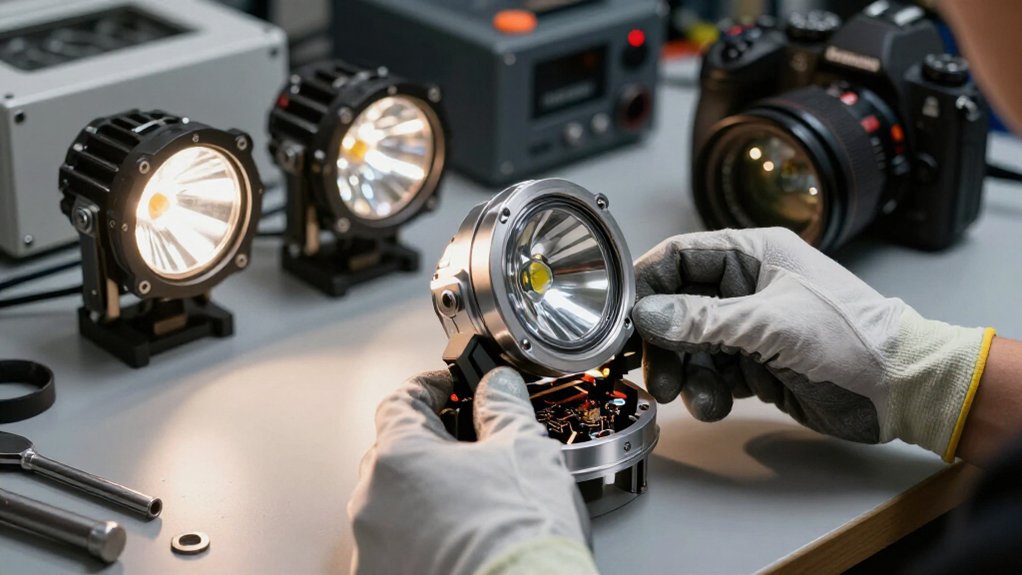
Premium off-road lights cost more because you pay for engineered optics that put usable light on the trail, not just higher lumen claims.
Thermal pathways, drivers, sealed housings, and vibration testing help prevent dimming, water intrusion, and failures after repeated impacts.
Coated lenses reduce reflection, while correct wiring, fusing, and aiming protect output and electrical reliability.
Warranty support, replaceable optics, and import costs also raise the price.
The next sections show where your money goes.
Cost Breakdown by Component
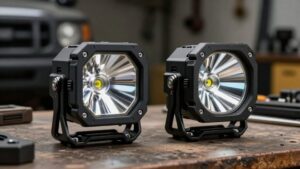
A premium off-road light’s price reflects the components needed to produce controlled, reliable illumination—not just its LEDs. Your light’s optical system uses precision reflectors and lenses to shape a consistent beam, so more output reaches the trail instead of disappearing as wasted scatter.
Heat sinks, copper driver boards, and rigid housings move heat away from the LED junction, limiting temperature-driven dimming, driver stress, and premature failure. Quality drivers provide stable current, while engineered thermal pathways and EMC certification support dependable operation.
IP69K sealing or MoistureBlock construction limits water intrusion. Corrosion-resistant aluminum housings resist warping and cracking; vibration qualification verifies performance under off-road shock. Some platforms add color science and uService optics you can reseal, extending field serviceability but adding engineering and manufacturing cost.
Why Lens Coatings Matter
Lens coatings matter because they determine how much LED output reaches the trail rather than reflecting off the glass. Bare glass sends light back; a coating stack reduces reflection and glare, increasing usable transmission.
That optical efficiency matters more than a lumen label: two lamps with similar output can deliver different throw and flood patterns on the road. Premium coatings also manage wavelength-dependent scatter, preserving contrast so you can distinguish rocks, ruts, and edges instead of seeing a washed-out field at distance.
Manufacturers control layer thickness and uniformity closely to keep beam color and cutoff behavior consistent from unit to unit. They engineer the stack to resist UV exposure, temperature swings, and chemical contamination, helping the lens retain clarity rather than dull over time.
Vibration Testing and Durability
Trail vibration can fatigue solder joints, stress driver boards, and loosen internal connections, so premium off-road lights undergo vibration testing to verify those components survive repeated impacts.
Brands may apply military-spec test profiles that reproduce trail and desert shocks. You pay for fixtures, instrumentation, cycles that expose solder-joint cracking, driver-circuit stress, and reflector warping before faults dim or disable the lamp.
Engineers also use high-grade aluminum housings and robust thermal pathways to limit flex cracking and heat-cycle damage. Vibration and temperature swings compound stress, so rigid housings and controlled heat flow protect internal parts.
IP69K sealing plus vibration qualification helps prevent micro-cracks from becoming moisture paths after impacts or pressure washing. Verified lifespan claims, often exceeding ten years, reflect deeper qualification against vibration-related degradation rather than packaging-grade components.
Warranty and Service Support
Premium lights often cost more because you get durable warranty coverage backed by documented service paths and available replacement optics. You can replace lenses or optics and reseal supported units without voiding the warranty, reducing repair costs after impacts or lens haze.
That serviceability, paired with moisture and durability testing, helps keep your lights operational over the long term.
Warranty Coverage
Warranty Coverage
When off-road lights face heat, vibration, moisture, and pressure washing, warranty coverage and serviceability can materially affect their cost.
Premium brands price longer warranties that cover failures from these loads, while engineering limits claims. IP69K qualification, moisture-blocking designs such as MoistureBlock, and vibration and dunk testing protect seals, optics, and electronics.
This validation costs money but can reduce your repair risk.
Coverage also depends on installation. Manufacturers publish current and voltage guidance for 12-volt systems and charging near 14.4 volts; undersized wiring or overcurrent can damage components and jeopardize claims.
Premium wiring and thermal protection help manage those conditions.
You also pay for warranty infrastructure: customer support, parts, and documented repair procedures. uService, for example, lets you replace lenses or optics in the field without voiding coverage, keeping repair focused on a component instead of the whole light when a covered failure occurs.
Service Accessibility
Service accessibility adds value by letting you repair a light instead of replacing the entire sealed unit. That access requires planned disassembly, replaceable optics, controlled fasteners, and moisture barriers such as MoistureBlock. Technicians can address fogging, lens damage, or beam degradation in the field, then reseal the housing to restore performance.
| Service feature | Engineering value |
|---|---|
| Replaceable optics | Swap damaged lens/optic assemblies |
| Resealing procedure | Maintains moisture control |
| Warranty rules | Defines permitted repairs |
Baja Designs’ uService® lets you replace lenses/optics and reseal without voiding the warranty. You fund service documentation and a repair path, not merely a sealed enclosure. With IP69K-rated construction, field restoration can preserve performance; clear procedures help you avoid seal damage during reassembly. This matters when terrain damages components during remote trips.
Long-Term Support
Long-term support depends on more than warranty length: manufacturers must design lights to stay reliable and repairable over years of heat, vibration, and water exposure.
Your light should shed service costs through replaceable components: Baja Designs uService lets you open the housing, swap the lens or optics, and reseal it without voiding the warranty. MoistureBlock limits moisture wicking, while IP69K testing addresses pressure washing and immersion. Better thermal design helps control LED and driver temperatures, reducing a common end-of-life failure mode.
Vibration testing and Class 5 EMC qualification check performance beyond shelf conditions. Modular construction also lets technicians replace failed parts instead of discarding fully potted assemblies. That can cut downtime and replacement expense across years of use. Warranty coverage and responsive service matter, but they’re credible only when the design supports inspection, repair, predictable operation, and dependable access to replacement parts when needed.
Vehicle-Specific Installation Costs
Your vehicle’s mounting points determine bracket selection, fastener torque, and protection against vibration and impact.
Wiring and integration may require model-specific harness routing, sealed connectors, and correctly rated relay and fuse circuits. Technicians also spend time positioning and calibrating the lights to preserve beam geometry and verify electrical and thermal performance.
Vehicle-Specific Mounting
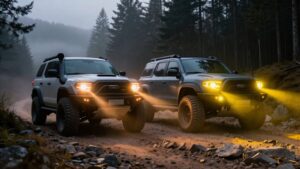
Because premium off-road lights are engineered around specific vehicle layouts, installation often requires purpose-built brackets and precise beam positioning to achieve the intended height and angle while minimizing shadows.
Your Bronco, Jeep, or truck’s mounting points dictate bracket geometry; a universal mount may place LEDs too low or misalign the beam. Higher A-pillar positions, often used for long-distance patterns, can require fabrication and added labor. Correct placement also preserves access for lens service and lets moisture-control seals work as designed.
| Mounting need | Cost driver |
|---|---|
| Fitment | Brackets, geometry, beam aim |
| A-pillar | Fabrication, added labor |
That engineering isn’t cosmetic: it matches the light to the layout, reduces shadows, and places the optic at its height and angle. You pay for fit, output, and a mount that remains aligned over terrain.
Wiring and Integration
When premium off-road lights draw substantial current, a vehicle-specific harness must use correctly gauged wire, proper fusing, and a relay rated for the load. An LP9-class system can draw about 8.8 A at 12 V, so undersized conductors create voltage drop, heat, and dimming; a fuse must protect the wire, while the relay isolates the lamp load from your switch circuit.
Your vehicle’s charging system may supply roughly 14.4 V, not its nominal 12 V. Because watts equal volts times amps, that difference can alter current demand and stress drivers and electrical components. Premium harnesses also specify grounds and sealed connectors to resist vibration, joint fatigue, and water intrusion after washdowns or dunks.
Modular optics such as uService® and MoistureBlock-style sealing add integration requirements: route cables and preserve seals at mounting points. You’ll ensure correct circuit isolation and wiring keep bench performance from becoming a serious fire risk.
Labor and Calibration
Correct wiring is only part of a reliable installation; vehicle-specific labor also sets the lights’ aiming geometry. Your technician adjusts mounting height, angle, and spacing against the manufacturer’s beam-pattern specifications. That calibration directs flood and spot zones to intended distances without creating hot spots or glare.
It also accounts for suspension travel, so bumps don’t shift beam placement into other drivers’ sightlines.
Installation labor includes matching harness gauge, connectors, and fusing to current demand. An LP9-class Pro light draws about 8.8 amps at 12 volts, and poor integration can cause voltage-related dimming as alternator output changes. Technicians also inspect O-rings, moisture-control interfaces, and strain relief to preserve weather resistance, including IP69K-rated protection. Finally, field testing checks output consistency, electrical stability, and aim under driving vibration; work a basic bolt-on kit may skip.
Beam Performance on Rocky Trails
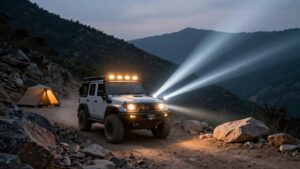
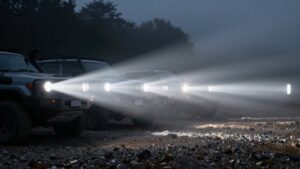
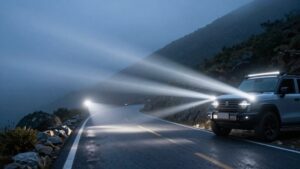
On rocky trails, beam geometry matters as much as total lumen output: a wide flood pattern illuminates technical footing 20–30 feet ahead and reduces blind spots around rocks, while a focused spot beam reveals hazards 100 feet or more down faster sections.
| Trail zone | Beam engineering |
|---|---|
| Near rocks | Flood fills close shadows |
| Corners | Low-zone light tracks turns |
| Fast sections | Spot exposes distant hazards |
| Wet, dusty runs | IP69K sealing protects optics |
Precision optics keep rock-face edges defined on uneven ground; reflectors control scatter. Thermal management limits LED/driver overheating, so you’ll retain output through vibration-heavy climbs; poorly designed units may dim or fail after 30 minutes.
Sealed housings resist mud, dust, and spray; zoned systems pair near-field corner light with spots for obstacles at 60+ MPH.
Import Duties and Tariffs
Import duties can raise a premium off-road light’s landed cost substantially, especially if customs classifies it as electrical lighting equipment rather than an automotive part. Even a modest rate applies to the declared value, which may include components, assembly, and freight, so you can see it compound before the product reaches a distributor.
Clearance paperwork and port processing fees add costs beyond the duty, increasing what dealers pay. Brands may import complete lamps or regulated drivers and controls when tariff classifications or local rules limit cheaper sourcing.
Those charges can thus reach your purchase price. Premium makers often absorb them to protect margin for warranty support and field service, while funding IP69K housings and robust optical and thermal designs built for reliable, long service.
Overpaying for Unneeded Lumens
Advertised lumen totals can push you toward buying more brightness than your trails require, while premium lights cost more to shape that output into usable flood, spot, or combo patterns. Your target depends on pace, terrain, and beam placement; a larger number won’t automatically improve visibility.
Use these ranges to size actual trail demand:
- Basic routes often need about 2,000–3,500 lm.
- Moderate trails may need 4,000–6,000 lm.
- Aggressive terrain can justify 8,000–12,000 lm.
- Beyond your use case, extra output can waste power and increase heat without revealing useful detail.
Premium pricing funds precision optics, efficient drivers, and thermal paths that sustain output; budget bars may dim after tens of minutes. A claimed 5,000 lm can deliver 3,500, while sealing and vibration testing reduce failures.
Compare Lights Before Buying
Once you’ve matched output to your trails, compare lights by usable beam, not headline lumens. Compare beam reach and lateral spread at speed; a 45+ MPH driving pattern should balance distance with width for shoulder hazards. Don’t equate claimed 5,000 lumens with usable illumination: efficient LEDs and drivers waste less power as heat.
Inspect thermal design and materials. Copper-based boards and robust housings can slow dimming and driver failure; some platforms rate life near 50,000 hours. Check waterproofing and moisture barriers, especially if you pressure-wash your rig; IP69K marks a demanding protection target.
Finally, match wiring and fuse capacity to actual draw. A premium unit may pull about 8.8A at 12V, so verify harness sizing and voltage drop to avoid overheating or premature failure.
Conclusion
Premium off-road lights cost more because you’re paying for engineered optics, coated lenses, vibration-tested housings, dependable service, and vehicle-specific integration, not just advertised lumens. On rocky trails, beam shape, thermal control, and mounting stability matter more than peak output.
Duties can raise prices, too. Compare measured performance, warranty terms, and installation requirements before buying. Choose the light that matches your terrain and electrical system; you’ll avoid paying extra for output or features you won’t use.