LED Light Bar Size Guide: What Length Fits Your Truck, Jeep or UTV
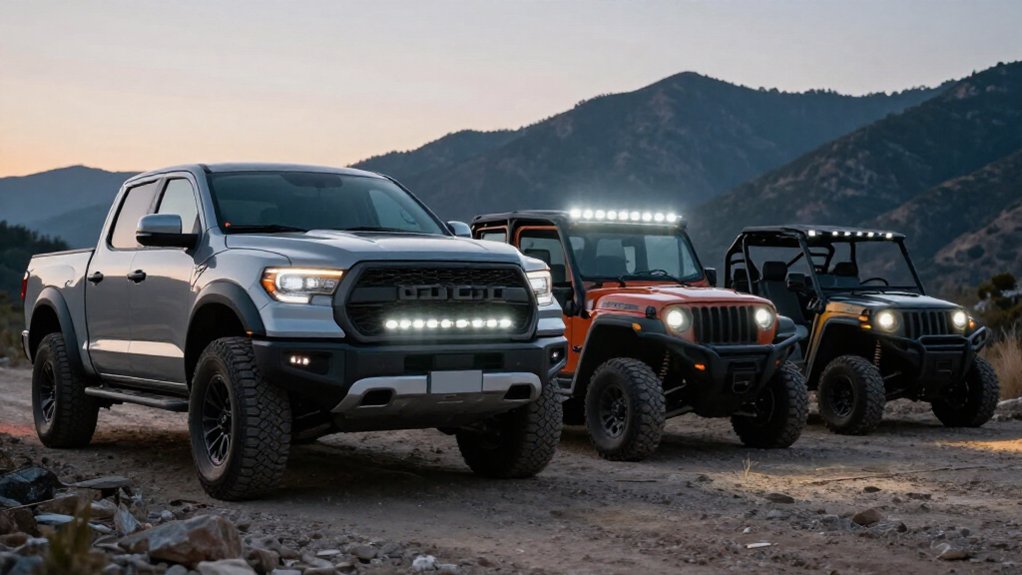
Your LED light bar size depends on mounting width, clearance, and beam needs.
Midsize trucks typically fit 30–40-inch roof bars; full-size trucks, 40–50-inch bars.
Wranglers use a 50-inch windshield bar or 20-inch bumper bar.
UTVs often suit 10–30 inches, with 6–12-inch bars for compact mounts.
Measure the surface and allow clearance for brackets and movement.
Choose spot for distance, flood for nearby coverage, or combo.
Check local laws, control glare, and use a relay harness.
More guidance can refine your setup.
Truck, Jeep & UTV Fit
Choose an LED light bar by measuring the usable mounting width, then leave room for brackets and clearance; a labeled 20- or 50-inch bar may not fit the space you have.
Match mounting location. On a Jeep, a 50-inch bar commonly spans the windshield; use 20 inches at the bumper or grille, or 30 inches along the hood. Midsize Tacoma, Ranger, Colorado, and Frontier roof racks take 30- or 40-inch bars; a 20-inch bumper bar lights the foreground.
Full-size F-150, RAM 1500, and Silverado roofs commonly suit 40- or 50-inch bars. On narrower roofs, a 50-inch bar may overhang and create wind noise or vibration. For a UTV cage, choose 20 to 30 inches: 20 for tight space, 30 for trail coverage without the wind penalty of a longer bar.
Truck, Jeep & UTV Fit
For a Jeep Wrangler’s classic windshield setup, a 50-inch bar is common; a 20-inch bar suits the bumper or grille, while a 30-inch bar often fits the hood line. For other rigs, choose roof bars for forward coverage and bumper bars for close-in light.
| Vehicle | Position | Length |
|---|---|---|
| Jeep Wrangler | Windshield | 50-inch |
| Midsize trucks | Roof/bumper | 30–40-inch/20-inch |
| Full-size trucks | Roof/bumper | 40–50-inch/20–30-inch |
| UTV | Roof/cage; bumper/A-pillar | 10–20-inch; 6–12-inch |
Midsize trucks such as Tacoma, Ranger, Colorado, and Frontier pair 30- or 40-inch roof bars with a 20-inch bumper bar. Full-size F-150, RAM 1500, and Silverado setups commonly use 40- or 50-inch roof bars for greater throw, plus a 20- or 30-inch bumper bar. Choose by beam purpose, not badge alone; long roof bars may need center support.
Mounting Width and Clearance
Measure the usable mounting width at the exact spot where you’ll install the bar, not the vehicle’s overall width. Brackets, clearance, and end caps need room beyond the light itself, so don’t size from the opening alone. Subtract a couple of inches per side when checking space for hardware and movement.
Then compare that allowance with the bar’s installed dimensions; a labeled 20-inch, 30-inch, 40-inch, or 50-inch model may occupy more space once you include mounting bosses and end caps.
On larger bars, particularly 40- to 50-inch units, check whether your mounts need center support. Leave clearance for its hardware to limit vibration stress. A 50-inch roof or windshield concept can still overhang a UTV’s roof or conflict with brackets. Verify fit before you buy.
Light Bar Length by Vehicle Type
Match bar length to your vehicle and mounting position: Wranglers commonly use 50-inch roof bars or 20- to 30-inch bars at the bumper or hood, while UTVs typically fit 10- to 30-inch bars. For midsize trucks, choose a 30- or 40-inch roof bar; full-size trucks can usually accommodate 40- or 50-inch bars, with shorter bumper bars for close-range light.
Before buying, check your mount’s available width and clearance to confirm the bar fits without overhang.
Truck Light Bar Sizes
Choose a light bar by vehicle size and mounting location: UTVs commonly use a 20-inch roof or cage bar, with 10–20-inch bars for tight mounts or fill lighting.
For midsize trucks such as the Tacoma, Ranger, Colorado, or Frontier, choose a 30–40-inch bar on a roof rack for broad forward coverage; a 20-inch bumper bar lights the approach and trail. Full-size F-150, Ram 1500, and Silverado models can accommodate 40–50-inch roof bars for throw.
Add a 20–30-inch bumper bar if you’d like to illuminate the low foreground the roof beam misses. A longer bar can increase coverage: a 50-inch model rated 19,600 lumens is roughly 78% brighter than an 11,000-lumen 20-inch bar. Check rack width, mounting clearance, beam aim, and wiring capacity before choosing.
Jeep Light Bar Sizes
For a Jeep Wrangler, a 50-inch bar gives the classic windshield-top fit, while a 20-inch bumper or grille-mounted bar lights the close foreground. If you want a hood-line option, a 30-inch bar bridges longer spot throw with wider trail illumination, giving you more coverage than a bumper-only setup.
Choose length by output and mounting space, too. A 20-inch Tough Double Row produces about 11,000 lumens; its 50-inch counterpart reaches roughly 19,600 lumens; about 78% more, but needs more room and draws more power. A curved bar can follow the Wrangler’s windshield or roof contours; a straight bar usually mounts more easily on flat surfaces.
Before ordering, measure the usable width at your chosen mount, not the vehicle’s overall width. Include brackets and clearance in your check so the installed bar fits without overhang.
UTV Light Bar Sizes
How much light does your UTV need, and where will you mount it? On most side-by-sides, a 10, 20-inch bar suits the roof or windshield, while a compact 6, 12-inch unit fits bumpers or A-pillar/cage locations where space is tight.
For one primary light, many riders choose a 20, 30-inch combo beam. Its flood pattern covers trail width, while its spot component adds useful forward reach.
A larger UTV can carry a 50-inch bar across the upper windshield for a wide, high-presence setup, but check usable width to avoid overhang, vibration, and wind noise.
Double-row bars add height, weight, and wind resistance compared with slim single-row models. Consider beam placement, too: a shorter bar mounted low can light the foreground better than a longer bar mounted high on UTVs.
Match Length To Mount
The right light bar length depends on your vehicle and mount: Wranglers commonly take a 50-inch bar across the windshield, while 30 inches suits a hood-line mount and 20 inches fits a bumper or behind the grille. For midsize trucks, the Tacoma, Ranger, Colorado, or Frontier, choose a 30- or 40-inch bar for a roof rack; a 20-inch bumper bar adds close-in foreground light.
Full-size trucks, including the F-150, RAM 1500, and Silverado, often use 40- or 50-inch roof bars. Pair one with a 20- or 30-inch bumper bar to illuminate the near field without relying on roof-mounted light alone. On a UTV or side-by-side, a 20- or 30-inch bar fits the roof, cage, or windshield; you’ll want 20 inches when mounting space is tight.
Check Available Width
Before choosing a light bar, measure the usable mounting width where it’ll sit, then allow space at both ends for brackets and clearance. Measure the mounting surface, not your vehicle’s overall width, and subtract bracket and clearance space at each end. Installed width, not advertised length, sets fit; include end caps, brackets, and clearance.
A 20-inch bar often fits UTVs and side-by-sides, and works for tight bumper or grille installs. For a Wrangler, choose 50 inches for the classic windshield mount, 30 inches at the hood line, or 20 inches on the bumper or behind the grille.
Truck roofs and racks suit 30 to 40-inch bars. Full-size trucks may take 40- or 50-inch bars, but verify rack or rail width with hardware installed; paper fit isn’t enough.
Choose Flood or Spot
Choose your LED light bar’s beam pattern based on where you need light: spot beams throw farther down open trails, while flood beams illuminate nearby obstacles and road edges. Spot optics concentrate candela into a narrow cone, making them useful when you drive a truck, Jeep, or UTV across fast, open terrain and need to see farther ahead. Flood optics spread light broadly, improving peripheral visibility near the vehicle and across brush or road edges.
For most single-bar installations, choose a combination pattern to balance distance with trail-edge coverage. If you’re mounting a shorter bar low on the bumper for foreground fill, a flood-heavy beam can reveal rocks, ruts, and other obstacles immediately. When your route is open and speed demands longer sightlines, select a spot beam or a spot-leaning combination instead. Match the pattern to your mounting position and typical terrain, not just the bar’s length and the terrain you drive most.
Check Local Road Laws
Check your local and state or provincial light-bar laws before installing a bar, since rules may limit the number of auxiliary lights, their brightness, or how you aim them, not just their size.
If you’re fitting a roof- or windshield-mounted 20-, 30-, 40-, or 50-inch bar to a truck or Jeep, check whether its height, coverage, or position meets local requirements. A bar above factory headlamps may still need precise aiming, an approved housing, or a permitted mounting location.
Don’t assume color rules are universal: some jurisdictions allow amber auxiliary lighting more readily than white, while others restrict both. Confirm whether your setup needs inspection or a compliance sticker. Size matters, but legal placement and operation determine whether that length is road-ready.
Relay Harness Requirements
Any light bar with meaningful output needs a relay harness, regardless of whether it’s 10, 20, 30, 40, or 50 inches. Don’t power the bar directly through your dash switch; its wiring may overheat and create a fire risk. A relay lets the battery supply the lamp while the switch controls only the relay coil, protecting your truck, Jeep, or UTV wiring. It reduces the chance of switch damage or blown fuses.
Plan harness installation before mounting and aiming the bar; routing and securing wires take time. Follow the maker’s fuse instructions, and keep wires clear of hot or moving parts. If you’re pairing a 40- or 50-inch roof bar with bumper-fill lights, size the relay harness for combined current draw.
Preventing Windshield Glare
After sizing the relay harness for your light bar, consider where its beam will land: a high-mounted 40–50-inch bar is more likely to reflect off the windshield than a lower 20–30-inch bar.
On a truck, Jeep, or UTV, choose a combination pattern for trail coverage without excessive straight-on wash. Aim the bar down until its hot spot rests on the trail; mount height changes where light lands at distance even when lumens stay constant. A high spot aimed too high can bounce through glass and reveal windshield haze.
- Mount high? Choose wider coverage and tune aim carefully at night.
- Amber light can reduce backscatter through dust, snow, and fog versus white.
- Check in rain or mist; keep the hot spot below glass.
Recheck after dark.
Bracket Compatibility Checks
Bracket compatibility starts with the usable mounting width, not the vehicle’s overall width; include bracket clearance at both ends because it can make the installed span wider than the bar. Measure the roof, bumper, or grille surface where you’ll attach it, then match hardware to that location.
- A 20-inch bar often suits a bumper, grille, or compact UTV roof; verify the bracket pattern and available depth.
- For 30-, 40-, or 50-inch bars, check roof-mount hardware; 40- and 50-inch models typically need center support.
- Compare bar length with roof dimensions: a 50-inch unit may fit a full-size roof but overhang a compact UTV. For longer setups, reduce vibration and protect the mount with hardware such as a Black Magic Tough bracket; confirm fit.
Conclusion
Before you buy, measure your truck’s, Jeep’s, or UTV’s mounting width and confirm clearance around the grille, roof, or windshield. Choose a bar length that fits your vehicle type, then match flood or spot optics to your terrain.
Check local road laws before wiring it. Use a relay harness sized for the bar’s current draw, and verify bracket compatibility. Aim the beam to prevent windshield glare and secure every fastener before your first off-road drive.