Are Amber Lights Better for Fog? How Color Cuts Backscatter
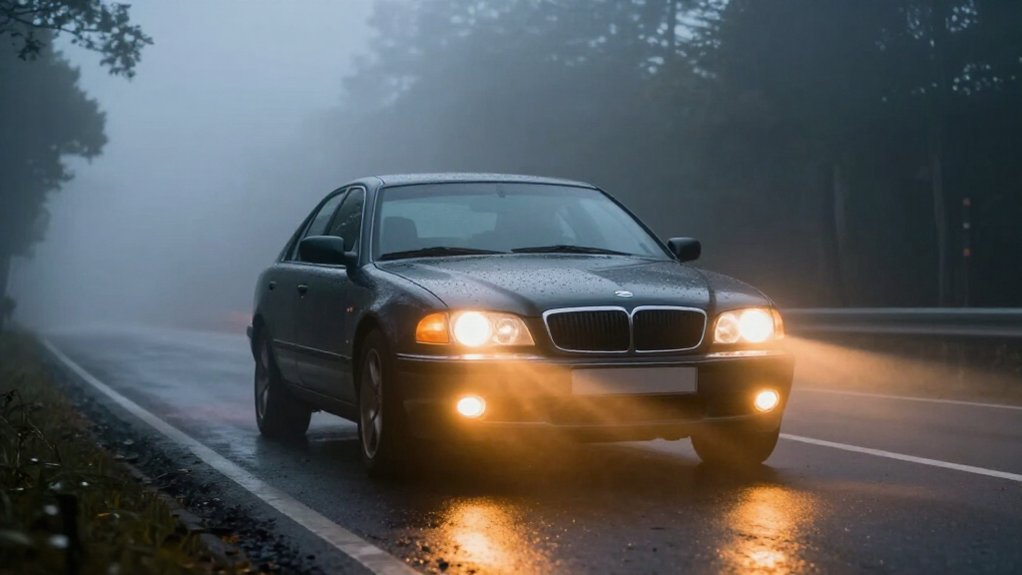
Amber lights can reduce perceived fog glare because they contain less blue-violet light, which fog droplets scatter readily.
That may make the beam feel less harsh, but it doesn’t guarantee better visibility: droplet size, density, and beam placement determine backscatter and road contrast.
Aim lamps low, with a wide pattern and sharp cutoff, to limit upward spill; poor aim can create glare at any color.
The details below explain how tint and conditions affect performance.
Amber’s Backscatter Advantage
Because amber light has a longer wavelength and less short-wavelength blue/violet content than cool-white light, it can reduce the visible backscatter that fog sends toward your eyes.
When droplets scatter light back toward you, less returned glare can make the scene feel less harsh. Amber may appear darker on the road in ordinary fog, so reduced glare doesn’t necessarily mean better visibility or greater illumination.
Your result also depends strongly on beam geometry. A low, wide pattern with a sharp cutoff limits upward light, reducing the amount that strikes droplets above the road; this control can matter as much as color.
In dense snow or dust-like conditions, amber’s longer wavelength may offer a backscatter advantage over yellow, because airborne particles intensify scattering and glare.
Amber’s Reduced Blue-Light Output
That comfort advantage often comes from amber’s lower blue-violet output: compared with typical white light, it can reduce the short-wavelength light that fog droplets scatter back toward you.
Because shorter wavelengths are more readily scattered by droplets, less blue content can mean less glare and a more comfortable view. If white headlights bloom in fog, warmer amber light may lessen the reflected flare you see.
The effect isn’t a guarantee of visibility: droplets and spectrum influence what reaches your eyes. Yellow light around 3000K–3500K often offers a practical balance, retaining useful brightness while reducing backscatter. Deep amber can suppress reflections further, but it may appear dimmer, so you may perceive less detail. Color changes the amount and character of scattered light; it doesn’t remove fog.
Beam Placement in Fog
Beam placement usually matters more than color for fog visibility: mount fog lights low and wide, and aim them with a cutoff that keeps light on the road and shoulders rather than in the fog ahead. Water droplets scatter light mainly through Mie scattering, so illuminating the droplet field directly ahead can send light back toward your eyes and wash out road contrast.
If you aim lamps too high or upward, even an amber beam can create that glare. Keep the upper cutoff below eye level and direct useful output onto pavement and shoulders. Because color alone rarely extends penetration distance substantially, judge visibility by road illumination and contrast, not brightness in fog; compare colors only with identical housings, beam patterns, and aiming settings.
Amber Lens Options
Amber lenses can reduce backscatter by shifting the beam toward longer wavelengths, but deeper amber may look dimmer and trade road illumination for glare reduction. You’ll find selective amber or yellow-leaning tints offer a balance, depending on the lens and optics.
Check beam photos or lux readings from the same housing and aim to confirm the pattern provides a low, wide spread with a controlled upward cutoff.
Reduced Glare
In dense fog, amber lenses can reduce perceived glare by filtering more blue and violet light, which scatters readily in suspended droplets. That filtering can make the road’s contrast feel steadier, especially when cool-white light produces distracting reflections.
Your beam’s shape still matters: a low, wide cutoff limits upward light that would strike droplets and return toward your eyes. Amber-leaning output can complement that control by retaining less blue-violet energy.
| Condition | Practical effect |
|---|---|
| Dense fog | Less perceived glare |
| Heavy snow or dust | Amber may help reflections |
Choose by comparing beam color and output in the same housing pattern; product labels such as “amber” and “yellow” can overlap. Don’t assume the name predicts performance. Evaluate visibility and glare under repeatable conditions, while keeping lamps aimed correctly.
Lens Tint Options
Which tint suits your conditions depends on the balance between usable light and reduced reflections: light selective-yellow or amber lenses transmit more light for fog, while deeper amber filters more short-wavelength output and may help limit backscatter in heavy snow or dust.
Amber lenses commonly use glass or polycarbonate, with shades ranging from light golden to deep amber. Darker tint passes less short-wavelength blue-violet light and may reduce harsh reflections, but you’ll also see less road illumination.
Amber’s longer, more orange wavelengths can reduce some backscatter from fog droplets compared with cooler white light. In dense haze, light selective-yellow or amber can preserve perceived contrast while providing more usable output. Choose a lighter tint for fog; consider deeper amber for heavy snow or dust.
Beam Pattern Compatibility
Match an amber lens to a low, wide beam with a sharp cutoff: its color may reduce perceived backscatter, but upward spill can worsen glare and haze. Amber’s longer wavelengths are less affected by blue-violet light that airborne droplets reflect strongly, yet amber can look darker on the road than yellow at similar output. So color alone doesn’t establish fog performance; you need a aimed pattern that keeps light low and spreads it laterally.
Amber options also vary: some labeled amber are selective yellow, while filter depth changes the beam’s hue and intensity. Compare the color, cutoff, and width rather than trusting the label. A tight cutoff with broad lateral coverage serves you better than a brighter amber lamp that sends excess light upward.
When comparing housings, use the same bulb rating and mounting position, then review beam photos and lux measurements. Lens geometry and reflector design can influence results as much as tint.
Fog Density and Droplet Size
As fog density rises, you’ll lose visibility faster because more droplets scatter and attenuate your beam. Smaller droplets can intensify Mie scattering, so you’ll need careful beam aiming and low glare to preserve a readable view.
Amber can reduce harsh backscatter versus cool white, but it won’t travel much farther; it may help you see roadway contrast before haze overwhelms the scene.
Fog Density and Visibility
In fog, visibility depends on droplet size and density: denser fog scatters more light, weakening the beam and sending more back toward you, which reduces contrast regardless of color. At greater density, more light returns as veiling glare, so you lose road-edge and obstacle contrast.
Amber may soften this backscatter in some conditions, but it won’t restore visibility once scattering overwhelms road illumination. In very dense fog, expect less harsh reflection; not a major increase in reach. Keep your beam low, wide, and correctly aimed; limiting upward light often matters more than a small color change.
| Fog condition | Beam intensity | Visibility effect |
|---|---|---|
| Moderate | More usable | Contrast declines |
| Dense | Weaker forward beam | More backscatter |
| Very dense | Limited reach | Amber may soften glare |
Droplet Size and Scattering
Droplet size helps explain why fog can scatter headlights back toward you: typical droplets, often tens of microns across, produce Mie scattering that affects visible wavelengths and can create veiling glare.
As droplets interact with light, they redirect energy rather than simply blocking it. A greater number of droplets per unit volume increases the cumulative scattering along your line of sight, so dense fog returns more light toward your eyes and reduces scene contrast.
Droplet size and concentration both matter: size governs how individual particles scatter visible light, while concentration determines how many scattering events the beam encounters. Your lamp’s beam pattern also affects the glare you see; a low, wide beam with little upward spill sends less light into droplets above the road and therefore less scattered light back to you, especially in dense fog conditions.
How Amber Affects Backscatter
Because amber light has a longer wavelength than cooler white light, it generally sends less light back toward the driver from fog droplets, though the effect depends on droplet size and density. In sparse fog, fewer droplets intersect your beam, reducing backscatter from either color. Dense fog raises droplet density, so Mie scattering increases and more light returns toward you.
Amber can still reduce glare and help you see illuminated road features with contrast. Droplet size also changes scattering, so wavelength alone can’t predict visibility. For mixed rain, fog, or snow, yellow lamps around 3000K–3500K offer a compromise; deeper amber may suit heavy, dusty, or snowy conditions. Still, aim your beam low and wide to avoid lighting droplets directly; poor aim adds glare at any hue.
Mountain Pass Night Driving
On mountain passes, yellow light around 3000K–3500K is usually the more versatile choice for foggy, but not extreme, conditions: it cuts some blue-rich glare while preserving more usable road illumination than deeper amber.
At elevation, you may encounter dense, rolling fog, rain, snow, or blowing dust, and the distinction matters. Amber shifts farther from blue and violet wavelengths, which scatter readily in droplets and particles; you may see less reflected glow, but the darker, orange appearance can reduce usable road brightness.
For ordinary fog and mixed precipitation, yellow often balances glare reduction with visibility better. In very dense particulate haze, heavy snow, or blowing dust, amber’s longer wavelengths may help.
Regardless of color, choose a low, wide beam with limited upward spill. Its pattern and correct aim can reduce light entering fog above the road more effectively than changing from yellow to amber alone. You’ll still need to adjust speed as visibility and conditions change.
Misaligned Lamps Increase Glare
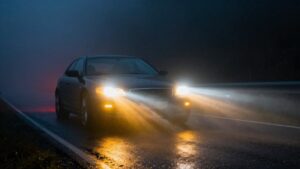
Even amber fog lamps can increase glare when they’re aimed too high, sending light into the fog layer where it scatters back toward your eyes. A lamp’s color can reduce perceived backscatter: amber’s longer wavelength scatters less than white or yellow light and may appear less intrusive. But color can’t compensate for poor beam geometry.
A low, wide cutoff with little upward spill directs illumination onto the road, helping you see contrast without lighting the fog above it. If your lamps sit too high or point upward, their beam enters the fog and increases reflected light, even when amber reduces scattering. Set the aim to match mounting height and keep the cutoff tight; choose amber if you’re especially sensitive to reflection when fog persists.
Mistaking Brightness for Effectiveness
Aim controls backscatter, but brightness can still mislead you when comparing fog lamps. A high lumen rating doesn’t tell you how much light reaches the road or returns from droplets. In dense fog, no color travels dramatically farther; beam shape and vertical cutoff matter more.
- Warm yellow or amber can reduce reflected blue-violet light, lowering backscatter toward you.
- Yellow, around 3000K–3500K, often balances road illumination across fog, rain, and snow.
- Deep amber may soften reflections yet look darker; perceived comfort isn’t proof of effectiveness.
- Compare beam photos or lux readings in the same housing and aim; focus can outweigh a brightness label.
A brighter cool-white lamp may increase glare if it sends more light upward, while a well-focused amber beam can outperform brighter lamps.
Check Local Fog-Light Regulations
Before changing fog-light color, check your local rules: many jurisdictions restrict which colors front lamps may use and when fog lights may be switched on. Rules vary by location, so verify your vehicle code and lighting guidance before buying or installing a replacement.
Check permitted front-lamp colors, required markings, and whether use depends on visibility or road conditions; some areas limit fog lamps to fog, snow, or similar reduced visibility.
| Check | Why it matters |
|---|---|
| Color | Amber, yellow, or white may be restricted |
| Use | Rules may limit activation conditions |
| Aim | Low, wide beam limits fog backscatter |
Even where amber or yellow is legal, choose a lamp and aim it low; color can’t compensate for upward light or beam control.
Conclusion
Amber lights can reduce short-wavelength scatter, but they don’t eliminate fog backscatter or guarantee better visibility. Your results depend on droplet size, fog density, beam placement, and correctly aligned lamps; excess brightness can worsen glare.
Choose amber lenses only when they suit your system, and aim fog lamps low and wide. In mountain-pass conditions, slow down and increase following distance. Before changing or adding lights, check local regulations and prioritize a clear, adjusted beam over color alone.