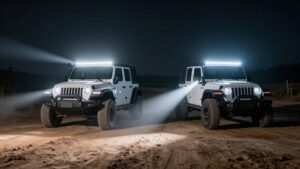
What States Require Light Bar Covers? A State-by-State List
On public roads, you may need to cover and switch off a light bar in California, Oregon, Michigan, and New York; Virginia requires you to cover or disable auxiliary lights mounted above factory headlights.
Use a snug, opaque cover that blocks visible beam, and secure it so it stays in place.
Rules vary by mounting position and roadway, and a cover alone may not authorize use.
Check state requirements; the state-by-state details clarify what applies.
State-Specific Cover Laws
Because cover requirements vary by state, check the rules wherever you drive. A light bar that qualifies as off-road equipment may face separate limits on public roads. Before entering a highway, confirm whether your state requires an opaque cover, switching the bar off, or both.
Some rules also allow physical disconnection instead of covering, while others specify mounting height or bar location. Don’t assume that a powered-off bar meets a cover requirement; these are distinct compliance steps. Likewise, a cover doesn’t authorize you to use prohibited lighting while driving.
Check applicable statutes and agency guidance, including any glare or dazzle restrictions. If you cross state lines, verify each jurisdiction’s rules before travel and keep the required cover installed or equipment disconnected as directed.
States Requiring Covers
If you drive on public roads in California or Oregon, keep your light bar off and covered; Virginia requires covers for lights mounted above factory headlights, while Michigan and New York generally restrict light bars to off-road use, so turn them off and cover them when driving on public roads.
States Requiring Covers
| State | Public-road rule | Required action |
|---|---|---|
| California, Oregon | Bars must stay off and covered on public highways. | Keep bars off and covered. |
| Virginia | Cover lights mounted above factory headlights, or disable them. | Cover or disable. |
| Michigan, New York | Treat light bars as off-road equipment; switch them off and cover them on public roads. | Switch off and cover. |
Check applicable rules before travel. Don’t assume a cover alone makes road use lawful: where lights must be disabled, keep them switched off on every public road.
Qualifying Light Bar Covers
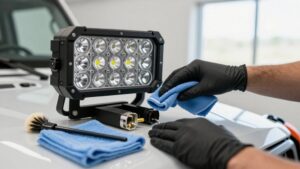
For states that require light bars to be covered, use a snug, opaque cover that blocks all visible output; a translucent dust cap may not prevent glare or satisfy the rule. Choose a cover sized for your bar and mount, and secure it properly so it stays in place on public roads.
The standard is functional: the lamp must not project a visible beam or create glare for other drivers. In California, auxiliary or off-road lights must be off and covered. In Virginia, cover auxiliary lights mounted above factory headlights on public highways; if you leave them uncovered, they must follow high-beam behavior.
Check the rule that applies where you drive, and verify the cover blocks the output before entering a public roadway.
Cover Color Requirements
Check whether your state specifies white, amber, or red cover requirements; don’t assume a colored cover is permitted. In strict states, use an opaque, color-neutral cover that blocks the beam entirely.
Confirm any state-specific exceptions, since switching the light bar off may not satisfy the cover requirement.
White Cover Requirements
Although some states require light bars to be covered on public roads, these rules don’t specify that the cover must be white. Instead, you should treat a cover as a functional requirement: it must block the lamp’s output, not satisfy a color standard.
California requires forward-facing auxiliary lights, including light bars, to stay off and covered with an opaque cover on public roads. Oregon requires roof-mounted LED light bars to be covered and switched off on public highways. Virginia requires you to cover lights mounted above factory headlights to prevent glare on highways.
Michigan, New York, and other cited state guidance likewise addresses lights being off or covered, without specifying white. Choose an opaque cover that fully blocks the beam, and check applicable rules before driving in each state.
Amber Cover Allowances
Cover rules generally focus on blocking the beam, not on permitting a specific color. Requirements address whether a lamp can project light on a public road. California requires an opaque cover over auxiliary or off-road forward lights used on public roads. Virginia requires opaque material over lights mounted above factory headlight height on public highways; a covered or disabled light must not produce an exposed beam.
Michigan and Kentucky guidance likewise emphasizes turning light bars off or covering them, without naming amber as an approved cover color.
If you choose amber, confirm the cover is opaque, not merely tinted. It must block the beam to limit glare and meet the stated coverage requirement. Check state rules before driving; color alone doesn’t establish compliance.
Red Cover Restrictions
A red cover isn’t automatically permitted just because it’s opaque: on public roads, it must prevent red light from showing where state rules prohibit that color. In Florida, civilians may not display red or blue auxiliary lighting on public roads, so check that your cover blocks all red output when required. California requires off-road and auxiliary lights to be off and covered with an opaque cover on public roadways; the rule centers on coverage, not a red cover’s appearance.
In Virginia, cover or disconnect auxiliary lights mounted above factory headlights on public highways, ensuring they can’t cast glare. Michigan guidance likewise calls for keeping auxiliary lights off or covered and preventing forbidden forward colors from showing. Before driving, verify the applicable state rule and inspect the cover under normal operating conditions. Don’t assume a red lens or cap makes an otherwise prohibited light lawful when you use public roads.
Color-Neutral Cover Rules
When a state requires a light bar cover, the rule usually concerns opacity, not color: the cover must block the beam from being seen or used on public roads.
You won’t find prescribed cover dye in these rules; officials care whether the beam stays blocked. California requires you to cover or disable auxiliary lights on public roads; an opaque cover must prevent glare from reaching traffic. Virginia requires opaque covers, or disconnection, for lights mounted above factory headlights on public highways. A tinted or translucent cover may fail if light passes through.
Choose an opaque, color-neutral cover and verify it blocks the beam. Michigan and Kentucky don’t treat cover color as compliance: don’t operate or expose light bars on roads. Check rules before driving.
State-Specific Color Exceptions
Color rules can still apply when a light bar is covered: California and Virginia generally require compliant white or amber forward lighting, while Florida prohibits blue or red forward lights on public roads. In California, an opaque cover must prevent glare; changing color isn’t a substitute. In Virginia, cover auxiliary lights above factory headlights or switch uncovered lights off when high beams are on.
Keep forward color compliant. Florida prohibits blue or red; select white or amber even with a cover. Michigan generally requires bars off or covered on public roads, with white or amber output.
Don’t assume RGB or RGBW becomes street-legal behind a cover: no state generally permits color-changing LEDs on public roads. Before driving, set the bar to pure white or amber and follow cover and shutoff rules.
State-by-State Legal Definitions
Because states define light-bar restrictions differently, check the rule that applies where you drive.
In California, you must switch off and cover forward-facing auxiliary off-road lights with an opaque cover on public streets to prevent glare. Virginia requires you to cover lights mounted above factory headlights, or make them inoperative, on public highways. Uncovered lights must turn off when you use high beams.
Michigan guidance limits light bars to off-road use: turn them off or cover them on public roads. New York likewise permits off-road use only, so keep bars completely off on public roads; covering them can help avoid enforcement concerns. Montana generally bars roadway use, making nonuse—not a universal cover rule—the key compliance point.
Check statutes and agency guidance in each state before driving.
Parked-Vehicle Cover Rules
Cover rules vary by state, so switch off your light bar and use an opaque cover where required before entering a public roadway. In California, forward-facing auxiliary or off-road lights must be off and covered on roadways; the cover must block the beam. In Virginia, cover bars mounted above factory headlights with opaque material, or disconnect them, on public highways. Michigan treats bars as off-road equipment, so turn yours off and cover it on public streets rather than merely dimming it.
Oregon requires roof- or roll-bar-mounted LED bars to remain covered and switched off on public highways, even when you aren’t using them. New York limits bars to off-road use; keep yours completely off on public roads and preferably covered to reduce enforcement concerns.
Uncovered Highway Driving
An uncovered light bar can violate highway rules even when it’s switched off. If you drive on public roads, check whether your state requires an opaque cover, not merely an unlit bar.
In California, auxiliary or off-road lights must be switched off and covered; leaving the bar uncovered generally isn’t compliant. Michigan generally treats light bars as off-road equipment, so you should turn yours off and cover it for on-road driving. Virginia requires you to cover or disconnect lights mounted above factory headlights on public highways.
Oregon requires roof- or roll-bar-mounted bars to remain covered and off on public highways. Montana generally bars light bars from public roadways, making an uncovered bar a potential violation even if it doesn’t cause glare. Verify current state requirements where you drive.
Improper Cover Fitment
A light bar that’s switched off may still violate cover rules if its cover doesn’t fully block the LEDs. Fitment matters: a cover must match the bar’s lens dimensions and stay opaque.
- A brand-matched cover that’s too narrow can leave gaps around the bar’s perimeter, allowing beams to escape.
- A tinted or UV-rated cover may look dark yet transmit enough light to attract a violation.
- A cover made from material that warms or warps at speed can become semi-transparent, exposing the LEDs.
California requires light bars to be off and covered with an opaque cover on public roads. Virginia requires higher-mounted lights to be covered or disconnected on public highways; gaps or insecure, nonopaque covers can fail inspection. Confirm the cover blocks all light and fits securely before relying on it.
Pre-Trip Equipment Inspection
Before driving onto public roads, check that your light bar is either disconnected or fitted with an opaque cover that blocks all visible light; dimming it isn’t enough. Make this a required stop in your pre-trip inspection: verify the bar cannot project a beam on a public road. Check these points:
- In California, confirm the bar is off or covered; an uncovered beam can dazzle oncoming traffic.
- In Virginia, physically cover or disconnect roof-mounted and higher-than-headlight bars before highway travel.
- In Kentucky and Michigan, verify off or covered status; don’t rely on dimming or assume visibility is harmless.
Inspect the cover for opacity and secure fit, then recheck it before entering public roads; enforcement can follow visible or active equipment on highways.
Conclusion
Before you install or use a light bar, confirm your state’s rules for required covers, qualifying designs, cover colors, and legal definitions. Check whether you must cover the lights while parked or may uncover them on highways.
Don’t assume one state’s standard applies elsewhere. Fit each cover securely, keep it in good condition, and inspect your equipment before every trip. When requirements remain unclear, consult your state’s current law or highway enforcement agency before departure.
LED Light Bar & Whip Light Remote Control App Finder
Filter 24 verified iOS and Android apps that control LED light bars, whip lights, rock lights and underglow by brand, light type and features.