Fog Lights vs Driving Lights: Beam Shape, Purpose and Legal Use
Fog Lights vs Driving Lights: Beam Shape, Purpose and Legal Use
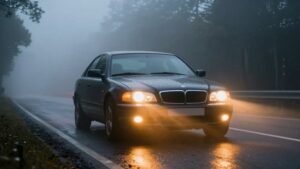
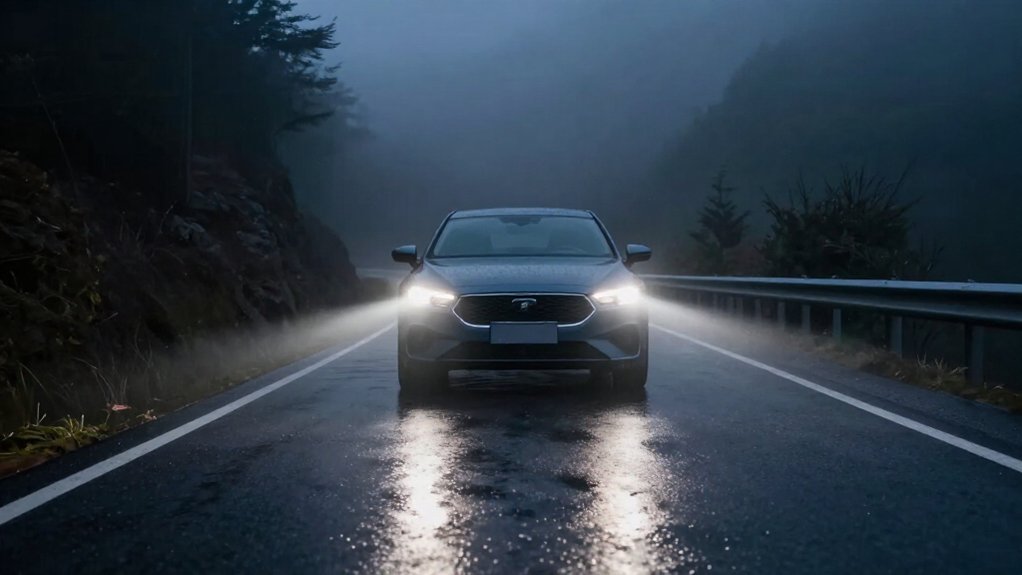
Fog lights cast a wide, low beam across nearby road edges; their sharp cutoff helps limit backscatter in fog, heavy rain, snow, or dust.
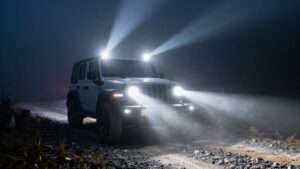
Driving lights focus a tighter spot or combo beam for long-range visibility on clear roads, but moisture can reflect output toward you.
Keep low-beam headlights on, switch driving lights off near traffic, and use fog lamps only when conditions restrict sight distance.
Check local laws; you’ll find guidance on safe use.
Beam Pattern and Purpose
Fog lights cast a wide, low beam across the road close to your vehicle, typically reaching about 20–60 meters. Their low, flat cutoff keeps light near the ground, limiting reflected glare in fog, heavy rain, snow, or dust.
| Use case | Beam | Reach |
|---|---|---|
| Fog conditions | Wide, low | 20–60 meters |
| Open terrain | Spot or combo | 200–800+ meters |
| Near-field | Ground and edges | Fog lights |
| Far-ahead | Hazard detection | Driving lights |
Choose fog lights for close road-edge and ground reference; they support, but don’t replace, your headlights. Driving lights concentrate intensity farther ahead, helping you detect hazards at speed on open terrain.
Don’t treat either pattern as universal: match auxiliary lighting to conditions, maintain appropriate speed, and use lights in accordance with local rules when visibility changes.
Lens and Reflector Design
Beam shape depends on lens and reflector geometry: fog lights use low-mounted optics to spread a wide, flat beam with a sharp cutoff, keeping light near the road and limiting glare from moisture. That geometry keeps the scatter pattern at low angles, where you need illumination on the road surface.
Driving lights use reflectors and lenses that focus output into tighter spot or combination beams, aimed higher and farther ahead. Their long-throw optics suit open-road visibility, but you shouldn’t substitute them for fog optics in poor weather: the higher, concentrated beam can reflect from airborne moisture and reduce contrast.
LED fog lamps may use built-in reflectors, projector lenses, and white or amber optics to shape dispersion for adverse conditions. Check that the lens and reflector work as a matched system and that the lamp’s beam suits its intended role; incorrect optics can compromise what you can see. Verify the correct fitment and aiming before you drive safely.
Glare and Backscatter Control
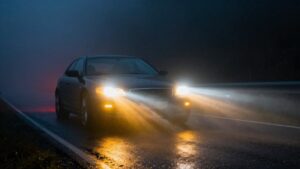
Glare control depends on keeping light below the moisture in your sightline: fog lights use a low, wide beam with a sharp cutoff to limit backscatter from fog, rain, snow, or dust. Driving lights throw farther at higher angles; moisture can reflect their output toward you, reducing contrast. Fog optics maintain a sharp, flat cutoff; driving beams distribute intensity farther ahead. If you see bright haze ahead in poor weather, your beam may aim too high.
Use:
- Keep fog lights low; their broad near-field pattern limits illumination of suspended moisture.
- Use low beams when conditions call for reduced glare; avoid auxiliary driving lights in haze.
- Check local rules: many regions restrict driving lights on roads and require you to extinguish them when approaching traffic.
Switching Lights Mid-Drive
As visibility changes, switch to the light pattern suited to the conditions: use fog lights in dense fog, rain, snow, or dust, and turn off driving lights when visibility is adequate or another vehicle approaches.
Keep low beams on in mixed conditions; use fog lights only when precipitation or dust restricts sight distance. Their broad, low pattern can improve visibility, while long-range driving lights can reflect from droplets or particles, increasing glare and reducing what you can see.
As weather clears, switch fog lights off when reflections become distracting. When an oncoming vehicle appears, extinguish driving lights, as you would dip high beams; restore them only after it passes and conditions warrant. Check local rules, as fog lights may be illegal in clear weather.
Bumper-Mount Clearance Requirements
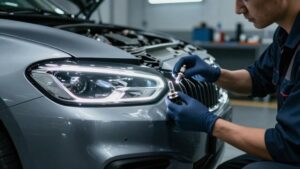
Mount bumper fog lamps low enough to keep their broad beam close to the road, while preserving the cutoff that limits glare. Many setups use at least 12 inches (about 30 cm) of ground clearance, but your local rules may set another minimum.
Check height, angle, and alignment before you drill or wire; clearance changes can shift aim and weaken the cutoff.
Use this checklist:
- Measure mounting height on level ground; don’t assume the bumper’s lower edge meets the required clearance.
- Set fog lamps low and level, then verify their broad beam remains close to pavement without glare.
- Treat driving lights separately: their longer throw needs suitable height and careful aiming to protect approaching drivers.
Recheck aim whenever ride height or bumper position changes notably.
Replacement Bulb Availability
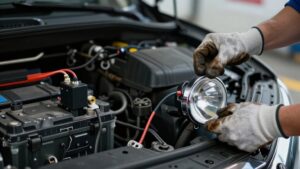
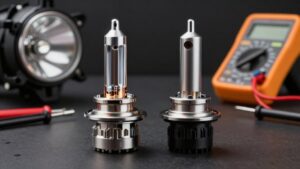
For replacement bulb availability, check whether each lamp is serviceable or sealed: many fog lights use sealed LED modules, while older housings may accept replaceable bulbs. Driving lamps vary too: manufacturers sell LED units and halogen kits; with halogen, you can often replace a plug-in bulb, but sealed LED designs usually require a complete lamp assembly.
When you shop, match the precise base and part number, such as H11, H8, or 9005; don’t assume a fog bulb fits a headlamp, because their housings use different optics.
Before buying, verify serviceability and vehicle approval markings. A non-matched replacement can affect compliance and beam performance, even if its connector fits. Choose the specified part to preserve the lamp’s approved operation and safe output for your vehicle.
Weather-Related Performance Limits
Beyond bulb compatibility, weather performance depends on beam control, not just brightness. Fog lights use a wide, low beam mounted near the ground, helping you see road edges through fog, heavy rain, snow, or dust while limiting reflected glare. Keep them as short-range support, typically about 20–60 meters; they don’t replace your headlights.
Driving lights use spot or combo optics to project roughly 200–800+ meters ahead for open terrain, but their long beams can bounce off droplets and snow, worsening visibility.
- In dense weather, avoid projecting light upward or too far; more output can create more glare, not clearer vision.
- As visibility improves or traffic approaches, switch off auxiliary beams that could dazzle others; follow local rules.
- Use fog lights only when conditions warrant.
Auxiliary Light Battery Draw
Estimate each light’s current draw by dividing its wattage by your vehicle’s running voltage; a 90 W driving-light pair draws about 6–7.5 A at 12–14.4 V. Fog lights can draw comparable current, so running both sets increases the load and may reduce your battery and alternator reserve.
Check alternator capacity under real driving conditions, and use properly sized wiring and a relay to limit voltage drop and overheating.
Power Draw Differences
Driving lights usually draw more current than fog lights because they use higher-output lamps for long-range illumination. Compare paired-lamp ratings to estimate demand:
- Two 60 W fog lamps total 120 W.
- Two 90 W driving lamps total 180 W.
- That’s a 60 W increase for the pair.
Check each lamp’s rated current, since actual draw depends on system voltage and specifications. Higher output can increase voltage drop; use the specified wire gauge, secure connections, and correctly rated relays and fuses. Don’t bypass circuit protection.
Aim fog lamps low and reserve them for poor visibility; use driving lights only when conditions and local rules permit. Choose components that meet the manufacturer’s electrical requirements and protect your vehicle’s lighting circuit under the specified operating conditions.
Battery and Alternator Load
Auxiliary lights can add a substantial load, so check that your battery and alternator can supply their combined current without excessive voltage sag or overheating. A typical 12V LED auxiliary setup may draw roughly 10–30A total, depending on wattage. A 90W light draws about 7.5A at 12V, before real-world efficiency losses and voltage fluctuations. Add each lamp’s current when sizing wiring and switches; an appropriately rated relay harness and cable gauge help limit voltage drop, which can dim lights even when they still operate.
For extended off-road use, an auxiliary battery or isolator can protect your starting battery from discharge, particularly when alternator output falls at idle. Monitor system voltage under load, and fuse the circuit near its power source. Sustained low voltage can stress the alternator’s regulator and reduce light performance.
Check charging capacity and manufacturer specifications before installation; don’t assume your factory system has spare capacity.
Nighttime Wildlife Detection
At night, fog lights’ wide, low beams can reveal animals near the road edges with less glare in mist, while driving lights extend your view on dark, open roads. Use fog lights for near-field coverage in poor visibility and driving lights for greater reach only when conditions and traffic allow.
Follow local rules, aim lights correctly, and switch off driving lights for oncoming vehicles.
Spotting Wildlife at Night
To spot wildlife early on clear, dark roads, use focused spot or combo beams that reach farther than fog lights’ low, wide pattern, giving you more time to react. Fog lights aren’t suited to wildlife detection in clear, dry air: their near-ground pattern may leave animals ahead unseen until you have little time to respond.
- On open, dark roads, use a legal spot or combo auxiliary beam; scan deliberately and keep your speed controlled.
- In mist, light fog, or heavy rain, use low beams with properly aimed fog lights for nearby cues; rely on your main headlights for longer viewing.
- Turn auxiliary beams off when you approach traffic to avoid dazzling drivers; animals can appear suddenly, so never let illumination replace caution or safe speed.
Beam Reach and Roadside Coverage
For nighttime wildlife detection, driving lights extend your view down rural roads, while fog lights reveal the nearby shoulder where animals may step into your path. A spot or combo beam can reveal reflective eyes and silhouettes 200–800+ meters ahead. Driving lights may leave low roadside ground dim.
Fog lights cast a low, wide beam, useful within 20–60 meters. That near-field spread shows grass, road edges, and the first place an animal could enter your lane. Mount fog lights low to limit scattering from moisture, and place driving lights higher to project farther. Pairing these beam patterns can help you scan both the shoulder and roadway ahead.
In reduced visibility, prioritize fog lights; use long-range illumination only when it won’t impair other drivers. Keep your speed low enough to stop within the distance you can clearly see.
Safe, Legal Light Use
Choosing the right beam pattern also means using it responsibly: keep low-mounted fog lights on only when fog, heavy rain, snow, or dust reduces visibility, and aim them to illuminate nearby road edges without dazzling oncoming drivers. At night, nearby animals matter more than distant targets, so prioritize ground-level coverage.
- Use low, wide fog or fog-aux beams to scan verges where animals may emerge close to your vehicle.
- Don’t rely on high-throw driving lights in clear conditions; glare or poor aim can reduce your effective vision and may violate local rules.
- When vehicles approach, switch auxiliary driving lights off; treat them like high beams.
Check local limits: many jurisdictions allow fog lights only in limited visibility and require cutoff patterns that control glare properly.
Legal Use on Public Roads
When visibility drops because of fog, heavy rain, snow, or dust, fog lights are generally permitted, but many jurisdictions prohibit using them in clear weather because their glare can dazzle other drivers. Use them only to complement low-beam headlights, and switch them off as soon as visibility improves; they don’t replace your headlamps.
Driving lights face separate rules: many regions restrict high-power auxiliary units to approved designs, correctly aimed beams, and switching linked to high beams. Check your local requirements for public-road designation, mounting height, beam cutoff, and aim; compliance in one region doesn’t guarantee legality elsewhere.
In Australia, using fog lights in fine weather, day or night, is an offence in every state and territory, potentially bringing fines and demerit points for you.
Conclusion
Choose fog lights for low, wide illumination when mist, rain, or snow makes visibility difficult; use driving lights for longer, narrower reach on clear roads where they’re legal. Their beam patterns, mounting height, and controls determine performance, but neither can overcome unsafe speed or poor visibility. Aim and switch them carefully to limit glare and backscatter.
Check laws, mounting rules, and electrical load before installation. Turn your auxiliary lights off when conditions or regulations require.
Cordless LED Work Light Runtime Calculator
Estimate how long a cordless LED work light runs on a tool battery from volts, Ah and watts, with a 2, 4, 5 and 9 Ah pack comparison.
Spot vs Flood Beam Width Calculator
Enter two beam angles from a spec sheet and compare how wide each beam is at 50, 100, 200 ft or a custom distance.
For practical guidance on this related topic, see our guide to fog lights.