Why Are Fog Lights Yellow? Selective Yellow and Glare Explained
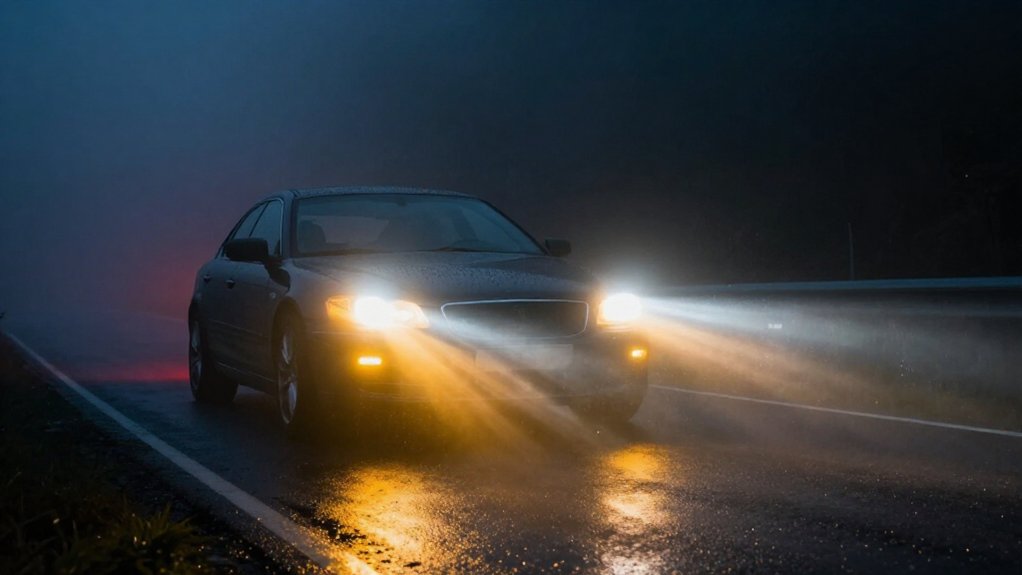
Yellow fog lights use selective-yellow filtering to limit blue-violet wavelengths that can contribute to discomfort glare when fog, rain, or snow scatters light back toward you.
This may make contrast easier to judge, but it doesn’t increase illumination or guarantee better visibility; filtering can reduce output by about 15%.
Keep fog lamps aimed low, clean, and compliant with local rules, and slow down in poor conditions.
More on color, beam pattern, and vision follows.
Selective Yellow Reduces Glare
By filtering more blue-to-violet light, selective-yellow fog lamps can reduce discomfort glare and dazzle in fog, rain, and snow, improving perceived contrast without increasing illumination.
For you, that can make the scene feel less harsh when visibility drops. The lamps don’t increase illumination, and filter losses may reduce output by roughly 15%; safer driving depends on hazard recognition, not brightness alone. UNECE Regulation 19 defines selective yellow through CIE 1931 coordinates and boundaries that keep the beam within its intended color region.
Evidence: a 1968 UK experiment reported about 3% better visual acuity than equal-intensity white headlamps. Netherlands research in 1976 found less discomfort glare with yellow light while traffic safety remained broadly equivalent. Color can’t replace correct aiming, clean lenses, or cautious speed.
Wavelengths Behind Selective Yellow
Selective-yellow fog lamps reduce blue-to-violet wavelengths, which can contribute to perceived glare in fog, rain, and snow. By filtering short wavelengths, you limit blue-rich output rather than simply adding a cosmetic tint. UNECE chromaticity limits define this yellow region; for front fog lamps, y ≥ 0.940 − x and y ≥ 0.440 constrain its boundary.
| Factor | Safety relevance |
|---|---|
| Spectral filtering | Blocks much blue-violet light |
| Output trade-off | Filter losses reach about 15% |
Compared with white light, filtering sacrifices 15% of output. A 1968 UK tungsten-lamp test reported about 3% better visual acuity with selective yellow at equal intensity.
Its chromaticity lies largely beyond typical sRGB, confirming that regulated wavelength limits, not a screen-like tint, define the yellow. Keep your lamps compliant and aimed correctly.
Rain-Slick Mountain Roads
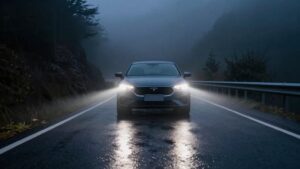
On rain-slick mountain roads, properly aimed yellow fog lamps (about 2400–3000 K) can make wet terrain easier to read than cooler white beams (about 5000–6500 K). Rainwater on pavement and airborne droplets can scatter short-wavelength light toward your eyes, increasing glare and weakening contrast. Selective yellow shifts output toward longer wavelengths, which may reduce backscatter; it won’t eliminate reflections or restore visibility.
On bends, you need to identify road edges, surface changes, and obstacles without mistaking foreground brightness for clear distance. A brighter cool-white beam can cause more dazzle in rain while giving you less useful terrain detail. Keep fog lamps aimed low and aligned with their intended pattern; poor aim can send light into spray or opposing drivers. Slow down and increase spacing.
2400K–3000K Yellow Fog Lights
At 2400K, 3000K, selective-yellow fog lamps produce an amber beam that can improve contrast by reducing short blue-violet wavelengths. In fog, rain, snow, or dust, you may see less backscatter and perceived dazzle than with cooler white light, though filtering can reduce light output by about 15%.
Choose compliant lamps designed for low-visibility use, and balance glare reduction against the usable illumination you need to spot hazards.
Why 2400K–3000K?
Why do many fog lamps use light around 2400K–3000K? This warm range limits blue-to-violet output, which can reduce perceived dazzle and glare in rain, fog, and snow. Around 3000K is common because it balances visual comfort with useful illumination; higher-K, cooler light tends to produce more backscatter from droplets, ice, and dust.
The color also isn’t an arbitrary tint: UNECE/ECE rules define selective yellow within CIE 1931 coordinates, including a front-fog-lamp boundary such as y ≥ 0.940 − x. In one UK tungsten-source experiment, selective yellow produced about 3% better visual acuity than equal-intensity white, although other studies find similar safety performance. Filtering may cost roughly 15% of spectral output, but you may value the more comfortable usable light. Choose compliant lamps and aim them.
Yellow Light in Fog
Yellow fog lights typically use a warm 2400K–3000K color temperature, reducing blue-violet output that can contribute to perceived glare in fog, rain, snow, and dust. In dense conditions, shorter blue-violet wavelengths can scatter from droplets and particles back toward you.
A warmer beam may thus appear less dazzling and preserve usable contrast. By comparison, 5000K–6500K white light can produce stronger backscatter, eye strain, and reduced scene definition.
| Condition | Beam appearance | Visibility cue |
|---|---|---|
| Fog | Yellow glow | Softer scatter |
| Rain | Warm reflections | Clearer contrast |
| Snow | Amber-lit flakes | Less dazzle |
UNECE R19 defines selective yellow by CIE 1931 chromaticity limits; SAE J583 permits it for front fog lamps. Filtering may remove about 15% of blue-violet output. Check approval and aim; use fog lamps only when conditions require.
Balancing Glare and Visibility
Balancing glare against usable light matters more than choosing the warmest-looking beam.
Selective-yellow fog lamps usually operate around 2400K–3000K, often near 3000K. Their reduced blue-violet output can lessen perceived dazzle when fog, rain, or snow sends short wavelengths back toward your eyes. This backscatter can wash out contrast, so a cooler beam may hinder your view even if it appears brighter.
A yellow filter may reduce total output by about 15%, yet your visual system can perceive greater comfort and contrast in poor visibility. Selective yellow isn’t any amber tint: UNECE color limits define its region in CIE 1931 space.
Use yellow fog lamps when visibility drops substantially; in clearer conditions, 5000K–6500K lamps generally provide sharper long-range detail. Keep lamps aimed correctly, and slow down when you can’t see hazards in time to react safely.
Driver Vision Differences
Your contrast sensitivity determines how well you detect hazards through fog, rain, or snow, and yellow light may reduce glare without improving vision equally for everyone. Individual color perception affects how you judge yellow and white lighting, especially when blue-violet filtering reduces lamp output.
In low light, rely on adequate visibility and safe speed—not color alone—to guide driving decisions.
Contrast Sensitivity Differences
How well you detect contrast in fog, rain, or snow depends partly on how your visual system processes the light reaching your eyes.
Selective-yellow fog lamps filter blue-violet light that droplets can scatter back as veiling glare. That glare can wash out edges, reducing contrast for detecting lane markings, obstacles, and road boundaries. Limiting this content may reduce dazzle and help you maintain contrast sensitivity during sustained driving.
A 1968 UK experiment found about 3% better visual acuity with selective-yellow than equal-intensity white tungsten headlamps. A 1976 Dutch study found yellow and white equivalent for traffic safety, but yellow caused less discomfort glare.
UNECE chromaticity limits define selective yellow, but don’t guarantee better visibility. Keep speed and following distance appropriate to conditions; drive carefully.
Individual Color Perception
Even when two drivers face the same glare, they may perceive yellow and white light differently.
Selective yellow filters more blue-violet wavelengths within UNECE’s CIE 1931 limits; many people find this spectrum less dazzling in low-visibility conditions. But your response depends on visual processing, not color temperature alone. Droplets or dust can scatter light toward your eyes, making brighter, higher-K white beams feel more glaring despite correct aim.
Equal-intensity studies report small or mixed effects: a 1968 UK experiment found roughly 3% better acuity with selective yellow; 1976 Netherlands research found reduced discomfort glare for some observers. Your glare and contrast sensitivity shape which beam feels safer. You may prefer 3000K yellow for comfort; another driver may favor white light in clear conditions.
Vision in Low Light
In fog, snow, rain, or dust, suspended particles scatter light back toward you, increasing glare and reducing contrast and depth perception. You may also notice that cool white beams produce more discomfort because blue-to-violet wavelengths contribute to perceived dazzle. Selective yellow lamps filter some of this range, which can improve visual comfort even when they deliver less total brightness. At roughly 2,400–3,000 K, yellow light may support terrain recognition and reduce eye strain compared with 5,000–6,500 K white in fog or snow. But don’t treat color as a substitute for safe speed and following distance.
A 1968 UK test reported 3% better acuity with equal-intensity yellow; a 1976 Dutch study found safety broadly equivalent to white, but less discomfort glare. Regulations specify selective yellow.
Dusty Desert Roads
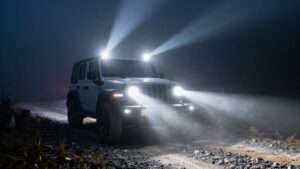
On dusty desert roads, airborne particles scatter headlamp light back toward you, creating glare that can obscure terrain and reduce depth perception. Dust acts like backscatter: it sends brighter, cooler light toward your eyes, weakening contrast and making distance judgments less reliable.
Selective-yellow fog lamps, often around 3000K, reduce short blue and violet wavelengths that contribute more to perceived dazzle in airborne dust. They don’t stop scattering, but they change the light returning to you, so glare may feel less uncomfortable and terrain features can be easier to recognize.
In clear desert darkness, whiter 5000–6500K lamps may provide more usable long-range output, whereas yellow light can feel safer in dusty haze.
Slow down, increase following distance, and keep your lamps clean to preserve visibility when dust thickens.
Check Local Color Regulations
Before fitting yellow fog lamps, check the rules where you drive: UNECE Regulation 19 permits compliant selective-yellow front fog lamps in Europe, while Regulation 48 has required white headlamps on newer vehicles since 8 October 2016; some older vehicles with yellow headlamps may remain permitted.
North America permits selective-yellow front fog lamps under SAE J583, but check your state or provincial rules and inspection requirements. Compliance depends on measured chromaticity, not a marketing label or color-temperature claim. UNECE defines selective yellow within CIE 1931 boundaries, including a limit toward white and other limits. Choose approved equipment, preserve required beam aim and mounting, and confirm the installation meets local standards. If you’re unsure, consult your vehicle authority; permission in one jurisdiction doesn’t guarantee compliance elsewhere.
Factory Lens Tint Confusion
Even when local rules permit selective-yellow fog lamps, a factory yellow lens isn’t just cosmetic: it filters the lamp’s spectrum to meet defined color limits and reduce the blue-violet light reaching the road. UNECE defines selective yellow in CIE 1931 chromaticity space; for front fog lamps, one boundary is y ≥ 0.940 − x. That target explains the deliberate tint.
Don’t confuse this filter with a bulb’s 3000K or 6000K setting:
- It selectively shapes wavelengths; transmission loss can approach 15%.
- It reduces blue-violet output, not simply total lumens.
- A yellow-looking lens may be a marketing tint, not compliant optics.
If emitted color misses the criteria, don’t assume the same glare benefit. Check the lamp’s approval markings and specifications before relying on tint for night driving.
Compare Beam Patterns
Beam pattern matters more than color alone: approved fog lamps cast a flat, wide beam close to the road, limiting light aimed into drivers’ eyes. That geometry matters in fog, where you need near-field contrast, not maximum reach. Selective yellow filters the spectrum; it can reduce perceived dazzle from light scattered back by fog, snow, or rain.
White fog lamps may look brighter and longer in clear air because short wavelengths transmit effectively, but dense haze can turn their near beam into conspicuous bright scatter. Yellow beams often preserve usable contrast against illuminated particles, though neither color replaces correct aiming or safe speed. Approved optics and color limits work together; check your lamps’ approval and careful aim, and don’t treat tint alone as protection.
Conclusion
When you choose fog lights, match their color and beam to the conditions you face. Selective yellow may improve contrast in rain, dust, or snow, but it doesn’t eliminate glare or replace sound driving technique.
Check your local regulations and confirm that a tinted lens produces the intended output. Prioritize a controlled beam pattern, correct installation, clean lenses, and reduced speed when visibility drops. Your safest setup supports clear vision without dazzling other road users.