What Fog Light Bulb Do I Need? Find Your Bulb by Vehicle
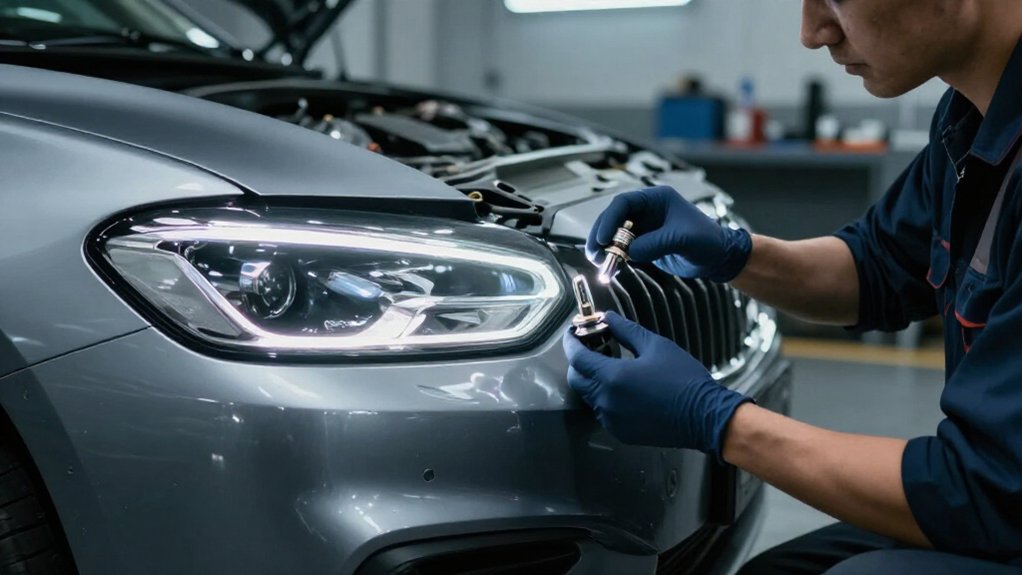
To find the right fog light bulb, match your vehicle’s year, make, model, and trim to its specified bulb code using a reliable fitment chart or owner’s manual.
Check the base and indexing tab, not just bulb shape: 880-family bulbs use PG13 bases with straight tabs, while 881-family bulbs use PGJ13 bases with angled tabs.
Confirm wattage and connector compatibility before ordering.
Your existing bulb’s markings can verify the callout; learn how to check fitments.
Vehicle-Specific Fog Bulb Lookup
Before choosing a fog light bulb, check the application for your vehicle’s exact year, make, model, and trim; similar vehicles can use different bulbs. Use that application to confirm the required bulb callout before purchase.
Some applications specify an 880-family bulb with a PG13 base and straight indexing tab; others use an 881-family bulb with a PGJ13 base and angled tab. Those base and tab differences determine whether the bulb fits the socket.
If your vehicle calls for a 5202/PSX24W-style bulb, match the designation exactly: PS24W and PSX24W have different pin and polarity/contact orientations, so halogen versions aren’t interchangeable. For an LED upgrade, retain the specified base type and part number. LED kits avoid halogen wattage concerns, but they still need to fit your vehicle’s socket.
Fog Bulb Cross-Reference Chart
Use your vehicle’s year, make, and model to find the correct fog bulb in the cross-reference chart, then verify its base and indexing tab. Compare the listed application with your vehicle’s trim and lamp position; one model year can use different fog assemblies. Similar aliases don’t guarantee a match.
| Bulb family | Common aliases | Chart check |
|---|---|---|
| 880 family | 890, 892, 893, 899, 862 | PG13; straight tab |
| 881 family | 885, 886, 889, 891, 894, 896, 898 | PGJ13; angled tab |
| PS24W | 5202 | Don’t swap with PSX24W |
| PSX24W | 2504 | Don’t swap with PS24W |
Check chart notes: LED replacements may ease halogen wattage concerns and tolerate polarity variation; confirm your vehicle’s listing and bulb base before ordering, not by appearance or alias alone.
Fog Bulb Fitment Terms
For fog bulb fitment, match the bulb code and keyed base to your vehicle’s socket, not just its brightness.
Your owner’s manual or vehicle-specific fitment listing should identify the required designation. The 880 family, including 880, 890, 892, 893, 899, and 862, uses a PG13 base with a straight indexing tab. The 881 family, including 881, 885, 886, 889, 891, 894, 896, and 898, uses a PGJ13 base with an angled tab. These keyed bases don’t interchange just because the bulb numbers look related.
Check designations: PS24W is commonly sold as 5202, while PSX24W is commonly sold as 2504; their contact and polarity arrangements differ. If your vehicle specifies PSX24W, choose that type, not PS24W. For LED replacements, don’t assume a non-polarity-sensitive listing makes halogen codes interchangeable. Likewise, if your results specify H3 LED or another code, use that designation to confirm fit and electrical compatibility.
OEM Fog Bulb Wattage Limits
Check your vehicle’s manual or existing fog bulb for the OEM wattage limit—often about 55 W for halogen—and match the specified bulb family and rating. Your factory wiring and connectors support a defined load, so exceeding it can cause excess heat or electrical damage.
Before upgrading, verify that any replacement, including an LED, suits your vehicle’s fog circuit and stays within its safe load limits.
OEM Wattage Specifications
Match your fog bulb’s wattage to the OEM specification for your exact vehicle, model, and trim, not just its base or connector. Bulb families can share a fitting while requiring different wattages, so the bulb number matters. For example, 880 and 881 bulbs may have different OEM ratings, as can 5202 and PSX24W bulbs. Don’t select by appearance or connector alone, and don’t assume an LED replacement suits every halogen rating.
First identify the installed bulb designation from its base markings, such as 880, 881, 5202, or PSX24W. Then confirm the specified bulb type and wattage for your vehicle, model, and trim in the owner’s information or a vehicle-specific parts reference. Match that rating when you replace the fog bulbs to preserve the intended fog-light performance.
Factory Wiring Capacity
Although a higher-wattage fog bulb may fit the socket, it can exceed your vehicle’s factory wiring capacity, overloading the harness and creating a safety risk. Your fog circuit uses a defined electrical budget matched to its factory harness and control module. A higher-wattage halogen bulb can draw more current than the circuit supports, potentially disrupting operation or compromising safety.
Match the specified bulb family and rating: an 880/881 or 5202/PSX24W application isn’t interchangeable just because bulbs appear similar. If your vehicle specifies PSX24W, often labeled 2504, use that type rather than PS24W/5202; pin and electrical requirements differ and may prevent correct operation. LED replacements generally draw less power than stock halogen, but you still need the correct base, such as 880 versus 881.
Confirm the part number and wattage for your exact model year and trim, since OEM options can change the required specification before selecting a replacement bulb.
Avoiding Excess Heat
To control heat in your fog-light housing, use the OEM-specified halogen wattage for your exact vehicle and bulb family. Halogen bulbs dissipate heat within their rated limits; a higher-wattage substitute can overheat the reflector, socket, or wiring. Don’t rely on appearance alone: 880 and 881 bulbs use different bases, and 5202 and PSX24W variants may not share the same application.
Check the marking on your existing bulb’s base to identify its family and rating before you buy. For an LED replacement, confirm the product is approved for your vehicle’s fog socket and wattage category. Halogen wattage limits reflect heat output, not just base shape. Also distinguish PS24W from PSX24W: their contact orientations differ, and incorrect fitment can create electrical stress and excess heat.
Checking Vehicle Manuals
Start with your vehicle’s owner’s manual to confirm the OEM fog-bulb type and maximum wattage for its housing; exceeding that limit can overdrive the circuit or generate excess heat. Many fog lamp housings are engineered around specified halogen ratings, and your manual identifies the approved wattage for your vehicle.
Before ordering, cross-check the exact bulb designation; PS24W and PSX24W aren’t interchangeable, despite similar names. Check the listed base style and part number as well. Match those details to the bulb and socket in your vehicle, rather than relying on a generic “fog light” listing. A designation mismatch can prevent proper seating or create a wiring or connector mismatch. If your manual provides market-specific fitment notes, use the entry for your model year and trim.
Safe Upgrade Limits
After confirming the bulb designation, check your vehicle’s OEM fog-light wattage limit before upgrading. Find the rating in your owner’s manual or read the markings on the removed bulb; verify the socket callout and wattage before you buy.
Stay within the factory specification. Halogen 880/881 and 5202/PSX24W families serve specific electrical loads, so a higher-wattage bulb isn’t a way to increase brightness. It can draw excess current, overheat wiring, and shorten bulb or relay life.
Match the exact designation: if your vehicle requires PSX24W, don’t substitute PS24W/5202. Similar-looking wattage doesn’t ensure fit or electrical contact.
For LED upgrades, select a direct replacement intended for the original halogen wattage class. That keeps its load and thermal expectations aligned with your vehicle’s fog-light system.
Check Existing Bulb Markings
How can you confirm the correct fog light bulb? Turn the fog light housing off, then remove the installed bulb and inspect its base markings. Use the stamped number, not appearance alone, to identify a family such as 880/881, 5202/PSX24W, H3, or PK22s.
880-style bulbs use a PG13 base and straight indexing tab; listings may group 880/890/892/893/899/862, which interchange only within that family. 881-style bulbs use a PGJ13 base and angled tab; listings may group 881/885/886/889/891/894/896/898. Don’t swap the two base styles.
For PSX24W, buy PSX24W (often 2504), not PS24W (often 5202): pin polarity is inverted. If markings are unclear, match them against a year/make/model bulb finder before ordering. Confirm the replacement connector and seating match your vehicle’s original fog lamp housing.
H16 Type A vs. Type B
H16 fog bulbs come in Type A and Type B, and their base keying determines which version fits your vehicle’s fog-light socket.
Type A and Type B use different physical pin patterns, so the wrong base may not seat or lock correctly, even when the bulb is labeled H16. Don’t assume the versions interchange because they share the H16 family name. Vehicles, model years, and trims may call for different types.
Before ordering, check the markings printed on your existing bulb’s base and match them to the replacement listing. If the markings aren’t clear, verify the specification using your exact year, make, model, and trim in a vehicle-specific fitment finder. Confirming the keyed base helps you select the H16 version your socket accepts and avoid ordering the wrong replacement.
880 vs. 881 Fitment Cases
For 880- and 881-style fog lights, fitment depends on the bulb’s base and indexing tab: 880-family bulbs use a PG13 base with a straight tab, while 881-family bulbs use a PGJ13 base with an angled tab. These designs don’t seat alike, so an 880 won’t fit an 881 socket, or vice versa.
Within each family, you’ll see aliases: 880, 890, 892, 893, and 899 share the 880-style base; 881, 885, 886, 889, 891, 894, 896, and 898 use the 881-style base. Listings may group numbers together, but don’t rely on the label.
Check your vehicle’s year, make, and model fitment data, then compare the replacement’s base and tab with the fog bulb you remove. That check helps confirm the fit for your vehicle.
LED Polarity Checks
Before installing an LED fog bulb, confirm it matches the factory bulb’s base and socket; then check whether its label says “non-polarity” or “polarized.” A non-polarity LED works in either contact direction, while a polarized one may need to be rotated in the socket if it doesn’t light.
Use the vehicle’s factory bulb marking and specified application to confirm fit before testing electrical orientation.
- Check the LED maker’s listing for your exact vehicle and bulb number.
- Many common conversions accept either pin direction, but don’t assume yours does.
- If it stays dark, switch off the fog lamps and remove the bulb.
- Rotate it in the socket, reseat it, then test again.
- Never force a fit; PS24W/PSX24W halogen orientation rules may not apply to LEDs.
Fog Housing Connector Shape
At the fog housing, match the socket’s connector shape and pin layout to the bulb’s base; similar-looking bulbs may not fit the same vehicle. Identify your vehicle’s specified bulb before ordering; the socket, not appearance alone, confirms fit.
- An 880-style bulb uses a PG13 base with a straight indexing tab.
- An 881-style bulb uses a PGJ13 base with an angled indexing tab.
- 880, 890, 892, 893, 899, and 862 generally share connector geometry.
- PS24W/5202 and PSX24W/2504 aren’t interchangeable; their pin orientations are inverted.
- For an LED upgrade, match the connector; non-polarity-sensitive designs may work either way.
Check your owner’s manual or vehicle-specific bulb listing, then compare the removed bulb’s base with the socket before installation. Don’t force a mismatched plug into place.
Conclusion
To find the right fog light bulb, match your vehicle’s year, make, model, and trim against a reliable fitment chart. Confirm the bulb marking, connector shape, OEM wattage limit, and housing fit before buying.
Don’t assume H16 Type A and Type B, or 880 and 881, are interchangeable. If you choose an LED bulb, check polarity and verify that it fits without modifying the housing. When listings disagree, confirm the specification in your owner’s manual or with your vehicle manufacturer.
For practical guidance on this related topic, see our guide to headlight upgrades.