H11 Vs 9005 Vs 9006 Bulbs: Differences in Fit, Beam and Brightness
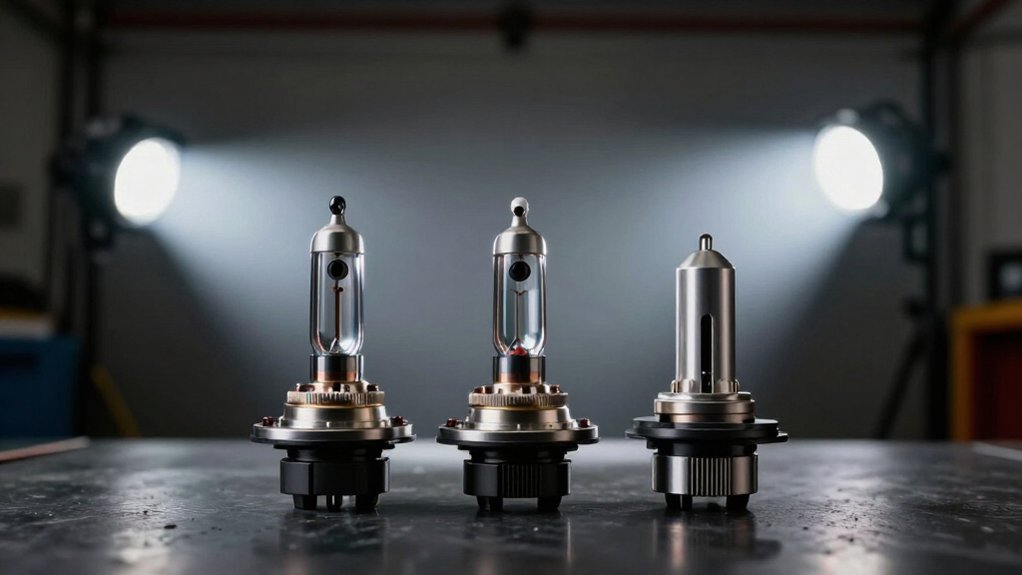
H11, 9005 (HB3), and 9006 (HB4) differ in socket, locking geometry, and beam purpose, so you can’t swap them unless your housing specifies that fit.
H11 uses a PGJ19-2 base for a controlled, wide low beam; 9005’s P20d base suits a longer-range high beam; 9006’s angled P22d base supports a low beam.
Typical outputs are about 1,350, 1,700, and 1,000 lumens, respectively.
Check your vehicle marking and seating before choosing; the details below clarify selection.
Bulb Specs at a Glance
Although H11, 9005 (HB3), and 9006 (HB4) may look similar, they use different bases and aren’t interchangeable unless you modify the housing or connector. Check your vehicle’s manual and socket before purchase; a mismatch can prevent secure installation or compromise beam aim.
| Bulb | Typical specifications |
|---|---|
| H11 | PGJ19-2; low beam/fog; approx. 1,350 lumens |
| 9005 | P20d; high beam; 65 W; approx. 1,700 lumens |
| 9006 | P22d 90°; low beam; 55 W; approx. 1,000 lumens |
| Fit check | Confirm bulb matches housing and connector |
Match function too: 9005 reaches farther for high beams; 9006 gives a wider, controlled low-beam pattern, while H11 often serves low beams or fog lamps. Verify your vehicle application: ratings vary by product.
Use the specified bulb, preserve seals and wiring, and check beam aim after service to prevent poor visibility or glare to oncoming drivers.
Distinctive Bulb Designs
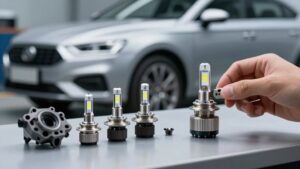
How do their designs differ? Each bulb has an L-shaped profile, but appearance alone won’t confirm fit. H11s use a PGJ19-2 base, with geometry intended for low-beam, fog-light, and DRL applications. Their design supports a low, wide pattern and glare-reducing foreground illumination.
A 9005, also cross-referenced as HB3, uses a P20d base and a single-beam layout designed for high-beam, long-distance projection. The 9006, or HB4, uses a P22d base angled at 90°. Its L-shaped form conceals a different locking arrangement and low-beam cutoff design for dispersion.
Check each bulb’s base geometry and clocking tab orientation against your vehicle’s specification before installation. Though the housings may look alike, these types aren’t interchangeable without changing fitment design. Installing a mismatched bulb can compromise seating and function.
Real-World Beam Visibility
Once the correct bulb is fitted, its beam pattern determines what you can see on the road. A 9005 typically delivers about 1,700 lumens in a narrow, long-range high-beam projection, helping you detect hazards farther ahead on unlit routes. An H11 produces roughly 1,350 lumens and forms a low, wide beam that lights the near road while controlling glare.
A 9006, at about 1,000 lumens, can appear dimmer than an H11 in comparable conditions. These figures don’t guarantee visibility: your headlight housing or projector optics shape beam width and cutoff. Use the bulb type specified for each position. Installing a brighter 9005 where a low beam is required can disrupt the cutoff and increase glare for oncoming drivers, without safely improving your view ahead.
Tool-Free Rear-Access Replacement
Before opening the headlight housing, confirm the specified bulb size—H11, 9005/HB3, or 9006/HB4—because their keyed bases and locking tabs aren’t interchangeable. Park on level ground, switch off lamps, let them cool, and consult your manual.
From the rear, remove the access cover or dust cap; reach the connector, then twist the bulb at designed grip points to release it. Pull it straight out without forcing the housing. For an LED upgrade, unplug by the connector, never touch glass or optics, and connect the driver in the socket’s required orientation. Reseat the bulb fully, secure its lock, and replace the cover before testing.
Choose a replacement suited to its intended beam pattern: 9005 gives a narrower high beam, 9006 a wider low beam, and H11 low/fog illumination.
Vehicle Socket and Adapter Checks
At the socket, verify the exact bulb number on the housing or your current bulb: H11, 9005/HB3, or 9006/HB4. Lamp caps are keyed differently, so these types aren’t interchangeable. Check the socket base: 9005/HB3 uses P20d, while 9006/HB4 uses P22d, a 90° base.
A connector that seems to fit doesn’t confirm correct seating.
Inspect the locking tabs and their orientation; 9005 and 9006 index differently in the reflector or projector. Before you buy an LED upgrade, compare your vehicle’s two-pin or encapsulated connector layout and how it sits inside the housing. The bulb should plug in without force or pin modification. Don’t use an adapter merely because it makes electrical contact: the wrong base can misalign the light source, producing an incorrect beam pattern and potentially dangerous glare.
Warranty Coverage
Check the warranty terms for your specific H11, 9005/HB3, or 9006/HB4 LED kit: coverage often depends on using the bulb type specified for your socket and following the manufacturer’s installation checklist.
Before you buy, confirm the warranty period and exclusions for that product line. H11, 9005/HB3, and 9006/HB4 use different bases and locking tabs, so don’t force a mismatched bulb into the housing. Manufacturers may reject claims if an incorrect type causes poor beam focus, alignment, or electrical compatibility.
If your vehicle needs a CANbus decoder or anti-flicker component, install the specified hardware and follow the checklist steps. Keep records and installation details; they can help document compliance if a fault occurs. Verify beam aim after installation and correct fitment issues before driving at night.
Heat-Related Housing Damage
A bulb mismatch can damage a headlamp housing, even if it appears to fit. If you substitute a 9005 or 9006 for an H11, the filament may sit at the wrong position, changing beam geometry and concentrating heat where the optics can’t tolerate it. A 9005 draws about 65 watts, compared with 55 watts for a 9006; using the higher-heat bulb where your headlamp specifies lower output can raise housing temperature over time.
Poor fit, alignment, or adapters can trap heat near the reflector and upper lens, accelerating degradation and fogging.
LED replacements also need correct seating, orientation, and heatsink contact; otherwise, blocked airflow can increase internal temperatures. Watch for discoloration, lens yellowing, or failure; stop using a damaged assembly and verify fitment before driving.
H11 Weather Performance
In rain, an H11’s low, wide beam helps you see the road while limiting upward scatter and glare. For cold-weather reliability, keep the bulb’s output and alignment in spec, since wear or poor seating can weaken visibility in snow.
Choose a neutral-white color temperature rather than an overly blue one to preserve contrast.
Rainy-Weather Visibility
When rain reduces long-range visibility, an H11 low-beam pattern helps by spreading light across the road close to your vehicle while limiting glare.
- Its wide, downward-focused beam lights wet pavement near your car, where you need immediate guidance.
- Rain scatters light, so H11’s near-field coverage can be more useful than a long-range beam.
- At about 1,350 lumens, H11 produces less distance brightness than a 9005 at about 1,700 lumens; don’t expect high-beam reach.
- Choose 5,000K–6,000K light; overly blue output can weaken contrast in rain.
Keep your speed conservative and increase following distance; even a low beam can’t restore visibility through rainfall. Check the lens and aim, and use the vehicle’s H11 type so its reflector or projector preserves the intended cutoff and distribution.
Cold-Weather Reliability
Cold-weather performance depends on more than rain-ready beam spread: an H11 halogen typically produces about 1,350 lumens, so it may feel less intense than a 9005’s roughly 1,700 lumens on dark roads.
In freezing temperatures, halogen output can take longer to stabilize after startup, so allow for a brief period of reduced illumination and drive accordingly. Some H11 LED upgrades use heat sinks and driver controls to maintain output in cold conditions, but performance varies by brand; check product testing and compatibility rather than assuming every LED is superior.
If your housing requires an H11 projector-style cutoff, vibration or a loose fit can disrupt beam control. Verify alignment after installation to prevent glare and preserve visibility. Use the correct H11 base, not a 9005 or 9006. A mismatched base or lock tab can weaken electrical contact, causing flicker and uneven warm-up.
Secure the bulb and inspect operation before driving in snow or darkness on icy roads.
Best Bulb for Fog Lights
For fog lights, choose H11 when specified; its low, wide beam helps illuminate the road without excessive glare in poor weather. Some vehicles use 9006, which provides a more controlled spread than 9005, a high-beam bulb that can worsen glare and visibility in fog.
Check your owner’s manual and fog-lamp housing, since H11, 9005, and 9006 bases aren’t interchangeable.
Best Bulb Type
Which bulb works best for fog lights? H11 is the common choice, but you should confirm the bulb specified for your fog-lamp housing. Choose by fit and application, not brightness alone; an incompatible base won’t lock or seat correctly.
- H11: Select it when your fog housing is marked H11. It’s the typical fog-light option.
- 9006: Consider it only if your housing is designed for 9006 optics; its roughly 55-watt, 1,000-lumen output makes it a more reasonable candidate than 9005.
- 9005: Avoid treating this roughly 65-watt, 1,700-lumen high-beam bulb as a fog-light upgrade; its intensity can increase glare.
- LED replacement: Match the original fog application, such as H11 in an H11 housing, and verify correct optics to help prevent glare for other drivers around you.
Beam Pattern and Visibility
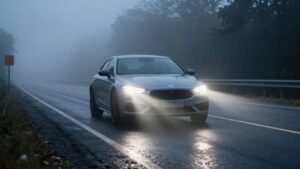
Once the bulb fits, its beam pattern determines how well you can see in fog. H11 casts a low, wide beam that spreads light across the road surface. Its downward distribution and controlled cutoff help limit glare and reduce backscatter from mist or rain.
9005 sends a narrower, more intense beam farther ahead. Though it produces about 1,700 lumens versus roughly 1,350 for H11, extra output doesn’t guarantee better fog visibility; reflected light can obscure your view. 9006 produces a wider, controlled low beam and suits precipitation better than 9005, but it isn’t as fog-focused as H11. At about 1,000 lumens, it has lower output.
For fog lights, choose a bulb engineered for a low, controlled beam. Prioritize cutoff and distribution over raw lumens.
Vehicle Fitment**
Because fog lights need a low, controlled beam, match the bulb to the housing rather than choosing by brightness alone. Check your manual and housing marking; confirm the base and connector before buying.
- Choose H11, common for fog and low-beam use, when your housing specifies it; its low, wide pattern helps limit glare.
- Treat 9005 (HB3) as a poor fog choice: its high-beam projection can aim light too high, glaring other drivers.
- Choose 9006 (HB4) only when specified; some vehicles use it, but its output and cutoff may not match the engineered pattern.
- Don’t interchange them: bases and locking geometry differ, and connectors aren’t plug-compatible without modification.
After installation, check aim against the manufacturer’s specifications before driving in poor visibility, to protect oncoming traffic at night.
Match Factory Color Temperature
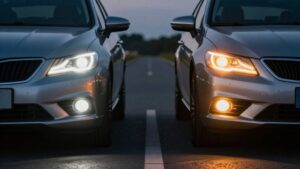
To keep your headlights looking consistent, choose an LED color temperature close to your factory bulbs: about 5000K for a warmer, yellowish-white match or 6000K for a brighter, whiter appearance. Use the lower end if your halogens look warm; choose 6000K if their output already appears white.
An 8000K option can look blue and reduce contrast in fog, rain, or snow, making hazards harder to distinguish. Match the left and right bulbs, including 9005 and 9006 combinations, because different hues can make the beams seem uneven in color and brightness.
If you replace only one bulb, compare its visible hue with the bulb that remains rather than relying on its label. Verify alignment after installation and check the beam pattern for safe road use.
Conclusion
Choose the bulb your vehicle specifies: H11s, 9005s, and 9006s differ in socket design, beam role, and output, so they aren’t interchangeable by appearance alone. Before buying, verify the socket, connector, and any required adapter. Match the bulb’s beam pattern and color to factory specifications.
Inspect rear access and housing clearance. Avoid excessive heat or glare; correct fit protects visibility and other road users. Test lamps after installation; aim them correctly before driving.