UTV Street Legal Laws by State: Lighting, Plates and Registration
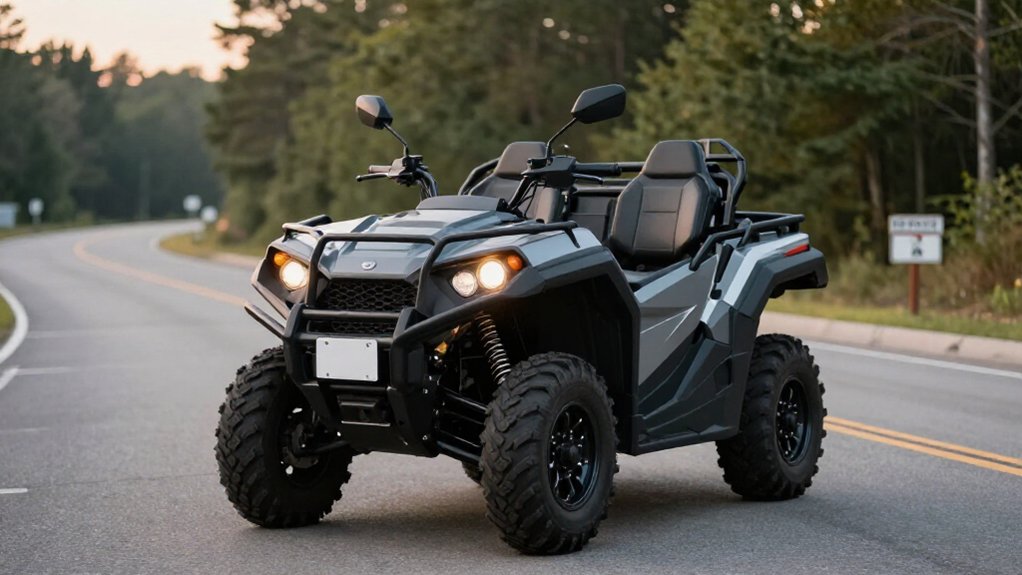
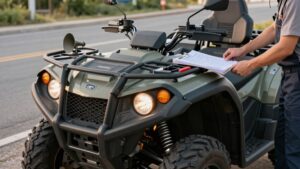
UTV street-legal laws vary by state, so a plate alone doesn’t authorize road use. Check your state’s registration class, permitted roads, and required equipment, including headlights, tail and brake lamps, turn signals, reflectors, horn, and any required plate light.
Verify plate placement and renewal deadlines, and arrange a VIN inspection if required. Don’t assume another state’s registration proves compliance.
Confirm every rule for your vehicle and route; the details below can help you identify what to check.
State-Specific Lighting and Plate Rules
State-specific equipment rules can affect both what you install and which roads you may use. In Utah, your street-legal UTV or ATV must have headlamps, tail lamps, stop lamps, red rear reflectors, and amber/red electric turn signals. You also need a braking system other than a parking brake and a horn or other warning device.
Verify that Utah requirements are met before operating on roads; registration doesn’t establish equipment compliance.
North Carolina classifies a street-legal side-by-side as a Modified Utility Vehicle (MUV). You may operate it on roads posted 55 mph or less, subject to rules for that registration class.
Kansas doesn’t register UTVs as street-legal. If you rely on an out-of-state title, registration, and plate, the issuing state’s equipment rules govern your UTV’s street-legal setup.
Rear Plate Illumination Standards
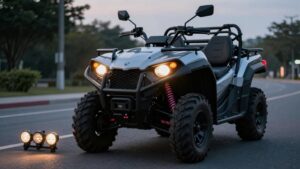
When your UTV’s rear plate is required on public roads, many states also require a white light that illuminates it at night.
Your state’s equipment rules control the details. Utah expressly includes white rear plate illumination in its minimum street-use lighting package. Keep the lamp functional and wired to operate with your headlights when required. Officers may cite an unreadable plate even when your other lights work.
| Item | Practical standard | Why it matters |
|---|---|---|
| Color | White light | Matches stated requirement |
| Operation | Works with headlights | Supports nighttime compliance |
| Visibility | Plate is clearly illuminated | Reduces citation risk |
| Design | Approved lamp; avoid glare | Preserves visibility |
Check local rules before nighttime public-road riding. Before street use, verify your jurisdiction’s current equipment rules and choose a compliant lamp and wiring setup.
Plate Mounting Height Limits
Mount your UTV’s plate within the height range your state allows; many states measure from the ground to the plate’s center and use an approximate 12-to-72-inch range, but you must verify the exact rule.
Measure to the plate’s centerline, not its bottom edge, and check your state’s wording for both height and mounting orientation. Authorities may apply standard passenger-vehicle rules to your UTV, and they can assess the plate as equipped.
An angled bracket or a plate mounted too high or low may prompt a stop, even when your lights and turn signals comply. If your state requires rear plate illumination, position the plate where its lamp fully illuminates it; an out-of-range location can also violate lighting rules.
Before riding on roads, compare your installed plate’s position with the state requirement, then adjust the bracket and confirm the plate remains secure, visible, and oriented correctly.
Registration Renewal Deadlines
Your UTV’s renewal due date depends on your state and registration period, so check your DMV notice or account for the exact deadline. Don’t assume you have a grace period: late renewal may trigger penalties and can bar road use until your registration and plate are valid.
Renew early when allowed; reminder notices aren’t a substitute for your responsibility to meet the deadline.
Renewal Due Dates
UTV registration renewal deadlines vary by state, so check your DMV’s renewal notice or registration renewal page for the exact due date and whether it follows your plate or registration month.
Many states require you to renew before the expiration date printed on your registration card. Don’t assume a reminder gives you extra time; late renewal may bring a fine or additional fee, and your registration may no longer be valid.
If your renewal requires an inspection or emissions test, schedule it early enough to complete any required step by the stated deadline. Keep your mailing address and other DMV account details current so notices reach you.
If the renewal notice is missing or unclear, use the renewal page’s contact option to confirm the deadline directly with your DMV. Save confirmation of payment and any updated registration documents, and carry or display them as your state requires. Review the posted instructions before submitting your renewal.
State-Specific Deadlines
Because renewal deadlines vary by state and may follow your registration month or year, check your DMV notice or renewal page for the exact due date rather than relying on when you installed your UTV’s street-legal equipment.
Your renewal date, not your equipment-installation date, determines whether registration stays current. In Utah, street-legal eligibility requires valid registration, so renew before your plate or registration expires; compliant lighting alone won’t keep you lawful.
Kansas doesn’t offer in-state street-legal UTV registration. If you ride under an out-of-state registration, renew it on time to preserve the right to use Kansas roads.
In North Carolina, register your street-legal side-by-side as a Modified Utility Vehicle (MUV), and keep that registration current with N.C. DMV to operate on roads where MUVs are permitted. Address changes, lapsed insurance, or late fees may affect renewal, so confirm requirements with your DMV each time.
Grace Periods
After confirming your renewal deadline, check your state DMV’s rules for any registration grace period before the plate or tab expires. States differ: some let you renew within a limited period after expiration without penalties, while others provide no grace period. Read the DMV’s exact “late renewal” or “grace period” terms; don’t assume you may drive during the window.
A renewal grace period generally concerns registration only. It doesn’t extend expired insurance or inspection requirements that apply to your street-legal UTV. If you renew before receiving an updated plate or tab, carry the required renewal receipt or other proof in your vehicle. Confirm what documentation your DMV accepts and how long it remains valid. If your state offers no grace period, don’t operate your UTV on public roads after registration expires.
Late Renewal Penalties
If you miss your UTV registration renewal deadline, your state may charge a late fee set by the DMV. The amount may be a fixed charge or a percentage, and your state determines when it applies. A short grace period may let you renew before your registration lapses, but don’t assume it eliminates penalties.
Once registration lapses, you may receive a citation for expired plates if you drive, even when your UTV otherwise meets street-legal requirements. An officer may impose a higher fine, particularly if your plate or tag isn’t current or visible.
Renew as soon as possible; don’t rely on retroactive protection after the deadline. Your state may require proof of current insurance or equipment compliance before processing the renewal. Check DMV records.
Renewal Notices
Your state sets a fixed annual or biennial deadline for renewing a street-legal UTV registration, usually near the expiration month shown on your registration card. Use the expiration date, not the notice’s mailing date, to determine when renewal is due. Check your card and notice, since states set their own deadlines and procedures.
Many motor vehicle agencies let you renew online; use the portal to confirm your status and update your address so future notices reach you. Don’t assume a missing notice extends your deadline. Before submitting, verify whether your state requires current proof of insurance, an inspection, or updated emissions paperwork.
Required lighting and plate illumination don’t replace these renewal documents. Renew on time: a late filing can add fees and leave your plate or registration invalid until the agency processes your renewal. Save confirmation for your records and future reference if an agency questions your renewal.
Reading State Statute Details
When reading a state statute, start with its definition of a street-legal UTV, then check where it may operate and what equipment it must have. Next, confirm the vehicle meets the statute’s exact width, length, and speed-capability limits; don’t rely on summaries or outdated guidance.
For example, North Carolina defines a Modified Utility Vehicle under N.C. Gen. Stat. § 20-4.01. Check its operating rule too: a registered MUV may use roads posted 55 mph or less; crossing a higher-speed road is allowed only at an intersection under § 20-121.1.
Then identify required headlights, taillights, and signals, and verify registration and plate visibility, including required illumination. Apply each requirement to the vehicle and route before driving; lawful status depends on meeting each condition.
State-Specific Amber Beacon Rules
Amber-beacon rules depend on your state and how it classifies your UTV: some require a clearly visible, electrically connected amber or yellow rotating or strobe lamp, while others make it optional but restrict its placement or use.
Check your state DMV code before buying or wiring. Some states require a beacon only if registration classifies your UTV as a low-speed or modified utility vehicle, not every UTV.
If required, mount it visibly and connect it to the electrical system. If optional, law may dictate roof or upper-body placement and limit use to daytime or while moving.
A beacon can’t replace required headlamps, tail lamps, brake lights, turn signals, or plate illumination. County or city rules may differ, so confirm requirements for your registration class first.
Nighttime Roadside Breakdown
If your UTV breaks down at night, keep its required road lighting operational: headlights, tail and brake lights, turn signals, and, where required, a light illuminating the rear plate.
Pull off the roadway safely, signal before moving, and keep your lamps on. Equipment rules generally still apply after you stop; failed stop lamps, reflectors, or turn signals can invite a citation and prevent drivers from anticipating your movements. Many states require a white plate light so officers can identify your UTV during a night stop.
Requirements vary: Utah specifies headlamps, tail lamps, plate illumination, stop lamps, red rear reflectors, electric turn signals, and a horn. Check your state’s equipment list, and repair required lighting before resuming road travel as you return to the roadway.
VIN Inspection Requirements
Once your UTV’s required lights are in order, check whether your state requires a VIN inspection for street-legal registration.
You may need verification when you transfer an out-of-state title or registration, your VIN plate is missing or damaged, or the DMV can’t confirm the number electronically. An out-of-state UTV may require an in-person check before local title transfer or initial registration. The inspector compares the factory-stamped VIN on your vehicle with your ownership records.
Before booking, confirm who your state authorizes to inspect it; a mechanic may not qualify. Bring:
- Your title, manufacturer’s certificate of origin, or bill of sale.
- Your driver’s ID.
- Prior registration documents, if available.
Locate the stamped VIN, on the frame or near the dash, and make sure it’s readable. Without matching paperwork, the inspection generally can’t be completed.
Washington OHV Plate Decals
A Washington OHV plate decal authorizes use under the state’s OHV program; it isn’t a street-legal license plate. If you’re relying on that decal, keep it current and affixed where Washington’s issuing agency requires; officers may check its presence and condition during roadside enforcement.
- Use the decal only within designated OHV areas and trails, and follow the rules that apply to Washington’s OHV program; it doesn’t authorize ordinary roadway travel.
- For road use, you’ll need the proper registration type and equipment that meets requirements for each roadway you drive.
- Check the issuing agency’s instructions for placement, renewal timing, and which vehicles qualify for OHV coverage before riding.
Don’t treat an OHV decal as proof that your UTV satisfies street-use laws or state registration requirements.
Conclusion
Before you ride your UTV on a road, verify your state’s rules for plate lighting, mounting height, renewal dates, and amber beacons. Read the statute and guidance rather than relying on another state’s standards.
Keep registration current, complete required VIN inspections, and secure decals, including Washington’s OHV plate decal. If your UTV breaks down at night, use warning lights and move it out of traffic.
Rules vary, so confirm requirements before each ride.