LED vs Halogen Headlights: Brightness, Lifespan and Glare Compared
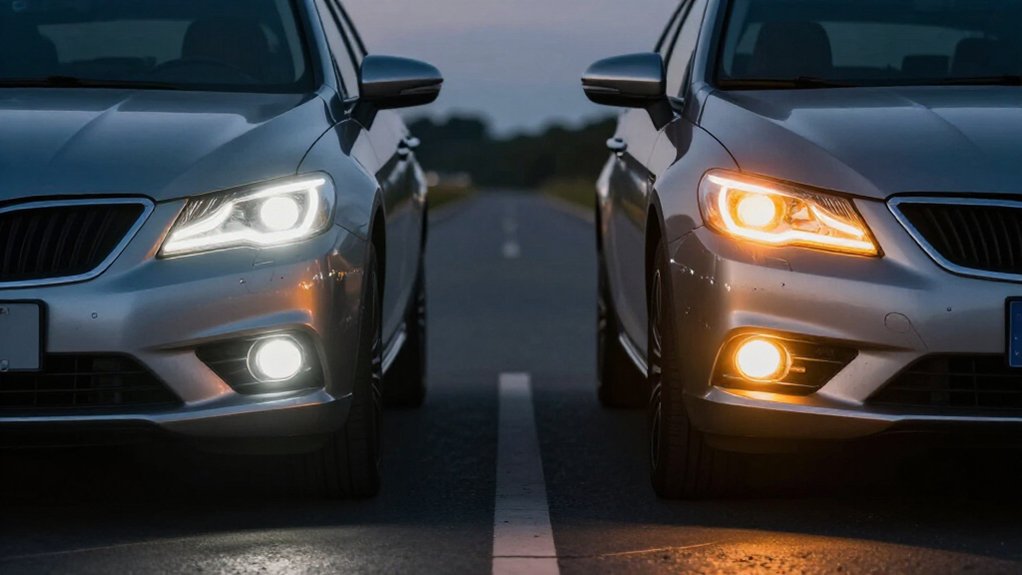
LED headlights reach full output instantly, often project more usable light, and can last 20,000–50,000 hours; halogens provide 1,100 lumens and last 500–1,000 hours.
But higher brightness doesn’t guarantee visibility: mismatched LED chips can scatter light and create glare, especially in reflector housings.
You’ll need the bulb positioned properly, compatible wiring, and precise aim.
Halogens cost less upfront; LEDs suit dark roads, while warmer light can help in fog.
The details ahead show what else to account for.
Beam Pattern and Glare Control
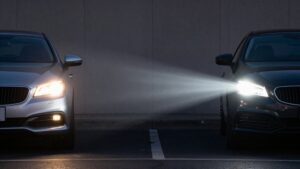
A headlight’s beam pattern matters as much as its brightness: glare occurs when light reaches an oncoming driver’s eyes. Your LED conversion can scatter light upward or sideways when its emission geometry mismatches your reflector or projector optics. Reflector housings often lack a sharp cutoff, so incorrect focal placement can expose drivers to stray light.
| Optic | Risk | What you protect |
|---|---|---|
| Reflector | Scattered glare | Oncoming drivers |
| Projector | Cutoff shift | Your visibility |
| Aligned beam | Controlled light | Everyone’s safety |
Projectors form a cutoff; align bulbs to the original focal point or glare may blind your oncoming neighbors. FMVSS 108 sets cutoff, pattern, intensity, and color requirements; some kits favor lumen claims.
LED Chips vs Halogen Filaments
LED chips generate light through semiconductor photons, while halogen bulbs heat a tungsten filament until it glows. An LED converts electrical energy directly into light; a halogen relies on heat inside a capsule. That difference changes how your headlamp responds and how precisely its source must sit at the reflector or projector focal point. If the chip’s position doesn’t match the filament’s geometry, light may scatter into drivers’ eyes.
- You get LED output when switched on; halogen light builds as its filament heats.
- LEDs often need 15–20 watts, compared with about 55 watts for halogen bulbs.
- Correct fitment protects visibility and helps prevent discomfort or danger from glare.
Check compatibility before replacing a bulb; choose a beam pattern approved for your vehicle.
Real-World Brightness and Lifespan
On the road, LED headlights typically provide stronger, more consistent illumination than halogens: a halogen bulb produces about 1,100 lumens, while many LED upgrades claim 1,600 or more. Because LEDs convert more electrical power into usable light, you may see a cleaner, more intense forward beam and improved road detail. Actual gains depend on bulb condition; worn halogens can dim substantially, so replacing aged bulbs may make the difference especially noticeable. LEDs also reach full output immediately, while halogens need time to heat their tungsten filaments. This can give you prompt illumination when you switch on your headlights.
Over time, LEDs commonly last 20,000–50,000 hours, compared with roughly 500,000 for halogens. You’ll replace them less often, and their brightness stays steadier across service life.
Installation Time and Tools
Those brightness gains depend on a correct installation. A halogen swap takes minutes and may need only a twist; LED upgrades can take longer, even when they require extra tools. Check your car’s wiring needs: an adapter harness or anti-flicker/compatibility module may be essential.
- Seat and clock each LED bulb precisely; poor positioning can distort the cutoff and send glare toward oncoming drivers.
- Route and secure wiring, then verify connections to reduce flicker and prevent movement-related faults.
- Keep the heat sink unobstructed and allow airflow, so heat can dissipate.
Don’t assume tool-free means risk-free. Follow the kit and car instructions, confirm a beam cutoff after installation, and stop if you can’t achieve alignment. A rushed fit can compromise visibility for you; get help.
Headlight Housing Type
Your headlight housing shapes the beam as much as the bulb does: reflectors spread light outward, while projectors use a lens to create a sharper beam with a defined cutoff.
When you replace a halogen bulb with an LED, check whether its emission point matches the housing’s design. A filament’s position determines how a reflector directs light; an LED in the wrong reflector can shift beam geometry, create uneven output, and increase glare.
Projectors may suit LEDs better when the source sits near the original filament’s focal point, helping preserve a focused pattern and cutoff. Even then, align and install the bulb correctly; scattered upward light can reach oncoming drivers’ eyes. FMVSS 108 sets beam and cutoff requirements; cheap kits may perform unpredictably.
Annual Replacement Costs
Once the beam is properly matched to the housing, replacement costs become another point of comparison.
Halogens typically cost $10–$50 per pair, yet last only 500–1,000 hours. If you drive often at night, recurring purchases can strain your budget and leave you weighing safety against expense.
- You may buy another halogen set each year, a frustrating cycle.
- LEDs cost $40–$150 per pair upfront, but their 20,000–50,000-hour life, often about 15× halogen’s, usually cuts annual replacement costs sharply.
- Their lower draw, commonly 15–20W versus 55W, can trim yearly lighting expense beyond bulb purchases.
With similar use, you’re far less likely to replace LEDs annually. Choose a quality unit with controlled beam output: poor conversions can create glare, weaken performance, or fail early, prompting costly rework.
Certification and Road-Legal Use
Even a brighter LED retrofit isn’t road-legal unless it meets the headlamp requirements for your market, such as U.S. FMVSS 108. These rules control beam cutoff, intensity distribution, and color to limit glare for oncoming drivers. Brightness alone doesn’t prove compliance; conversion kits may mismatch your reflector geometry and create scatter.
For proper optics, use the housing or adapter that positions the LED emitter at the halogen filament’s focal point and restores the intended cutoff. Check that the bulb or headlamp carries approval for your exact vehicle application and beam type; an unapproved retrofit can fail inspection even if it improves visibility.
Aim the lamps to specification. A certified setup can still project its cutoff upward when misaligned, producing glare and violating beam limits.
Upfront Purchase Price
You’ll typically pay $40–$150 per pair for LED bulbs, compared with about $10–$50 for halogens. LEDs often last much longer, which can reduce repeat replacement costs, but adapters or compatible, heat-managed housings may raise the initial price.
Choose LEDs matched to your vehicle’s optics; poor beam control can add cost without improving safety and may increase glare.
Initial Purchase Cost
LED headlights typically cost more upfront: expect about $40–$150 per pair, compared with $10–$50 for a set of halogen bulbs. Your final price depends on fitment, not just the box: LED conversions may need adapters, compatible drivers, or space for heat management. Halogen replacements are widely stocked, and you can often install them yourself with minimal tools. That simpler purchase can ease the pressure when a bulb fails unexpectedly.
- Choose halogen when you need the lowest immediate outlay and straightforward replacement.
- Budget for LED-specific hardware and verify housing fit before checkout; surprises can raise your bill.
- Don’t let a bargain kit compromise beam cutoff: compliant optics and correct aiming help protect oncoming drivers.
Compare verified, vehicle-compatible options to see your full checkout cost first.
Long-Term Value
Over time, LEDs can offset their higher purchase price through fewer replacements and lower power use. A pair typically costs $40–$150, compared with $10–$50 for halogens.
However, LED bulbs commonly last 20,000–50,000 hours, while halogens last roughly 500–1,000 hours, so you may buy replacements far less often. LEDs also draw about 15–20 watts, versus roughly 55 watts for halogens, reducing ongoing electrical demand.
Your actual savings depend on driving time, vehicle use, and bulb quality; don’t assume a specific payback period. Choose compatible LEDs and align them correctly with your headlamp optics.
A poorly matched conversion can create glare, compromise other drivers’ vision, and lead to inspection failures or correction costs. Factor those safety and maintenance risks into your long-term value comparison before upgrading.
Cold-Weather Starting Performance
When you start your car in cold weather, LEDs reach full brightness almost instantly, while halogen bulbs need time to heat their filaments. LEDs also tend to maintain steadier output in low temperatures, though cool-white light can reflect more from snow or rain and reduce usable visibility.
For winter reliability, consider that LEDs need fewer replacements, but any conversion must be compatible and correctly aimed to limit glare.
Cold-Start Response
In freezing conditions, LEDs deliver full brightness as soon as you switch them on, while halogen bulbs take time to reach peak output as their filaments heat up.
You notice this difference most on subzero mornings: LED electronics maintain steady output immediately, while a halogen beam starts dimmer. Clear lenses and correct aim still matter; neither technology can compensate for a hazy cover or misdirected beam.
- With LEDs, you can identify a hazard sooner when visibility is critical.
- In deep cold, you get immediate, consistent illumination instead of waiting for the halogen filament to heat.
- Check aim and lens clarity; you’ll protect usable sightlines whatever bulbs you choose.
That instant matters: seeing edges, pedestrians, and debris sooner gives you more time to respond safely.
Warm-Up Time
LED headlights reach full brightness almost instantly, giving you usable light as soon as you switch them on. In freezing conditions, that immediate output helps you see the road and makes your vehicle visible without waiting for a warm-up cycle.
Halogen headlights work differently: their tungsten filaments must heat to operating temperature. After you switch them on, output rises gradually, so the first moments can be dimmer.
Cold starts can make this delay more noticeable because the filament begins cold. LEDs deliver maximum output immediately, while halogens need time to reach peak brightness. For safe driving, account for the brief halogen ramp-up when visibility is limited, and avoid relying on full illumination until the beam has stabilized. Ensure either system is correctly aimed.
Winter Reliability
On a cold, dark morning, LED headlights deliver full output as soon as you switch them on, helping you see the road without a warm-up delay.
LEDs use solid-state components, so cold temperatures don’t affect brightness like filament behavior can. Halogen bulbs need their tungsten filaments to heat, briefly delaying peak output just as you start across icy, poorly lit roads. That difference can improve your first seconds of visibility.
- You get immediate light when frost and darkness narrow your view.
- You face fewer midwinter bulb changes: LEDs typically last 20,000–50,000 hours, versus about 500–1,000 for halogens.
- You still need controlled beams; correct cutoff and aim limit glare, while halogen’s warmer output may reflect less in some fog or rain.
Drive cautiously.
Choose by Driving Conditions
Where you drive should guide your headlight choice: high-quality LEDs generally project farther on dark rural roads and unlit highways, helping you spot hazards sooner, while halogens or well-matched mid-range LEDs can suit city traffic.
For unlit highways, choose LEDs for illumination distance and instant full output. In city traffic, either technology can work, but select LEDs only when their cutoff and glare control match your housing, limiting upward scatter toward other drivers.
In fog, warmer halogens or yellow-tinted bulbs around 2700K–3000K can reduce backscatter versus cool-white kits near 6500K. In rain or snow, prioritize precise LED optics and correct alignment to light the road while controlling reflections from wet surfaces. Check beam aim after installation; don’t trade usable visibility for brightness alone.
Conclusion
Choose headlights by matching the bulb to your housing and driving conditions. LEDs can deliver high output and long service life, but only when their beam pattern stays controlled in a compatible assembly. Halogens offer predictable fit and cold-weather performance, though they use more power and need replacement sooner.
Before upgrading, check certification, alignment, glare control, and installation requirements. Don’t judge brightness by claims alone; choose a road-legal setup that lets you see without dazzling others.