Are LED Headlight Bulbs Really Brighter Than Halogen? Lumens vs Real Beam
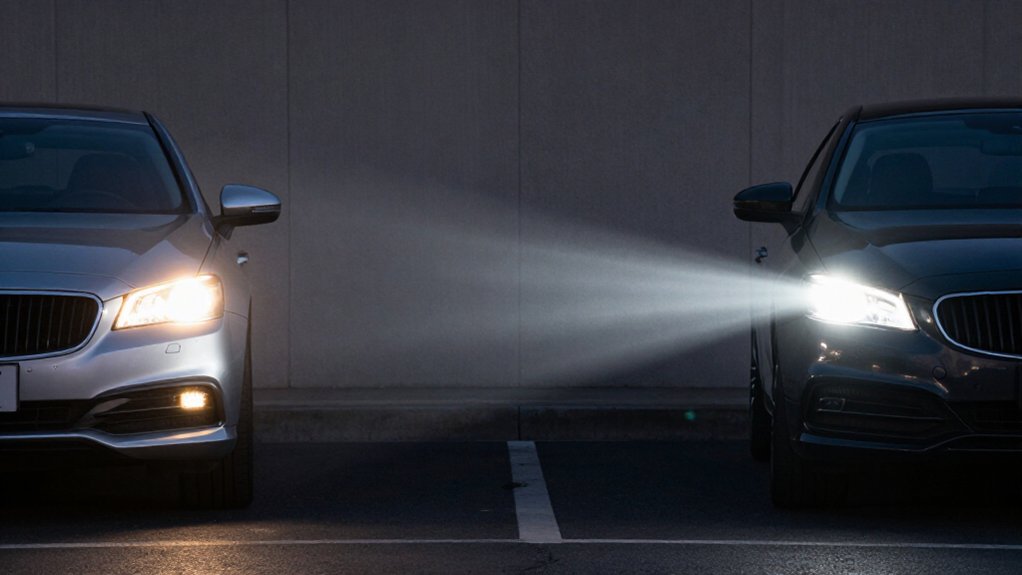
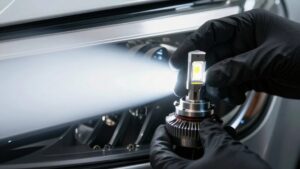
LED headlight bulbs can produce more lumens than halogens, but that doesn’t guarantee more usable road light. Lumens measure total output; lux measures illumination on a surface, so beam focus and housing compatibility matter.
In one projector test, a 60-watt halogen reached 550 lux, while an adjusted LED produced 250; better-focused LEDs have reached roughly 745 lux. Your results also depend on alignment, voltage, and heat.
The checks ahead show what matters most.
Lumens Versus Beam Pattern
Why can two LED bulbs with similar lumen ratings produce very different results? Lumens measure total emitted light, but your headlight’s beam pattern determines how much reaches directions you need. Diode position, aim, and reflector or projector optics shape that pattern; a bulb that doesn’t match the housing can waste output or create distribution problems.
In one projector low-beam test, the Aurora LED delivered about 250 maximum lux, while the GTR Ultra 2 reached roughly 745. The same setup produced about 550 lux with a stock 60-watt 9005 halogen, 430 with an HIR2, and 690 with a 100-watt RallyVision HB3. In a reflector high-beam test, the GTR Ultra 2 measured about 1,980 lux, versus 980 for the RallyVision. Compare beam results in your housing, not lumen claims.
Lux on the Road Surface
To see how much light reaches the pavement, compare lux rather than total lumens. Lux measures illuminance, or light per square meter; lumens measure a bulb’s total output. Because optics shape the beam, not every lumen reaches the road.
In one projector low-beam test, a stock 60W 9005 halogen produced about 550 lux maximum. A 55W Philips HIR2 9012 reached about 430 lux, while an Aurora LED measured around 250 lux after its position was adjusted. The GTR Ultra 2 LED reached about 745 lux in the same setup.
These results show why you can’t infer road illumination from advertised lumens alone: bulb model and beam design change measured lux substantially. Compare lux under matched conditions to determine whether an LED actually increases usable illumination.
Beam Focus on Curves
On curves, usable visibility depends less on total lumens than on how well the beam places light along the road’s changing path. As you steer, the beam’s cutoff and hotspot determine whether illumination follows the bend or leaves dark zones where you need to see.
Road tests show why beam control matters: one projector low-beam LED produced about 250 max lux, while a better-focused LED in the same style setup reached roughly 745 lux, even with positioning tweaks. On high beam, the GTR Ultra 2 measured about 1,980 lux in a reflector housing, compared with roughly 980 lux from a 100-watt halogen.
A clean hotspot can make curves appear brighter and wider, but poor focus can undermine high claimed brightness. Check measured lux and beam shape, not packaging lumens.
Reflector Versus Projector Housings
Your reflector housing may accommodate an LED’s emitter geometry better than a projector, producing a stronger beam: one F-150 high beam measured 1,980 lux with an LED versus 980 lux with a 100W halogen.
In a projector low beam, an adjusted LED measured only 250 lux, showing how bulb-housing mismatch and alignment can reduce performance. Compare measured beam lux in your vehicle’s actual optics; lumen and wattage claims alone don’t predict on-road brightness.
Reflector Housing Beam Patterns
In reflector housings, curved surfaces spread an LED’s light into a wider beam, while projector housings rely on precise light-source positioning to form a sharp cutoff. You should compare measured lux in the same housing and beam position, not rely on advertised lumen totals. A GTR Lighting Ultra 2 LED reflector high-beam measured about 1,980 lux, compared with about 980 lux from a Philips Rally Vision 100W HB3 halogen baseline.
That result shows how reflector geometry can nearly double measured output; it doesn’t prove every LED will perform similarly. Because an LED may position its light source differently from the original filament, your reflector may tolerate that mismatch better than a projector does. Its curved surfaces respond to light spread, so assess the beam pattern and lux before choosing a replacement rather than assuming a higher lumen rating guarantees useful road illumination in your vehicle under actual conditions at night.
Projector Housing Performance
A reflector’s strong LED result doesn’t predict performance in a projector, where the bulb’s light source must closely match the halogen filament’s position. In a projector low beam, poor source placement can shift the optics’ output and reduce measured illuminance: the Aurora reached about 250 maximum lux, while the better-positioned GTR Ultra 2 produced roughly 745.
A 100-watt Rally Vision HB3 halogen measured about 690 maximum lux, so it outperformed the weaker LED despite any lumen claims. Reflectors respond differently: their collection pattern depends on source shape and location, and the GTR Ultra 2 delivered about 1,980 lux in reflector high beam, versus roughly 980 for that halogen.
You can’t infer real brightness from lumens alone; compare measured beam lux for bulb and housing. An LED may beat halogen in one optic and trail it in another.
Bulb and Housing Compatibility
Across reflector and projector housings, an LED’s brightness depends on how well its emitters align with the optic’s focal point. If the emitter geometry doesn’t match, you may get a dimmer beam or misplaced light, regardless of the bulb’s claimed lumens.
In one projector low-beam test, the GTR Ultra 2 LED produced 745 lux, while the Aurora LED reached just 250 lux after repositioning. Halogen results also varied: a Philips Rally Vision 100W HB3 measured 690 lux, versus 550 lux for a stock 60W 9005.
In a reflector-based F-150 high beam, the GTR measured 1,980 lux, compared with 980 lux from the Philips.
These results show why you should compare measured road-level lux in your housing, not packaging claims alone. The same bulb can perform differently across optics.
Vehicle Electrical-System Voltage
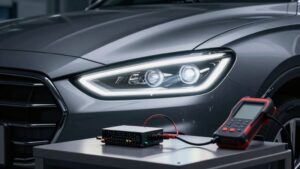
With your engine running, the charging system typically supplies 13.5, 14.4 V, and that voltage affects headlight output. A voltage drop can noticeably dim halogens, while LED drivers may regulate output within their operating limits.
If your charging system’s voltage is unstable or out of range, either bulb type may underperform, so compare brightness at stable voltage.
System Voltage and Output
During normal charging, vehicle voltage often reaches about 13.5–14.5 V, and LED output depends on whether that voltage falls within the bulb driver’s operating range. Under-voltage can dim an LED even when its advertised wattage is high. A regulated driver may hold current, and beam output, nearly steady as voltage varies; an unregulated design may respond more directly.
Halogen bulbs tolerate small voltage changes, but their filament temperature still tracks supply voltage. At healthy charging voltage, a halogen may emit more light than at nominal 12 V, while a regulated LED may gain little.
Compare output under matched test conditions:
| Technology | Voltage response | Typical behavior |
|---|---|---|
| Halogen | Tracks supply | Filament output |
| LED | Driver-regulated | Steadier output |
Measure bulb-harness voltage during lux tests; otherwise, lumen-to-beam comparisons may not be comparable directly.
Voltage Drop Effects
A regulated LED driver can stabilize output only while it has enough voltage to operate. Although your charging system may supply 13.8–14.4 V, wiring and connectors can drop several tenths of a volt at the headlamp under load. That loss can push a constant-current driver toward its voltage or efficiency limit, reducing LED power and measured beam lux.
In a comparison, the same bulb can produce different lux readings when voltage or connector resistance changes between low- and high-beam trials. Halogens respond to voltage variation, but changes affect them less severely; an LED may lose more output once its driver reaches a limit. You can reduce these effects with clean, tight connectors and grounds, helping the bulb maintain rated output and its beam.
Charging System Compatibility
Because LED headlight drivers need stable input voltage, a weak battery or failing charging system can reduce output or cause flicker.
Many vehicles regulate alternator voltage to roughly 13.8–14.4 V while the engine runs, so choose a bulb driver rated for that range to maintain consistent output. A faulty regulator can push voltage higher; the driver may activate over-voltage protection and dim or shut down.
Poor connections, corroded harness contacts, or a weak battery can also create drops under load, reducing usable light despite a high lumen claim.
Match the bulb’s voltage, current draw, polarity, and driver requirements to your vehicle’s electrical system. Check whether your vehicle needs a CANbus decoder; incompatibility can cause electrical instability and reduce real beam brightness on the road.
Before-And-After Garage Test
The garage test shows why bulb labels alone don’t predict beam performance: in projector low beam, the stock 60W 9005 Sylvania measured about 550 lux, while the Philips HIR2 55W (9012) reached only 430 lux. When you compare the same projector setup, Rally Vision 100W HB3 raised the reading to about 690 lux, while Aurora LED delivered just 250 lux even after you adjusted its position.
That gap points to beam alignment and housing compatibility, not simply wattage or an upgrade claim. GTR Lighting Ultra 2 LED reached about 745 lux in low beam, exceeding that halogen result in this test. In reflector high beam, it produced about 1,980 lux versus roughly 980 lux from the Rally Vision. These readings show you should judge a bulb by measured output in your housing and beam pattern, not its advertised lumens alone. Lux measures illumination at the target, not total output across every road condition.
Thermal Output and Lifespan
Unlike halogens, LEDs don’t heat a tungsten filament to produce light, so their lifespan depends more on how effectively the bulb’s heat sink cools its LED components.
You should also consider thermal stability when comparing measured brightness. In the test data, the GTR Ultra 2, an LED reflector high beam, reached 1,980 peak lux, nearly twice the halogen’s 980. That result shows cooling, optical alignment, and fit can help convert LED output into usable beam intensity when the bulb runs properly.
A halogen typically lasts about 500–1,000 hours, because its hot filament degrades. LEDs often carry ratings of roughly 20,000–50,000 hours, since they can operate at lower internal temperatures. But inadequate cooling can trigger thermal throttling and accelerate component wear, reducing brightness over time.
Chasing Blue-Tinted Bulbs
Why do blue-tinted bulbs often seem brighter? Their correlated color temperature (CCT) shifts light toward cool white, which can look more intense to you without increasing measured beam illuminance. Judge the beam in lux, not by tint or claims.
- In a projector low beam, Aurora reached about 250 max lux after adjustment.
- In the same setup, GTR Ultra 2 reached about 745 max lux; bulb and optics can deliver differences.
- Baselines varied: 60W Sylvania 9005 measured 550 max lux, while 55W Philips HIR2 9012 reached 430.
In reflector high beam, GTR recorded 1,980 max lux versus 980 for a 100W Philips Rally Vision HB3.
You’ll get output only when bulb fit and alignment suit the optics; blue tint can’t guarantee it.
Check Local Bulb Laws
After judging a bulb by its measured beam rather than its tint or lumen claims, check whether your local laws allow that bulb in your headlight housing. Many regions restrict aftermarket LED conversions, particularly in halogen projector or reflector housings, and may require DOT or ECE approval. Requirements depend on your vehicle, lamp type, and jurisdiction, so verify the standard before buying or installing a replacement.
Measured performance doesn’t override legality: one LED produced 250 lux in projector low beam before adjustment, while another reached 745 lux; neither result establishes approval. In reflector high beam, an LED measured 1,980 lux versus 980 for a 100-watt halogen. Check certification, fitment, and beam alignment, then compare road-level lux, not package lumens, wattage, or color claims.
Conclusion
LEDs can produce more lumens than halogens, but lumens alone don’t predict what you see. A correctly matched bulb and housing must create a controlled beam that delivers useful lux downroad without glare.
Check focus on straight roads and curves, compare output at the same system voltage, and account for thermal limits. Before buying, run a careful garage comparison, verify local bulb laws, and choose proven beam performance over blue tint or headline lumen claims.