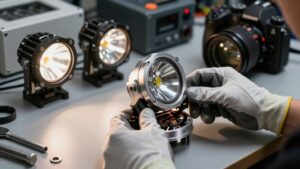
IP67 vs IP68 for Off-Road Lights: Which Waterproof Rating Do You Need?
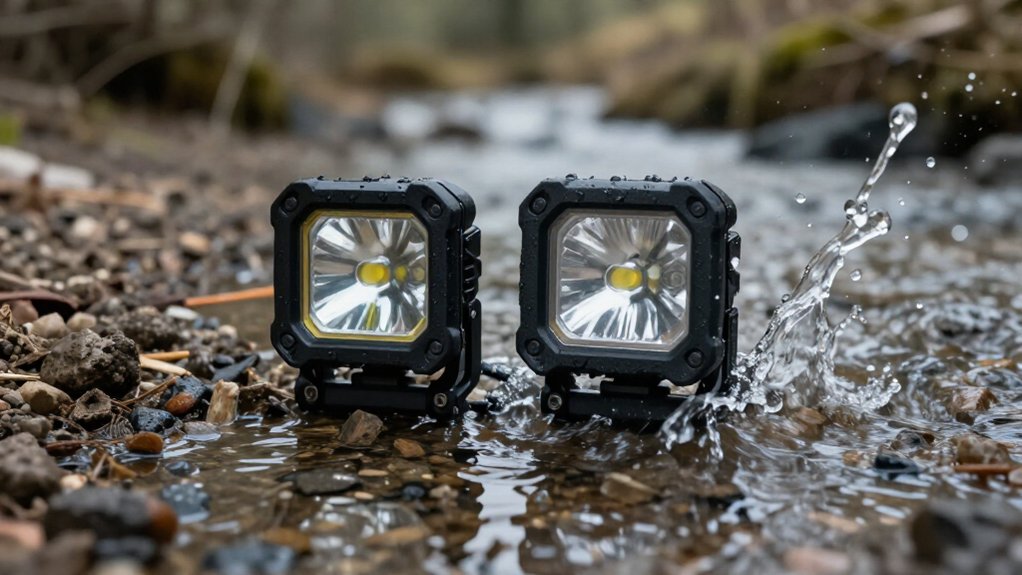
Choose IP67 for off-road lights if you mainly face dust, spray, and brief water exposure: both IP67 and IP68 are dust-tight, while IP67 is tested for temporary immersion at about one meter for roughly 30 minutes.
Choose IP68 when your route could keep lights submerged, but check the manufacturer’s stated depth and duration.
Inspect connectors and seals too; poor cable entries or servicing can undermine protection.
Further details can clarify which rating suits your route.
Submersion Depth and Duration
The key difference between IP67 and IP68 is how long and how deeply a light is tested underwater.
For your off-road setup, IP67 covers dust-tight protection and a short dunk: temporary immersion up to about one meter for roughly 30 minutes. IP68 remains dust-tight but supports sustained submersion beyond that level, within the manufacturer’s stated depth and duration limits. Don’t treat every IP68 light as equivalent; compare its rated limits.
| Exposure | Rating | Meaning |
|---|---|---|
| Short dunk | IP67 | Up to ~1 m, about 30 min |
| Sustained submersion | IP68 | Manufacturer-set depth and time |
| Different ratings | IP68 | Limits may vary |
| Water crossing | IP68 | Safer for sustained immersion |
| Possible submersion | IP68 | Check specified limits |
For crossings that may submerge your light, choose IP68 and verify its stated limits suit the route and duration.
IP Testing Conditions
Beyond depth and duration, the test method matters: IP67 checks dust-tight sealing and temporary immersion, while IP68 covers prolonged submersion within manufacturer-specified limits. For an IP67-rated off-road light, the water test means 1 meter of immersion for about 30 minutes; its first digit, 6, confirms a dust-tight enclosure.
IP68 doesn’t promise one universal depth or duration. You must check the manufacturer’s limits and match them to your exposure, because the test uses those specified conditions.
Don’t treat IP69K as a higher immersion rating: it follows a separate “K” test under ISO 20653, applying approximately 80°C water at 80–100 bar from multiple angles. That simulates pressure-washing or steam-cleaning, not submersion. Choose by the water exposure your lights will face; IP68 and IP69K answer separate survival questions.
Seal Failure Warning Signs
How can you tell when an off-road light’s seal is failing? After rain or washing, look for fogging or condensation inside the lens; moisture has likely breached the housing. Corrosion on internal LED boards, connectors, or terminals, and visible rust, also indicates water ingress through a failed gasket or compromised seal.
If the light flickers erratically, produces less output, or dies after exposure, water may have reached electrical connections. Inspect the enclosure for cracks, brittle rubber, or a gasket that has extruded from its seat. Check potting or sealant around the cable entry for damage.
Hazy or dull optics, especially after pressure washing, can signal trapped moisture or contaminants. Stop using a light in hazardous conditions; replace damaged seals and verify operation before driving.
Connector Access and Wiring Complexity
Even with an IP67 or IP68 housing, an exposed connector can become the weak link, so choose one that seals fully against dust and water. IP68’s continuous submersion testing can reveal water wicking along wire insulation or through connector glands. Add strain relief and correctly sized cable glands to block capillary paths.
Route bundles carefully, and seal unused leads with outdoor-rated, submersible heat-shrink so moisture can’t travel toward the connector. If you need service access, choose field-serviceable connectors with gaskets and locking features designed for repeated mating. Plan your service cycle before installation: frequent unplugging wears seals and can reduce real-world water tightness despite an IP67 or IP68 rating. Inspect seals at intervals. Verify each re-mated connector’s seal per manufacturer instructions before returning your vehicle to service.
Temperature Cycling Effects
A sealed connector helps, but repeated heating and cooling can also stress an off-road light’s housing and seals. When you run a lamp, its housing warms; rain, water, or ambient air then cools it, causing materials to expand and contract.
Over many cycles, that movement can fatigue gaskets and cable entries, creating micro-gaps that raise long-term moisture risk despite an IP67/IP68 rating. Cooling can also condense moisture inside a sealed cavity, especially after warm operation.
IP69K testing uses hot water jets (about 80°C at 80–100 bar), but it doesn’t reproduce ordinary ride-and-cooldown wear. Choose lights with durable seal materials and inspect seals and cable entries during maintenance. IP68’s greater immersion resistance helps against external water exposure, but it doesn’t prevent thermal cycling effects.
Warranty Coverage Differences
Warranty coverage often depends on whether your light’s real-world exposure matches the conditions its IP rating was tested for. An IP67 unit is tested for submersion, not pressure-washer use; high-pressure, high-temperature washing may exceed its certified limits. An IP68 light is tested for prolonged immersion only under manufacturer-specified conditions, so it may better fit continuous submersion.
- Check whether your exposure matches the labeled rating; an out-of-scope intrusion claim may be denied.
- Don’t treat a higher rating as a guarantee; certification doesn’t cover every water-jet condition.
- Keep exposure records and submit through your dealer if your policy requires it.
Before washing or operating near water, verify test limits and warranty terms; choose IP69K for pressure washing, and disconnect power before inspection.
Mud Intrusion Along Seal Edges
When mud packs against an off-road light’s seal edges, it can work into microscopic gaps between the gasket, bezel, housing, and lens. Thermal cycling between hot and cold can slightly relax seals, allowing wet debris to creep into the seam before it dries and hardens. Although the first IP digit confirms dust-tight construction, it doesn’t stop mud from concentrating at these interfaces.
Once contamination forms a capillary path, rain, splashes, or spray washing can carry moisture inward.
IP67’s short immersion test, typically about one meter for roughly 30 minutes, doesn’t represent repeated mud packing and water contact at a seam. IP68 adds longer or permanent immersion resistance only under manufacturer-specified conditions. You still need sound gasket compression, clean mating surfaces, and periodic inspection. After muddy runs, rinse seal edges and check for trapped grit or damage before relying on your lights.
Repairability and Replacement Costs
If water breaches an IP67 or IP68 light’s seals, you’ll often need to replace the unit because restoring its ingress protection in the field isn’t practical. IP68’s greater immersion exposure can raise long-term replacement costs if seals degrade. While IP69K can better withstand pressure washing when that’s part of your cleaning routine, choose the rating for your actual exposure to limit seal wear, downtime, and repair costs.
Repair Costs by Rating
Repair costs depend less on the IP number itself than on how well a light’s seals prevent ingress and how difficult it is to restore them. You’ll usually pay for gasket access, resealing, and careful alignment testing after water or dust enters. A higher-rated housing may cost more upfront, yet fewer seal compromises can limit component failures over time.
- IP67: Prolonged submersion or pressure-washer exposure can push water past seals. Driver or electronics damage adds parts and labor costs.
- IP68: Within its specified submersion conditions, stronger ingress protection can reduce failures and cumulative repair expense.
- IP69K: Frequent washdowns with hot, high-pressure jets can reduce damage, though repairs may require specialized work.
Maintain seals: inspect regularly. Follow the manufacturer’s service guidance to reduce ingress risk and avoid unexpected costs.
Replacement Versus Repair
After weighing repair costs, compare a fast full-unit replacement with targeted repairs to a damaged lead, connector, or lens seal. Replacing the whole light often gets you back on the trail quickly when you suspect an IP-sealing failure, but it can cost more than fixing an external fault.
Check high-wear points first: gaskets, O-rings, and cable glands commonly cause water ingress. Repairing these parts can reduce ownership costs and downtime.
If you open the housing, use the specified gasket materials and correct torque and fitment. IP67 and IP68 ratings rely on tested enclosure integrity; a poor reseal can compromise protection. Match or exceed the original sealing approach when replacing components.
Choose replacement if water has damaged internal electronics or heat management. Before driving, verify the repair and inspect wiring for safe, secure connections.
Best Rating by Driving Conditions
For dry trails and dust, either rating provides complete dust protection, so IP67 often suffices.
For shallow water crossings, IP67 covers temporary immersion, while you should choose IP68 if your routes involve prolonged water exposure. Check the manufacturer’s immersion limits, and don’t treat either rating as protection against pressure washing.
Dry Trails And Dust
On dry trails and light gravel, prioritize a dust-tight rating: the “6” in IP67 and IP68 means no dust ingress under standardized testing. For dry runs, compare water exposure and cleaning habits before paying for a higher rating.
- Choose IP67 when airborne dirt and road spray dominate; its dust-tight seal also tolerates temporary submersion of about 1 meter for roughly 30 minutes under standardized conditions.
- Consider IP68 only if extended immersion is realistic for your routes.
- If you pressure-wash after dusty, muddy rides, check the manufacturer’s cleaning limits; higher water protection may suit that maintenance.
For dry-to-moderate dust, either rating provides the critical “6”; choose IP67 often to balance cost and protection, and reserve IP68 for sustained water exposure. Inspect seals and wiring regularly.
Shallow Water Crossings
When shallow crossings splash your lights but rarely keep them submerged, IP67 is usually the best fit: its dust-tight seal withstands temporary immersion up to about 1 meter for roughly 30 minutes under standardized test conditions.
If you often cross puddles that splash the lens without covering it for long, IP67’s short-immersion rating generally provides appropriate protection.
Choose IP68 when mud or slurry can cling around the lens and housing, or when water may remain over the light longer than a typical crossing. Its submersion test goes beyond IP67, with depth and duration set by the manufacturer; check those limits before purchase.
Neither rating guarantees performance as seals age. Inspect them for wear, and clean the assembly carefully after each trip. Follow the manufacturer’s instructions to protect the light during maintenance and avoid damage to its seals.
Prolonged Water Exposure
For heavy rain, road spray, and occasional brief dunks, IP67 is typically sufficient, with protection tested for temporary immersion at about 1 meter for roughly 30 minutes. Choose by how long water remains around your light housing:
- For mud-trail splashes and short, shallow contact, IP67 usually covers the exposure; its test doesn’t guarantee performance in deeper or longer crossings.
- If you regularly cross uncertain water, choose IP68: manufacturers specify its tested submersion depth and duration, which exceed IP67’s temporary-immersion basis.
- Confirm those limits before installation; IP68 isn’t a universal depth rating, and exceeding the stated conditions can admit water and disable lighting.
Both ratings provide dust protection, but neither replaces secure wiring, proper mounting, or inspection after crossings; follow the maker’s limits for safety.
Choosing Your Off-Road Light IP Rating
Choose an IP rating based on how your off-road lights will encounter water, not on which number seems higher. If you face rain, splashback, and occasional contact, IP67 is usually sufficient; its standard immersion test covers temporary submersion about 1 meter/30 minutes. If you frequently cross deep water or expect prolonged wet operation, choose IP68, but verify the manufacturer’s stated depth and duration.
For pressure-washer or steam cleaning, look for IP69K-style testing, a better benchmark than IP67 or IP68 alone.
Before comparing water ratings, prioritize dust sealing: all three ratings share a first digit of six, indicating complete dust protection that protects connections and optics. There’s no universal “higher is better”; match the test method and exposure to your conditions, and follow installation guidance.
Conclusion
Choose IP67 if your lights face rain, spray, dust, and brief accidental immersion; choose IP68 when your routes include repeated or deeper submersion, provided the manufacturer specifies a test depth and duration. Don’t treat either rating as a guarantee: inspect seals, connectors, and wiring after impacts or service, and replace damaged components promptly.
Match the rating to your exposure, install connectors correctly, and verify the product’s limits before crossing water. Your safety depends on sound equipment.