Where Can You Legally Mount a Light Bar? Height and Placement Rules
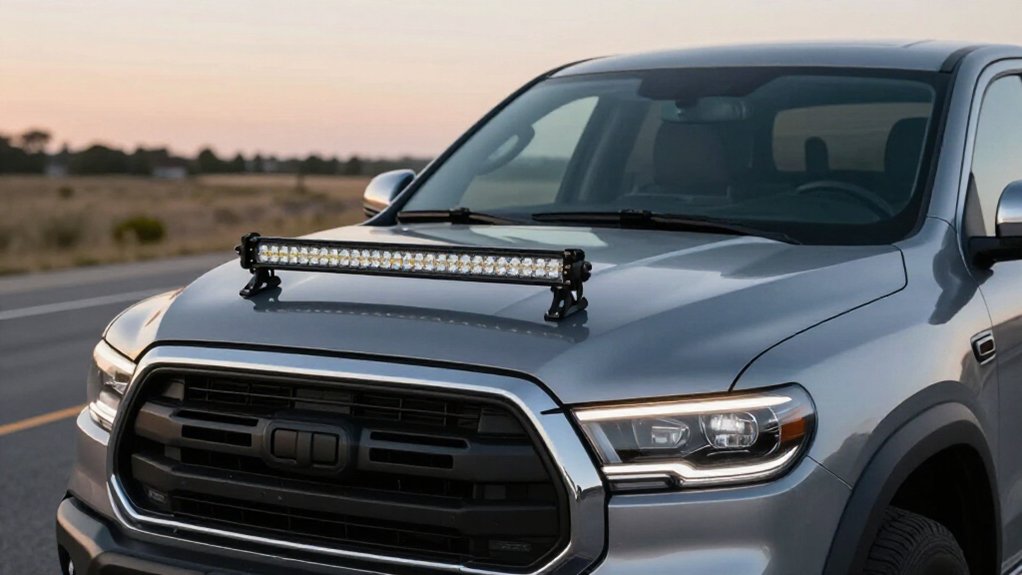
You can mount a light bar at the vehicle’s front, horizontally and symmetrically around its centreline, but ADR 13/00 doesn’t override local rules.
Keep it clear of the number plate, and aim it to prevent glare.
In Western Australia, lamps can’t sit above the bonnet’s front edge; Queensland’s roof-mount example permits forward placement in the vehicle’s front half.
The bar must work with high beam and switch off when dipped.
The following checks clarify other local requirements.
Australian Lightbar Placement Laws
Australian lightbar placement laws depend on both national design rules and state or territory enforcement. ADR 13/00 was amended to permit auxiliary lightbars on the vehicle’s front, positioned symmetrically about its centreline. That national allowance doesn’t guarantee compliance with local requirements, so check the rules that apply where you register and use your vehicle.
In Victoria, fit driving lamps or lightbars symmetrically in pairs where possible; otherwise, keep them symmetrical about the centre. They must operate only with high beam and switch off when it does. In Western Australia, mount them no higher than the bonnet’s front edge, horizontally and symmetrically about the vehicle’s longitudinal centreline. They may operate only with high beam; include manual deactivation to prevent use without high beam.
Beam Angle and Glare
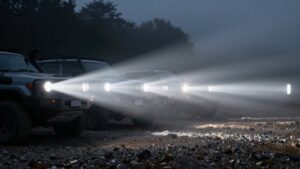
Mounting height and symmetry don’t guarantee compliance: aim the lightbar so its beam doesn’t dazzle other road users, directly or through reflections.
Choose a beam pattern that suits your driving needs. A narrow spot concentrates light farther ahead; a wide flood illuminates nearby areas but can send more stray light upward if you aim it too high. After installation, adjust the bar on level ground and check the beam on a suitable surface.
Keep its strongest part low enough that it won’t reflect into oncoming drivers’ eyes. Don’t assume a compliant mounting height makes the setup safe: the lens and reflector can still direct light toward traffic. Check your state’s operating conditions. If the bar may be used on-road only with main beam, switch it off with low beam; using it then can create glare and make your vehicle unsafe, and expose you to enforcement action.
Queensland Roof-Mount Example
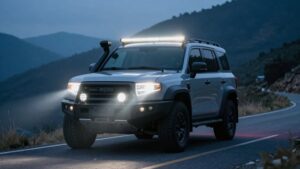
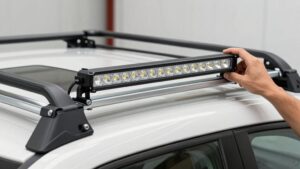
In Queensland, you may be able to mount a front-facing driving lightbar above the roofline, provided it sits in the vehicle’s front half, not at the rear or tail-end.
Use the factory front-most point—such as a standard bull bar or bumper—as your reference when judging the vehicle’s front section. A roof-rack position can qualify if it remains clearly within that half and aligns symmetrically with the vehicle’s centreline. You must also control glare: aim the beam so it doesn’t dazzle other road users or cause driver discomfort through reflections.
| Check | Placement |
|---|---|
| Front reference | Factory front-most point |
| Roof position | Front half only |
| Rear placement | Not permitted |
| Alignment | Centreline symmetry |
Confirm your roof-mounted lightbar’s placement against current Queensland requirements before you use it on-road.
Auxiliary Lamp Pairing Rules
You should mount auxiliary lamps in pairs, with matching positions mirrored across your vehicle’s centre line; rules vary by state.
Check your state’s limits on lamp numbers and pairing before installation. In WA, you must link auxiliary lights to high beam and provide a manual switch to turn them off.
Pairing Requirements
Although a single light bar may count as one lamp, many Australian jurisdictions require auxiliary driving lamps to sit symmetrically about the vehicle’s centreline.
If you fit multiple lamps, treat them as left/right matching sets. If you choose a single bar or an uneven number, check your state guidance: symmetry may still apply, and additional lamps must preserve left/right balance. Victoria requires pairs as far as possible; otherwise, lamps must remain symmetrical about the centre.
| Aspect | Requirement | Check |
|---|---|---|
| Pairing | Left/right symmetry | Maintain balance |
| Single/odd | State guidance may require symmetry | Verify arrangement |
| Orientation | Forward-facing; match height and orientation | Don’t count only lamps |
| Switching | High beam on; automatic shutoff | Check wiring |
Confirm local rules before driving; compliant placement also requires correct high-beam switching and automatic shutoff when high beam ends.
Matching Lamp Positions
For auxiliary driving lamps, including light bars counted as driving lamps, some jurisdictions require front-mounted lights to form a left-right pair, mirrored about the vehicle’s centreline. In jurisdictions with symmetry rules, place each lamp on the vehicle’s front and mirror its position across that centreline. If you install an uneven number, such as three, keep the full arrangement centred and symmetrical; don’t shift the lamps to one side.
Count every qualifying forward driving lamp you add, including each light bar, against your jurisdiction’s permitted total. Victoria, for example, calls for symmetric pairs as far as possible and limits driving lamps to four in addition to main-beam headlamps. Check placement and counting rules before mounting; a total doesn’t excuse asymmetric positioning, and symmetry doesn’t override a maximum.
High Beam Integration
Wire auxiliary driving lamps, including light bars, to operate only with high beam; they must switch off automatically when you dip the headlights.
In Victoria, mount lamps symmetrically, preferably in pairs. If you fit one or three, position them symmetrically about your vehicle’s centreline.
In Western Australia, install bars horizontally and symmetrically about the longitudinal centreline, no higher than the bonnet’s front edge. Include a deactivation control; the bars can’t operate independently of high beam or remain on when it’s off.
In South Australia, ensure your lights don’t obstruct your view of the road or dazzle other road users. Correct high-beam switching and careful aiming help meet that requirement.
Check applicable rules; compliant wiring doesn’t excuse incorrect placement, alignment, or use.
Number Plate Visibility and Obstruction
Keep your number plate fully visible to other road users, and don’t let the light bar, bracket, or wiring obstruct the plate or its lamp. Check clearance through suspension movement, and ensure the bar’s casing or beam doesn’t make the plate harder to read, day or night.
Confirm your local visibility rules, including any requirements that apply when the bar is engaged.
Keep Plates Visible
When you mount a front light bar, make sure it doesn’t block or materially obscure your number plate from the normal approach angle. Position the bar low enough and aim its beam so neither the housing nor stray light interferes with plate illumination where fitted or makes characters difficult to read. After fitting, inspect the plate from the normal approach angle, then check it at night from several distances.
Confirm that it remains clearly legible and that glare from the light bar doesn’t wash out its characters. If your arrangement forces the bar above or close to the plate line, reassess its position or choose plate-compatible trim that preserves clear visibility. Check visibility after any adjustment, not only during installation, with lamps fully operating.
Avoid Obstructing Number Plates
Beyond keeping the plate visible in normal conditions, you must verify the light bar doesn’t cover or obscure it when switched on. Mount the bar and its brackets clear of the number plate, including on a bull bar, grille guard, or roof rack. The plate must remain readable from the road at a normal driving distance and viewing angle.
Aim the beam so it doesn’t wash out the digits, and prevent direct or reflected light from creating glare on the plate. Account for suspension movement and front-end dip; components that clear the plate while parked may block it in motion. After installation, stand in front of your vehicle and inspect the plate in daylight and at night with the bar operating.
If the bar, its mounting hardware, or its light obscures or reduces legibility, reposition it before driving. Repeat the check after any adjustment or repair.
Check Local Visibility Rules
Check local visibility rules to make sure your light bar doesn’t obstruct the number plate or the driver’s view of the road immediately ahead.
Keep the plate fully visible to other road users, with clearance. Aim the bar so its beam won’t bounce off the bull bar or bonnet edge into your eyes. Reflected light can trigger legality concerns, as can glare that dazzles oncoming drivers.
Don’t angle the unit upward toward mirrors, the windscreen, or the plate area; lighting rules may restrict reflection and glare. Mount it clear of your sightline, including the roadway in front of your vehicle. Recheck height and placement after installation with the vehicle loaded and its suspension compressed. If loading or compression changes visibility or causes obstruction, adjust the mount before driving.
Bull-Bar Mounting Examples
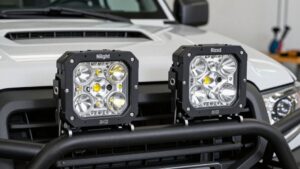
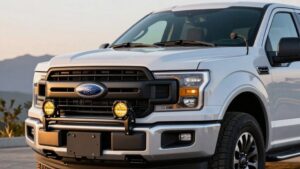
A bull-bar mount places the light bar at the vehicle’s foremost point, which is often the clearest fit for ADR 13-based rules that refer to the “front of the vehicle.” Mount it horizontally and symmetrically around the vehicle’s centreline, no higher than the bonnet’s front edge, to align with WA-style requirements.
For Victoria, wire it to operate only with high beam and switch off automatically when you turn high beam off. Aim it to limit glare and reflections that could discomfort you or other road users.
Victoria allows up to four driving lamps, including the LED bar, in addition to main-beam headlamps. Check placement, switching and beam direction against local rules in your state before you drive; a secure mount alone doesn’t establish compliance.
ADR Compliance and Certification
Although ADR compliance is essential, it doesn’t by itself make a light bar legal in every Australian state or territory.
ADR 13/00 governs forward driving lights and permits light bars mounted at the vehicle’s front, symmetrically about its centre. The amendment sets no explicit minimum light-bar width or height, but that doesn’t settle every placement question. Check your state’s rules and regulator guidance before installation.
In Victoria, VicRoads expects symmetrical positioning and operation only with main beam. Western Australia requires lamps to sit no higher than the bonnet’s front edge, operate only with main beam, and switch off automatically when main beam ends. Choose a model marketed as certified or approved for road use, then verify that its certification applies to your specific fitment.
Lightbar Cover Requirements
An approved light bar may still need an appropriate cover for road use. In Australia, prevent its beam from reaching and dazzling other road users whenever the bar isn’t permitted to operate.
A dimming cover may not suffice; use one that blocks effective beam projection. Where your rules permit the bar only with high-beam headlamps, cover it whenever it could otherwise operate without high beam.
- Check whether your light bar needs a cover, switching control, or both.
- Choose an opaque cover if the applicable requirement specifies one.
- Ensure the cover blocks the beam rather than simply reducing brightness.
- Keep the bar covered or switched off in prohibited operating modes.
Match the cover’s type and use to the wording that applies; requirements can differ.
Check State Transport Guidance
Where can you mount a light bar legally? Check your state transport authority before choosing a position; rules differ. Don’t assume another state’s approval applies.
In Western Australia, the light bar must sit no higher than the bonnet’s front edge, and you must place lights horizontally and symmetrically around the vehicle’s longitudinal centre line. In Victoria, wire auxiliary driving lights to operate only with main beam and switch off automatically when main beam ends. Install them symmetrically, especially as a pair.
South Australia permits forward-facing bars only if they don’t obstruct your view or dazzle, or discomfort other road users, directly or by reflection.
Also confirm any lamp-count limit. Victoria, for example, caps driving lamps at four, excluding main-beam headlamps. Verify guidance before installation.
Conclusion
Mount your light bar only where your state or territory permits, and check the rules for height, placement, beam angle, lamp pairing and covers. Keep your number plate visible, avoid glare, and use compliant equipment with any required certification.
A bull bar or roof mount isn’t automatically legal. Before you install or drive, confirm the current transport guidance for your jurisdiction; if the rules are unclear, seek advice from the relevant authority. Your vehicle must meet applicable requirements.