H10 vs H11 Fog Light Bulb: Fitment, Wattage and Which to Buy
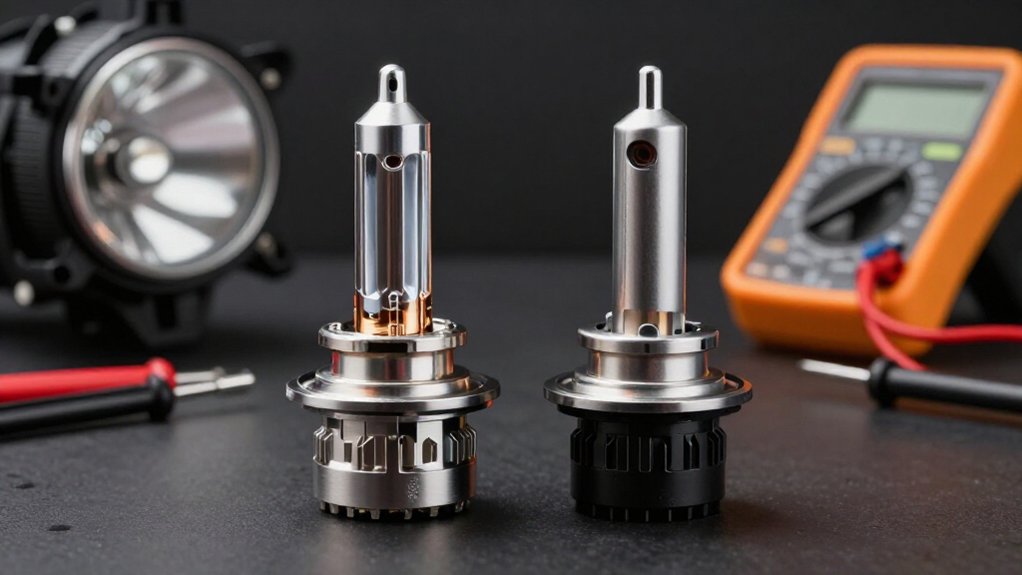
H10 and H11 fog bulbs may share a similar two-pin connector, but their bases, indexing, and locking tabs can differ, so don’t assume they’re interchangeable. Check your owner’s manual, lamp marking, and bulb part number before buying.
Match the specified wattage; H11 commonly draws 55W, while H10’s rating varies by application.
Install only if the bulb seats squarely and locks without force. Correct fitment preserves connection reliability and beam pattern.
More details follow on sealing.
H10/H11 Connector Differences
Although H10 and H11 fog bulbs use a similar two-pin connector inside an oval housing, their indexing and locking-tab positions can differ, so a bulb that looks compatible may not seat securely.
| Check | H10 | H11 |
|---|---|---|
| Base mark | Confirm H10 | Confirm H11 |
| Prong indexing | May differ | May differ |
| Secure fit | Verify socket | Verify socket |
Both use a two-prong interface with narrow-set contacts inside oval plastic casing. That resemblance can mislead you. But connector appearance alone can’t confirm fit.
Check the bulb base markings, or remove the bulb and inspect its indexing and locking tabs. Before you buy, match the part to your exact vehicle socket and fog light housing. Don’t force a bulb that won’t lock; a loose connection can leave the lamp unsecured and misaligned.
Bulb Wattage and Heat Output
Once you’ve confirmed the connector fits, check the wattage specified for your fog-light housing: H10 and H11 halogens can draw different amounts of power, and H11 is commonly rated at 55W.
An H10 is often listed as a 12V single-filament fog bulb, but don’t assume its wattage matches H11. Higher wattage increases electrical draw and filament heat, which can shorten bulb life in frequent use.
A bulb above your housing’s rating may stress the housing and overheat wiring or connectors designed for a lower load. Check your vehicle manual or lamp specification, then choose the approved wattage; don’t treat H10 and H11 as interchangeable. For LED replacements, halogen wattage won’t predict heat or brightness. Verify fitment and voltage, and assess LED output carefully.
Fog Beam Pattern Differences
On the road, a fog lamp’s reflector shapes a low, wide beam to illuminate nearby pavement without projecting like a headlamp. That controlled, flatter spread helps you see road edges through mist while limiting stray light. H10 and H11 can differ in filament position and reference design.
In a compatible housing, this can shift the hotspot or beam width; output can also alter perceived coverage. Halogen H11 commonly uses 55 watts and produces about 1,350 lumens; H10 output varies by variant. A mismatched bulb geometry may create a high cutoff or off-center hotspot, reducing pavement illumination and increasing glare.
Check your lamp marking or owner’s manual; choose the specified bulb, not one based on connector shape alone, to keep your intended fog pattern consistent on road.
Twist-Lock Socket Alignment
Even with the correct beam pattern, an H10/H11 fog bulb must match the socket’s twist-lock keying. Check the molded markings on both parts before installation; similar shapes don’t guarantee compatible tabs and slots. With an H11-style bulb, place its two narrow prongs in the connector housing, then align the locking tabs with the socket’s matching detents.
If the socket expects H10 keying, an H11 bulb may enter but fail to rotate, lock, or sit squarely. A misaligned bulb can point off-axis and compromise visibility for you and other drivers. Seat the bulb fully and twist it until it stops in the locked position, not almost locked.
If compatibility remains uncertain, test-fit gently. Don’t force rotation; remove the bulb and verify the keying instead before driving.
OEM Fog Lamp Specifications
Your fog lamp’s OEM specification, not a bulb’s similar appearance, determines whether it uses H10 or H11. Your vehicle’s lamp design and reflector or beam pattern call for a specific bulb family, so don’t assume these types interchange. Check the marking on your current bulb’s base or consult your owner’s manual to confirm the specified type before buying a replacement.
For OEM halogen applications, H11 fog bulbs are typically rated 55W at 12V. Your replacement should match the fog lamp’s specified family, voltage, wattage, and beam role. H11 is generally a lower-wattage fog or secondary-beam choice than a high-beam bulb such as the 65W H9. Keep the OEM 12V rating and specified type: a similar connector doesn’t guarantee correct fitment or illumination. The wrong bulb can compromise the designed beam pattern and safe visibility.
Replacement Bulb Availability
Although H11 fog bulbs are generally easier to find in the aftermarket, availability doesn’t make them interchangeable with H10 bulbs.
Check your vehicle’s specified bulb family and read the marking on the removed bulb before ordering. H11 appears in many headlamps and some fog lamps, so mainstream retailers tend to stock more H11 replacements than H10. That broader selection doesn’t authorize a swap: the socket and connector must match the lamp’s requirement.
Confirm the replacement’s 12-volt rating and exact base/connector style, then verify its part number. Don’t rely on a listing title that calls a product “equivalent” or “compatible”; those labels apply only when the version has the correct base. For LED upgrades, choose a model explicitly designed for your required H10 or H11 fitment, since mounting compatibility can vary by family. If you can’t confirm fit, don’t install it until you verify the specification.
Water-Ingress Seal Integrity
After confirming the correct H10 or H11 fitment, check the bulb’s seal before installation: water protection depends on an intact, correctly seated o-ring and a base that locks evenly into the socket. For H8/H11/H9/H16-style halogen bulbs, the large rubber o-ring beneath the metal tabs forms part of the weather seal. Inspect it for cuts, flattening, or displacement; don’t install a bulb with a damaged or missing ring.
Align the locking tabs and turn the base until it seats evenly, with no visible gap. A slight gap can let water wick into the housing. When comparing H10 and H11 replacements, verify that the base and o-ring design match the socket; similar appearance doesn’t guarantee proper compression.
If you find condensation or a wet base after rain or washing, treat it as a seal problem. Replace the bulb, reseat an intact o-ring, and recheck for moisture before relying on the fog lamp for safe, dependable operation in wet conditions.
H10 vs H11 Beam Reach
Your fog lamp’s reflector and the bulb’s filament position shape its beam pattern and road coverage more than wattage alone. H10 and H11 aren’t interchangeable, so a poor fit can shorten or skew the beam.
Check the bulb number on your lamp and choose a matching replacement to preserve safe light placement.
Beam Pattern
How far a fog beam reaches depends more on the housing’s optics than on the bulb’s lumen rating. H11 fog lamps are designed for a wide pattern suited to close-range visibility. H10 uses different reflector or cutoff geometry, so its beam may reach farther or appear shorter in a housing. That difference reflects how each housing positions and focuses the filament, not a universal advantage in bulb reach.
A 55-watt H11 may produce more intensity than a 42-watt H10, affecting apparent throw, but wattage alone can’t predict the pattern. Even if both bulbs fit the socket, a swap can shift the cutoff or shorten the beam. Choose the bulb specified for your fog-lamp housing; filament placement preserves the pattern and helps prevent glare.
Road Coverage
Road coverage depends on both bulb output and how the fog-lamp reflector focuses it: an H11 halogen is commonly rated at 55 watts and about 1,350 lumens, but an H10 bulb won’t deliver the same reach in every housing.
Your housing determines where the filament sits relative to the reflector, so a similar connector doesn’t guarantee matching reach. If you install an H10 bulb in an H11 lamp, the light may land off-axis, reducing coverage and visibility.
H11’s 55-watt halogen output generally reaches farther than lower-wattage options, though reflector design controls the result. Check your bulb’s markings or part number and confirm your vehicle’s specification before buying. Don’t choose by socket shape alone; use the specified bulb to preserve aim and safe coverage on the road.
H10 vs H11 by Vehicle Make
Toyota and Lexus fog-lamp fitment can vary, as can Ford and Mazda, so don’t assume one make uses a single bulb type. Check your exact year and model in a reliable fitment chart, then confirm the H10 or H11 marking on the factory bulb or in your owner’s manual.
An exact match helps ensure proper seating, electrical load, and safe operation.
Toyota and Lexus Fitment
Before replacing a Toyota or Lexus fog-light bulb, verify whether your exact year and model calls for H10 or H11. H11 is more commonly specified for Toyota and Lexus fog lamps, typically as a 55W, 12V, single-filament bulb. H10 uses a different base and position variant, so don’t assume it interchanges with H11.
- Check your owner’s manual for the fog-lamp bulb type listed for your exact vehicle.
- Match that specification against the part number printed on the bulb base.
- Compare connector tabs and socket indexing; similar appearance doesn’t confirm correct fit.
- Buy only the specified type, and confirm the bulb seats and locks securely before restoring power.
A mismatched bulb may not seat or lock, creating an unreliable connection. Before driving, test the lamps safely.
Ford and Mazda Fitment
Although Ford and Mazda fog-light fitment varies by year and trim, H10 and H11 aren’t interchangeable.
For either make, match the bulb marking and base shape specified for your lamp; don’t choose by appearance alone. Check the bulb’s part number or consult your owner’s manual, since applications can differ across trims. H11 halogen typically draws 55W, while H10 applications commonly use a different wattage.
Confirm the rating before buying to avoid under- or over-driving the lamp.
If your housing takes H11, an H10 may not lock in because socket and pin alignment differ. Use the exact listed type to maintain fit and operation. For an LED or HID upgrade, keep the correct H10 or H11 base for your Ford or Mazda; output or color temperature doesn’t make the bases interchangeable.
Verify by Year and Model
Fitment depends on your vehicle’s year, make, model, and trim, so check the owner’s manual or the existing bulb marking to confirm whether the fog lamp takes H10 or H11. Don’t assume one type fits every make: many vehicles use H11 for fog lamps, while H10 appears on select models or trims.
- Use year/make/model lookup as a starting point, then confirm the fog-lamp position—not the headlamp listing.
- Read the bulb marking or part number; H10 and H11 tabs and connectors may differ, so don’t force a mismatch.
- Check specified wattage: H11 halogen draws 55W; use your vehicle’s required rating to protect its electrical system and beam performance.
- If listings conflict, compare socket shape and indexing with your bulb before buying or installing.
DOT-Compliant Bulb Selection
For a DOT-compliant replacement, match the bulb designation in your vehicle’s OEM listing exactly; H10 and H11 can differ in pin indexing and connector geometry.
Before buying, read the marking on your existing bulb’s base and compare it with the OEM specification. This confirms the required family and helps prevent a bulb that won’t seat securely.
H11 fog bulbs are typically 12V single-filament, 55W halogens; match those electrical ratings because another voltage or wattage can compromise fitment or compliance.
A DOT label alone doesn’t establish correct application. If you’re considering LED, verify the bulb is the specified family and seats correctly; higher claimed lumens don’t guarantee safe beam aim.
Don’t mix bulb types or applicable L-shape and T-shape variants. Their connector and application geometry must match exactly. Install the specified bulb pair, then check that lamps lock in place and aim properly. That helps preserve visibility and avoids glare.
Conclusion
Choose the bulb your vehicle’s owner’s manual or OEM parts catalog specifies; don’t assume an H10 and H11 interchange just because their connectors look similar. Match the socket, wattage, seal, and beam pattern, then verify the lamp’s DOT-compliant marking and aim.
If you’re unsure, check the VIN-specific fitment or compare the removed bulb. Correct fit protects wiring and lens, preserves fog-light performance, and helps you see and be seen without creating glare for other drivers.