Off-Road Light Color Temperature Guide: 3000K vs 5000K vs 6500K
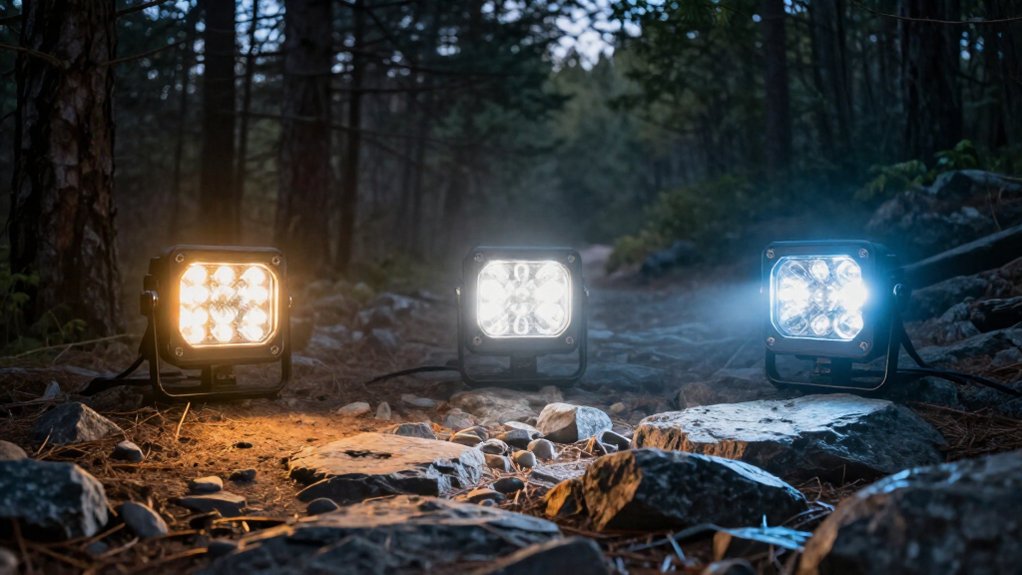
Choose 3000K for rain or snow, 5000K for mixed trails, and 6500K only when cooler white suits your needs and conditions are clear. Kelvin describes color, not brightness or reach; lumens measure output.
In fog, dust, or wet conditions, warmer light can reduce distracting reflections, but beam control matters most. Use a controlled pattern, compatible optics, and careful aim to keep light on the trail.
More guidance follows for safer setup choices and maintenance, too.
3000K, 5000K, and 6500K
Choosing between 3000K, 5000K, and 6500K comes down to conditions and comfort, not brightness alone.
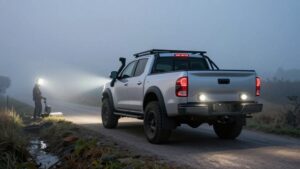
At 3000K, you get warm yellow light that can reduce harsh reflections and glare in fog, rain, snow, or dust. Choose it when visibility is degraded and reflected light could obscure hazards.
With 5000K, you get neutral, clean white illumination that feels natural and comfortable for routine off-road driving while preserving clear perception. It’s a balanced starting point.
At 6500K, you get cooler, blue-leaning white light for a crisp, high-contrast appearance, but control the beam carefully to limit glare for you and other drivers. Don’t assume a higher color temperature reaches farther: usable illumination depends more on beam pattern, aim, and optical design. Set your lights correctly before driving.
Trail Conditions Comparison
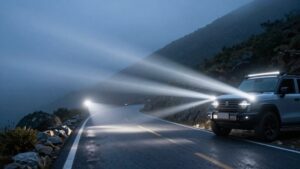
Trail conditions should guide your color-temperature choice: 3000K-5000K generally maintains more usable contrast in fog, dust, rain, and snow, while 6500K can intensify glare and reflections on wet or misty trails. Choose by exposure, then aim beams carefully; poor visibility makes controlled placement essential for spotting hazards without washing out detail.
| Conditions | Recommended temperature |
|---|---|
| Fog/dust | 3000K-5000K |
| Rain/snow | 3000K |
| Mixed trails | 5000K |
On reflective wet ground, 4300K-5000K, or 3000K when conditions worsen, often feels steadier than 6500K, whose cool tone can send more shine back toward you. Don’t treat color temperature as a substitute for safe speed: reduce pace, scan beyond the beam, and leave room to stop.
Reassess as weather and terrain change quickly; your best setting may shift during one ride.
Kelvin Versus Lumens
Kelvin describes an off-road light’s color appearance, not its output: 3000K looks warm, 5000K neutral, and 6500K cool, while lumens measure total light. Two lamps with the same Kelvin rating can produce very different amounts of light, so don’t use color temperature to estimate brightness. A 6500K lamp may look brighter in photos because its blue-white hue stands out, but that appearance doesn’t prove it delivers more lumens or reaches farther.
Choose Kelvin to get the hue you prefer, then compare lumen ratings to assess total output. For safer nighttime driving, check that the lamp provides enough usable light for your terrain rather than relying on a cool-looking color. Keep color and output separate when comparing options; neither rating can substitute for the other.
Beam Pattern and Lens Compatibility
Your lens’s cutoff, hotspot width, and aim determine beam reach more than color temperature, so match the pattern to your terrain and driving speed. Choose a low, controlled beam for fog or low mounting, and a focused spot or driving lens to limit spill; color may affect perceived contrast, but it can’t correct poor optics.
When you change Kelvin ratings, keep the optical assembly and bulb fitment compatible, then check alignment to prevent glare and scattered light.
Beam Shape and Reach
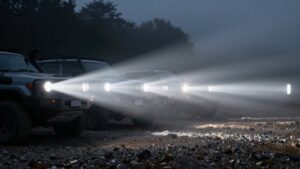
Beam pattern, not color temperature, primarily determines how far your off-road lights reach. With the same reflector and lens design, 3000K, 5000K, and 6500K can deliver similar distance. For long reach, choose a true driving-light pattern with a controlled hotspot and tighter upper sidelobes. A spot optic concentrates output; a flood lens spreads it across a wider area.
Check lens compatibility with your housing; you’ll aim each lamp correctly. An unsuitable optic or misaligned mount can widen the beam and increase spill, cutting useful road reach. Excess upward light can create glare and weaken your view ahead, so prioritize cutoff and side-lobe control.
Compare beams on the ground at distance: measure hotspot diameter and lux or foot-candle coverage rather than judging color temperature alone.
Lens Color Effects
Beyond beam shape and reach, lens color and finish affect how much of the light’s spectrum reaches the trail. A clear, smoked, amber, or tinted lens filters the lamp’s spectrum: it can make 3000K appear warmer and 6500K bluer. The reflector, optics, and cutoff geometry primarily set your beam pattern, but lens material can soften edges, lower peak intensity, and add stray light.
Match the lens to your spot, flood, or combo light. A mismatched lens can widen your beam or reduce throw. Tint may reduce glare, but it can dim perceived brightness and shorten reach without changing Kelvin. Check lane coverage, not color alone. Choose Kelvin and lens together for a controlled, low-glare hotspot with minimal backscatter; tint or diffusion may help or worsen haze in dust or fog in your actual conditions.
Pattern and Terrain
Even at the right Kelvin, a light can perform poorly if its beam pattern doesn’t suit the terrain. Choose optics for the route: tight spots help you see trees, rocks, and long straight trails, while wide floods illuminate uneven ground.
A narrow hotspot can extend reach, but a poor cutoff or weak glare control may send light into your eyes or other drivers’. At 6500K, light may appear brighter, yet inadequate baffling can increase perceived glare. For broad driving or flood beams, 3000K can feel easier on your eyes in dust and scattered light, reducing harsh contrast over ground. Check that the lens and reflector control the beam and keep it below your sightline. Aim lamps carefully; misalignment can cause glare and washout at any Kelvin.
Matching Lenses and LEDs
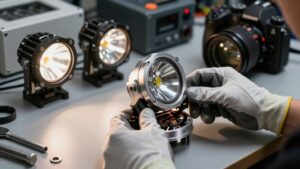
After choosing a beam pattern for the terrain, match the LED to optics designed to control it. Confirm that your LED package fits the lens type—projector, reflector, or spread—because optics shape beam width and hotspot more than 3000K, 5000K, or 6500K color temperature. A spot lens should deliver longer throw; a flood lens should widen coverage.
Don’t assume a 3000K fog-friendly LED guarantees a controlled cutoff: lens geometry also governs cutoff and lateral spill.
Use matched optics in your kit, especially when mixing temperatures. Different lenses can make a color appear brighter or hotter, even at similar lumen output. Verify the assembled beam delivers the intended pattern and controlled upward light; poor optics can reduce visibility in rain, fog, or dust, even with 5000K light.
Avoiding Glare and Scatter
To reduce glare and scatter, prioritize beam control over color temperature: a clean cutoff, a properly sized hotspot, and correct aim keep light on the trail and out of other drivers’ eyes.
A 3000K tone may seem less harsh in rain or fog, but poor aim or mismatched optics can still send reflected light back toward you and other drivers. Higher-Kelvin 6500K output can look more intense, so you’ll need especially accurate aiming and focal alignment to limit visible glare. Match the LED’s optics to your fixture and lens design: reflector, projector, or cover, because incompatibility creates stray light and scatter. Before choosing a color, inspect illumination on the trail and confirm a sharp cutoff with minimal light above the horizon. Re-aim or change components if spill persists, then verify the setup meets local requirements. Proper beam control protects visibility without sacrificing useful distance or provoking glare complaints. Keep lamps level and clean before each trip.
Matching Lights to Vehicle Paint Colors
Your vehicle’s paint color can influence how off-road lights look, but beam performance should remain your priority. 3000K adds a softer appearance to white, silver, and dark matte finishes; 5000K suits most colors and preserves paint’s natural appearance; 6500K stands out on black, dark gray, and deep colors but can look harsh against warm or sandy tones.
Choose 3000K when you want a softer visual effect around reflective rock or dust. For a balanced trail setup, 5000K typically keeps your paint’s color perception more natural while maintaining an OEM-adjacent look across varied finishes.
Reserve 6500K for deep paint if its cool contrast suits your build. When you combine temperatures, match them consistently across each light set; mismatched output can make body panels appear uneven. Treat appearance as secondary to beam pattern, mounting, and usable trail visibility.
Glare Risks on Public Roads
On public roads, glare risk depends more on beam control and aim than color temperature alone.
Your choice of 3000K, 5000K, or 6500K doesn’t determine usable brightness or guarantee comfort for oncoming drivers. Cutoff, hotspot size, and alignment control where light lands. A poorly aimed 3000K lamp can still shine directly into traffic, despite its warmer tone and reduced short-wavelength blue glare.
6500K’s cooler, blue-white beam may look brighter and draw more complaints when optics or aim aren’t tightly controlled. A neutral-looking 5000K beam may feel less harsh than many 6500K setups, but Kelvin can’t replace safe installation. Choose a road-legal pattern, set height and aim to specifications, and check the cutoff on level ground.
A properly controlled 5000K or 6500K beam reduces stray light toward traffic more effectively than a poorly cut off lower-Kelvin lamp. Check rules before using auxiliary lights.
Overlanding Camp-Site Lighting
At an overlanding campsite, match light color to the task: 3000K creates a softer feel around tents and the fire, while 5000K gives you natural-looking light for maps, gear, and footing.
Use 3000K lanterns for ambient camp areas; its warm tone feels less harsh. Choose 5000K for task lights so you can identify equipment, read maps, and spot uneven ground at setup.
Reserve 6500K for brief jobs that benefit from daylight-like perception, such as loading gear. It can feel less cozy and glare off wet ground, tents, or vehicle panels.
Whatever color you select, aim beams down and away from other campers, and use the lowest brightness that’s adequate for safe work. Color shapes comfort; beam control limits spill into eyes and the night sky.
Preventing Lens Condensation
Color temperature can affect lens condensation slightly, but sealing and moisture control matter more. If fogging recurs, choose 3000K: its operation may reduce heat-to-lens gradients as the LED and driver cool faster than the lens. But Kelvin alone won’t stop humid air from condensing inside after shutdown.
- Check the housing seal; torque O-rings, gaskets, and lens retention screws to specification.
- Confirm the unit’s desiccant or pressure-equalization vent works, and keep airflow clearance around its heat sink and driver.
- Select lights with anti-condensation coating and thermal management; after wet use, avoid abrupt cooling and keep the lamp powered while cooling only if its duty cycle allows it.
Temperature swings can obscure your beam, reducing trail visibility. Don’t defeat a seal or exceed manufacturer limits to manage fogging.
Post-Trip Lens Cleaning Routine
After each off-road trip, let the lenses cool, then remove dust and grit with a soft microfiber cloth or lens-safe blower before applying any cleaner. This prevents scratches to the coating. Rinse with clean water if needed, then use gentle automotive lens cleaner or 70% isopropyl solution on microfiber. Avoid harsh solvents; they can haze optics.
- If mud or bug splatter is caked on, soak it briefly with lens-safe cleaner; don’t scrub dry. Remove debris layer by layer with light pressure.
- Dry with a second clean microfiber, then inspect from several angles for streaks. Residue can reduce output and increase glare on later night runs.
- Finish with a beam check. Confirm cutoff and aim remain unchanged, and ensure the lens is clear for visibility in dust, rain, or fog ahead.
Conclusion
Choose your off-road light color temperature based on terrain, weather, and how you’ll use the vehicle. A 3000K beam can improve contrast in dust or fog, while 5000K offers a balanced, neutral view; 6500K may look bright but can increase glare and eye fatigue.
Match beam pattern and lens compatibility, and don’t judge output by Kelvin alone—check lumens and usable coverage. Aim lights responsibly on public roads, keep lenses clean and dry, and test your setup before remote trips.