SAE J845 Class 1 Vs Class 2 Warning Lights: Visibility Ratings Compared
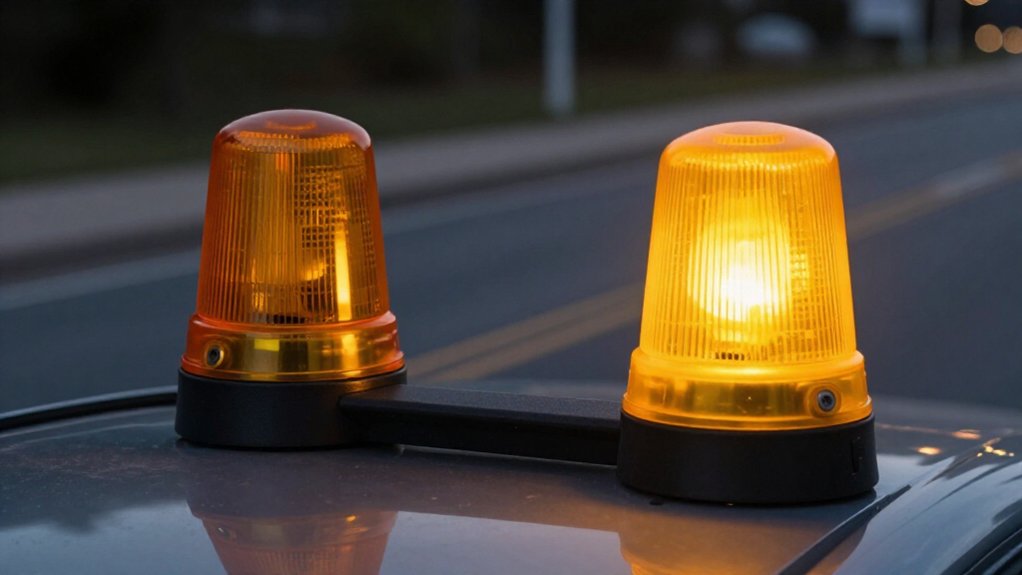
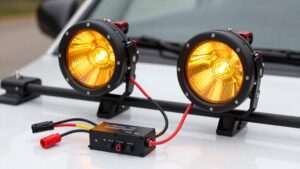
SAE J845 Class 1 warning lights deliver at least 8,100 peak candela, while Class 2 units range from 1,981 to 8,099 cd. That directional intensity, not lumens, sets the visibility class.
Both classes must flash omnidirectionally at 60–240 flashes per minute (1–4 Hz) to meet requirements. Class 1 can improve detection in fog, rain, snow, and daylight, but mounting, thermal output, and flash pattern also affect visibility. Further comparison clarifies these factors.
Candela Thresholds by Class
Candela thresholds define each SAE J845 class: Class 1 requires at least 8,100 peak candela, Class 2 spans 1,981, 8,099, and Class 3 falls below 1,980. Your ratings depend on peak candela measured in the specified direction, not total lumens. This distinction keeps class comparisons tied to intensity.
Class 1’s threshold provides roughly four times Class 2’s intensity and about ten times Class 3’s. Choose Class 1 when you need the longest detection distance and daytime visibility. Class 2 suits settings where high-speed demands are less severe, while Class 3 fits lower-speed or indoor and low-sunlight use when extreme visibility isn’t required. These thresholds give you a way to compare options.
| Class | Peak candela |
|---|---|
| Class 1 | 8,100+ |
| Class 2 | 1,981–8,099 |
| Class 3 | Below 1,980 |
J845 Flashing Requirements
Intensity is only part of SAE J845 compliance: an omnidirectional warning light must also flash at 60–240 times per minute (1–4 Hz), regardless of its mounting orientation. That rate window governs the pulse timing of a 360-degree light, whether you mount it upright, sideways, or elsewhere around the vehicle.
SAE J845 links this behavior with the class-based peak-candela threshold, so you can’t assess compliance from intensity alone. Your selected unit must satisfy both the applicable intensity requirement and the 1–4 Hz flash-rate limit. The band sets acceptable modulation timing while producing attention-getting pulses for roadside hazards.
If the system flashes faster than about 4 Hz or slower than about 1 Hz, it falls outside the specified range and risks non-compliance. Verify the measured flash rate against J845; don’t assume a bright output compensates for a pulse rate beyond the standard’s limits during your conformity review before you approve the warning-light installation.
Light Output in Low Visibility
In rain, fog, or snow, a higher SAE J845 peak-candela rating can help you detect a warning light at greater distances: Class 1 requires at least 8,100 cd, while Class 2 covers 1,981 to 8,099 cd. When backgrounds are obscured by smoke, fog, or rain, higher luminous intensity can keep the signal distinguishable.
Use SAE-aligned flash rates around 1–4 Hz (60–240 flashes per minute) to support attention in degraded conditions. A display with about two to four lights may improve roadside detection in darkness, but adding sources doesn’t guarantee better performance. Keep the flash pattern coordinated; complex or poorly matched strategies may add no safety benefit.
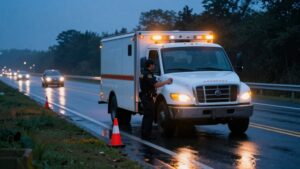
At nighttime scenes, especially on wet reflective surfaces, high output can create glare and reduce nearby personnel visibility. Verify output and flash performance under the conditions in which crews will use the warning system safely.
Daylight Visibility Distance
For long-range daytime warning, SAE J845 Class 1 lights must reach a peak intensity of at least 8,100 cd, supporting detection at standoff distances often cited as 500 feet or more. That threshold isn’t a guaranteed viewing distance; it describes the directional intensity class intended to improve detection in bright daylight.
Class 1 is about four times as intense at peak as Class 2, whose range is roughly 1,981–8,099 cd. This difference can raise the chance that oncoming drivers perceive your vehicle promptly, while Class 2 better fits moderate-speed alerts and shorter-range needs.
Compare candela rather than lumens: high total output alone doesn’t establish daylight reach; peak directional intensity determines the J845 class. Also verify SAE operation at 1–4 Hz (60–240 flashes per minute).
Mounting Location Considerations
Mounting location affects whether a warning light’s installation matches its claimed SAE J595 directional or SAE J845 omnidirectional performance, because aim and placement shape the coverage. You should position directional lights so their beams address an approach, while omnidirectional units need unobstructed coverage. Mounting height matters: placing lights above a driver’s eye line can improve long-range visibility against the nighttime background; low placement may shorten detection time.
At roadside scenes, assess near-field glare before choosing locations. Excessive brightness can hinder drivers and personnel from seeing someone close to the vehicle. Multiple lights, often two to four per display, may improve detection, but adding units can increase discomfort glare.
Your mounting points constrain the layout. Prioritize configurations that preserve personnel visibility, including arrangements that perform better behind the vehicle at night. Verify aim and position against the claimed standard; a rating alone can’t establish field coverage.
Replacement Parts and Warranty
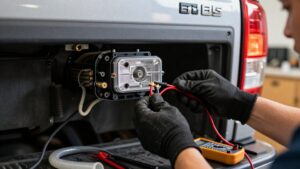
When replacing a failed strobe, choose a unit documented to maintain the original SAE J845 class and peak candela rating; the class is based on peak candela, not lumens.
Verify its label or documentation identifies the specified Class 1 or Class 2 and confirms flash-rate compliance within approximately 60–240 flashes per minute or 1–4 hertz. Replacing a Class 1 unit (at least 8,100 cd) with Class 2 (1,981–8,099 cd) can reduce daylight and long-range conspicuity, increasing roadside liability exposure.
Keep purchase records showing the part’s SAE specification and installation date; a mismatch may void warranty coverage. After installation, inspect and test peak output, flash rate, and pattern against the certified unit. Retain results with records to support compliance assessments during incident and insurance reviews.
Thermal Derating Under Heat
Even a correctly specified replacement may lose intensity during sustained operation: as LEDs and drivers heat up, the controller can reduce current, lowering peak candela and potentially pushing a Class 1 light below its 8,100 cd threshold.
Because J845 ratings use defined test conditions, output may fall short of catalog candela in high ambient temperatures or where mounting restricts heat dissipation.
This matters especially for high-output Class 1 designs that draw current and for tow or roadside shifts when strobes run continuously. You should verify thermal performance over the duty cycle you expect rather than relying solely on a rating test. Adequate heatsinking, airflow, and a mount that doesn’t trap heat help limit derating and keep peak candela closer to its rated level during operation.
Color-Specific Visibility Differences
When you compare red and blue warning lights, treat color as a visibility modifier, not a substitute for SAE J845 intensity. Class 1’s peak output of at least 8,100 cd can help preserve detection distance in glare and adverse weather, while Class 2’s lower output may constrain color-related gains.
You’ll get a meaningful comparison only when both lights meet the applicable intensity and flash-rate requirements.
Red Light Visibility
Because SAE J845 classes are based on peak candela, a red Class 1 light generally supports longer-range detection than the same design at Class 2 intensity when aiming and flash conditions are comparable. Within SAE flash-rate limits, about 60–240 flashes per minute, you’ll typically gain greater detection distance with Class 1 during roadway hazard response.
Class 1’s higher peak candela can also help you preserve red recognition against competing contrast, including bright daytime backgrounds where red may be less distinct than amber. Keep aiming and flash settings within applicable requirements, and weigh increased intensity against glare to nearby pedestrians and workers.
Your selection should match the operating scene, not assume peak candela alone guarantees visibility; mounting geometry and exposure conditions still matter for drivers.
Blue Light Visibility
For blue warning strobes, perceived visibility depends on ambient light and background clutter, so a unit that attracts attention at night may stand out less in daylight. That color effect doesn’t change SAE J845’s rating method: class depends on peak candela, not lumens. You should compare the unit’s output with its class threshold; blue alone doesn’t establish Class 1 performance.
A Class 1 light provides 8,100 or more peak candela, while Class 2 may reduce long-distance detection in daylight or higher-speed use. Check flash rate: 1 to 4 Hz (60 to 240 flashes per minute) generally supports detection across colors. At night, intense blue output or multiple displays can increase glare and impair nearby personnel on foot. Verify the required rate and class against your operating conditions carefully.
Flash Pattern Compatibility
When you select compatible flash patterns for SAE J845 Class 1 or Class 2 lights, keep the rate within the standard’s approximately 60–240 flashes per minute. Choose patterns based on each light’s intensity and timing compliance; alternating flashes may improve detection, while added complexity offers no clear benefit.
Synchronize multiple lights so their combined pattern remains coordinated and standards-compliant.
Compatible Flash Patterns
To remain compatible with SAE J845, select a flash pattern that keeps the effective rate within roughly 60–240 flashes per minute (1–4 Hz); the standard classifies lights by peak candela, not pattern type. Check the cycle, including pauses, because pulse count can differ from effective frequency.
Don’t let rapid sequences exceed about 4 Hz. SAE J845 doesn’t prescribe a sequence, so assess timing separately from class rating. Research generally finds left/right alternating, or wig-wag, flashes easier to detect than simultaneous flashes.
Added complexity doesn’t necessarily improve detection; simpler patterns can perform as well. Limited evidence suggests dimming to about 90% of peak luminance between pulses may improve visibility over fully off flashes. Treat this as guidance, not a J845 requirement, and verify measured timing.
Class-Based Pattern Selection
Your flash pattern should remain compatible with the applicable SAE requirements while the light’s class sets its candela-based visibility level. Under SAE J595 directional and SAE J845 omnidirectional criteria, intensity and flashing behavior both matter, so don’t treat Class 1 or Class 2 as permission to use any mode.
Keep your selected pattern within the relevant limits, with timing generally around 1–4 Hz, or 60–240 flashes per minute. Within that range, a faster rate can attract attention more effectively than a slower one. If your approved light offers it, choose alternating left/right, or wig-wag, flashes; drivers generally detect them better than simultaneous flashes.
Added complexity or extra modulation doesn’t reliably improve detection. When comparing Class 1 and Class 2 at the same vehicle location, keep the same alternating-pattern goal and rate range. Rely on the higher-candela class—not added pattern complexity—for greater far-distance visibility.
Synchronization Across Lights
Although synchronization can make a warning system’s pattern easier to read, it doesn’t change each light’s SAE J845 class: Class 1 must produce at least 8,100 peak candela, while Class 2 covers 1,981–8,099 cd.
Check that every synchronized emitter stays within SAE’s typical 60–240 flashes per minute (about 1–4 Hz) window; synchronization can’t correct an out-of-range rate or a fixture that fails its class intensity threshold. For road-user detection, configure adjacent lights to alternate in a clean wig-wag sequence rather than flash simultaneously. More elaborate patterns haven’t shown added safety benefit, so keep timing repeatable.
If you use modulation, such as dimming to roughly 90% of peak instead of switching fully off, coordinate each fixture’s state and preserve regular intervals. Verify the combined pattern on the installed system, since compatible controllers must maintain the rate window and avoid irregular gaps. Confirm that each lamp retains its required peak-candela class independently of the shared flash pattern and modulation settings.
Tow-Truck Class Selection
For tow trucks operating on interstates, divided highways, or routes above about 55 mph, choose SAE J845 Class 1, which requires at least 8,100 cd peak intensity for greater long-distance visibility. Use Class 2, rated roughly 1,981, 8,099 cd, when your work stays at moderate speeds and lower visibility demands; it may not support daytime detection on faster roads.
Both classes must meet SAE flash-rate requirements, commonly about 60, 240 flashes per minute (1, 4 Hz), so check documentation for candela class and flash performance rather than trusting brightness claims. Specify peak candela, not lumens: candela measures directional intensity and determines the J845 class. Put the required class and rating in your purchase specification: Class 1 at 8,100+ cd or Class 2 at 1,981, 8,099 cd, to verify the intended standard.
Conclusion
Choose your warning light by matching its SAE J845 class to your operating conditions, required visibility, and mounting position. Class 2 can suit lower-risk applications, while Class 1 provides greater warning output where longer-range recognition matters. Confirm the light’s candela performance, color, flash pattern, and thermal behavior against the applicable requirements; don’t assume a higher class alone guarantees effective visibility.
For tow-truck use, verify the governing rules and select a compliant configuration that remains visible in expected conditions.