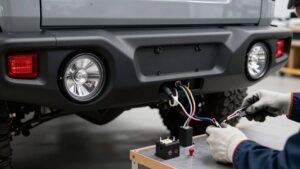
Can Reverse Lights Be on a Switch? Wiring Options and Legal Limits
Yes, you can add a switch for auxiliary reverse lights, but it mustn’t bypass the factory reverse interlock or let road-use lamps illuminate outside reverse.
Keep OEM lamps controlled by the transmission switch. For added lights, use a fused relay triggered by the reverse signal; any manual control should remain interlocked, with wiring isolated against backfeed.
Match the fuse and wire to the load, and check local vehicle codes and inspection rules; details below can guide you.
Factory Reverse-Circuit Rules
Even if you’re adding a manual control, the factory reverse-light feed should go live only when the transmission’s reverse signal is active—not simply when the ignition is on.
Your vehicle may use a transmission-mounted switch or park/neutral logic to trigger a dedicated conductor through its specified fuse and relay path. The OEM switch should control the lamps; don’t feed them directly from an added source. Factory circuits are usually polarity- and voltage-specific, commonly using a 12-volt feed switched at the reverse trigger.
Placing a modification in the wrong location can backfeed other circuits or defeat the interlock. If a BCM or ECU monitors the reverse input, changing it may set a fault or disable the lights. Preserve OEM connections, wire gauge, fuse rating, and grounding points; bypassed protection or loose grounds can overheat the branch. Check applicable rules before altering required lamps, and confirm the lights still operate only in reverse under all conditions.
Switch-Controlled Reverse-Light Wiring
To add manual control without defeating the factory reverse interlock, install a separate, normally-off switch in the positive feed that becomes live only when the vehicle is in reverse, typically at the transmission switch or reverse-light harness. Place the switch in-line with that feed, not on the ground side. If it must handle multiple lamps or higher current, use its input to trigger a relay; this keeps switch current low and supplies bulbs full battery voltage through fused wiring.
Fit an inline fuse near the source, sized for the circuit; typical lamp loads often use 10–15A, but verify load and wire rating. Confirm the switch can’t bypass reverse gear selection, which could leave lamps on outside reverse. Check local rules before modifying the circuit, and test operation with the vehicle secured.
Reverse-Light Use Cases
When a vehicle’s reverse signal is delayed, missing, or unreliable, a switched reverse-light circuit can help with short-range backing visibility, testing, or controlled demonstrations. You might use this indicator on a modified vehicle when a drivetrain swap leaves the factory reverse signal delayed or absent. During low-speed off-road maneuvers, you can signal a spotter without assuming the vehicle detects reverse reliably.
For towing or demonstrations, you can activate the lamps to confirm operation; installers may also check bulb function and polarity without shifting into reverse.
Treat the switch as a limited aid, not a substitute for the transmission-linked signal. When you move in reverse, the lamps must still operate predictably through the vehicle’s control. Check local rules before using an override, since colors, placement, and operation may be regulated. Use it only when surroundings are clear, and stop if illumination could confuse road users.
Auxiliary Light Wiring Options
You can use a dedicated manual switch, but make sure it can’t activate auxiliary reverse lights outside conditions permitted by local rules. A reverse-triggered relay lets the lights follow the gearbox signal while separate fused battery power carries their load.
Dual-control wiring can combine both methods, but configure it so the lights never operate in forward gear.
Dedicated Manual Switch
A dedicated manual switch can control auxiliary reverse lights, but wiring it to illuminate outside reverse gear may violate local road rules.
Wire the switch in the auxiliary feed, protected by an inline 5–10A fuse, so it controls only those added lamps. Before connecting, identify whether your vehicle switches the 12V positive side or ground; place the switch and wiring to suit that design. Don’t assume the factory circuit uses the same polarity as another vehicle.
| Your check | Why it matters |
|---|---|
| Fuse rating | Protects the added feed if a fault occurs. |
| Road rules | A manual override may count as auxiliary lighting outside reverse gear. |
Check your jurisdiction’s requirements before using the switch, and never let added lamps confuse or dazzle nearby drivers at night.
Reverse-Triggered Relay
For automatic operation without a manual override, use a reverse-triggered relay: its coil takes a signal from the reverse-light circuit, while its contacts switch fused power to the auxiliary lights. Connect the coil to the reverse-lamp positive or a fused reverse-output wire. Use a relay rated for the lights’ operating current and inrush.
Route load power through the relay contacts and a dedicated fuse, with wiring gauged for the light wattage. Secure the coil ground to a reliable chassis point, preferably using the factory ground rather than an unrelated lamp wire. Before connecting everything, use a multimeter to confirm the input shows voltage only when you engage reverse. Confirm they switch off otherwise. Follow local vehicle lighting rules; some jurisdictions may restrict auxiliary reverse lamps on public roads.
Dual-Control Wiring
When you want auxiliary reverse lights controlled from two locations, use an AUX circuit that preserves the reverse-gear signal. A common design routes the reverse-switch trigger through a control, then uses two SPST or SPDT switches to select whether the lamps operate. This keeps activation tied to reverse gear.
If you need independent operation, use a dedicated relay or inverter and a fused 12-volt supply. Have each switch control the relay coil, not carry bulb current.
Size wiring for the lamp load, and install the fuse close to the battery; switch contacts may not handle reverse-light amperage continuously.
Before connecting the system, check lighting rules. Some jurisdictions require reverse lamps to illuminate only in reverse.
Confirm a dual-control setup won’t create confusing or unlawful lighting behavior.
State Inspection Requirements
Check your state’s reverse-lamp inspection checklist: your lights generally must emit white light rearward and illuminate automatically in reverse.
Requirements vary by state, and some codes require the factory-controlled circuit. If your switch can activate the lamps outside reverse, an inspector may fail the vehicle, so keep the factory trigger intact and verify local rules.
Inspection Checklist
Your state’s inspection checklist may require reverse lights to illuminate only when the vehicle is in reverse and to comply with rules for rear-light visibility, aim, and labeling, ensuring.
Check your inspection items for auxiliary-light operation and wiring: the lamps should activate in reverse, with a properly fused feed, insulated conductors, and a secure ground. Shift out of reverse and confirm they switch off; they shouldn’t remain lit with the ignition on while the vehicle isn’t in reverse.
Inspect rear-facing output for visibility and correct aim, and ensure required labels remain legible. If you’ve added a switch or relay, bring its wiring diagram or installation records to the inspection. These checks help show that your modification preserves the intended reversing signal and meets the applicable safety criteria.
State Code Variations
Inspection rules for reverse lights vary by state, but many require them to work only when the transmission is in reverse.
State codes differ, so check your jurisdiction’s inspection standard before adding a switch. A manual control that lights lamps in any gear may fail for improper operation or confusing signals. Even where an add-on switch is permitted, inspectors may assess lamp brightness, aiming, and whether illumination remains limited to reversing. Use the factory reverse-signal input; any legal auxiliary control should work only while you’re in reverse and mustn’t override that logic.
| Inspection concern | What you should confirm |
|---|---|
| Activation | Reverse gear triggers lamps |
| Manual control | Cannot light lamps in other gears |
| Visibility | Brightness and aim meet rules |
| State rules | Verify local inspection standard |
Switch Compliance Checks
During a state inspection, the examiner may check whether a cabin switch bypasses the backup-switch or neutral-safety logic. They may test whether your reverse lamps illuminate only when the transmission is in reverse. A manual-only override that powers them in another gear can undermine the vehicle’s intended lighting function and draw a compliance finding.
If your switch directly feeds the lamps, inspectors may treat it as an alteration that bypasses the factory reverse signal. If the lamps activate outside reverse, your vehicle may fail for a lighting defect and require repair before passing. Requirements vary by state, so check your inspection rules and wiring diagrams before modifying the circuit.
For safer compliance, use an approved, interlocked control that retains the vehicle’s reverse-signal input. Don’t defeat backup-switch or neutral-safety logic; correct any noncompliant wiring before inspection.
Off-Road Work Lighting
Wire off-road work lights through a dedicated fused relay, so the dash switch triggers the relay instead of carrying the lights’ full current. Select a control for your setup. A pair may draw about 10–30 amps, depending on LED power, so match the fuse and wire gauge to the actual load.
Run proper 10–14 AWG wiring from the battery through the relay, and don’t send lamp current through a dash switch. Fit sealed, waterproof connectors, route cables clear of heat and moving parts, and ground each light directly to the chassis to limit voltage drop and flicker. Before using work lights on public roads, check local laws; restrictions on permitted lights, aiming, and color may apply even when off-road use is allowed.
Bulb Overheating Risks
Reverse-light bulbs can overheat if a faulty switch or relay keeps them powered after you’ve shifted out of reverse. Continuous operation can soften or warp reflectors and shorten filament or LED life. Halogen bulbs run hotter than LEDs, while excessive current or a poor ground can raise temperatures enough to damage bulbs and wiring insulation.
Fit bulbs with the specified wattage and voltage; mismatches can generate excess heat and cause thermal damage. Keep the bulb seated correctly, and clear dust or corrosion from its base and heat sink so heat can escape. Use heat-resistant wiring and terminals rated for under-vehicle conditions, where vibration and intermittent resistance can worsen heating. Check local rules before changing reverse-light equipment, and repair any fault to preserve compliant operation.
Backfeeding the Factory Circuit
When you power a load-side wire from the reverse-light switch, you can backfeed the factory circuit and energize components even when the original switch is off.
This bypasses intended isolation and may energize upstream components or other loads. Tying into the factory feed without blocking current can create return paths, causing dimming, flicker, blown fuses, or overheated connectors. If you need one trigger to operate multiple lamps, isolate the factory circuit with a diode arrangement or correctly configured relay.
- Use the factory reverse-light wire as a signal, not a lamp supply.
- Feed lamps from a separately fused source.
- Select isolation components rated for the circuit’s voltage and current.
- Keep fault current localized to protect factory wiring and connectors.
Follow component ratings and installation instructions.
Consult Your State’s Vehicle Code
Even a correctly isolated circuit may not be legal if a driver-controlled switch can turn on reverse lamps outside of reverse.
Check your state’s vehicle code for the section covering backup or reversing lamps. Many states require these lamps to activate only when the transmission is in reverse, so a manual switch could violate that rule. Some codes also require automatic operation and prohibit using lamps for signaling.
Before changing wiring, verify whether your state requires a direct connection to the reverse switch rather than an independent control. Don’t assume isolation makes a setup compliant. If the code isn’t clear, contact your local DMV or a state-certified inspector. Ask specifically whether your switch may energize reverse lamps while the transmission isn’t in reverse.
Conclusion
You can add a switch for auxiliary reverse-area lights, but don’t let it override factory reverse-light controls or create glare for other drivers. Use a fused, properly rated circuit and prevent power from feeding back into the vehicle’s factory wiring.
Before installation, check your state’s vehicle code and inspection rules; requirements can vary. If you’re unsure about wiring, placement, or legal use, ask a qualified technician. Keeping the setup compliant helps you avoid electrical damage and unsafe lighting.