Rechargeable LED Work Light Runtime Chart: Hours per Brightness Mode
Your rechargeable LED work light’s runtime depends on brightness, battery capacity, and conditions.
In testing, a LHOTSE light with a 1,200 mAh battery ran about 6 hours on Low and 4 hours on High; Medium runtime wasn’t specified, so don’t infer it.
Its advertised “up to 8 hours” is a marketing claim, not a measured result. Compare measured runtimes under consistent conditions, and treat them as planning benchmarks, not guarantees.
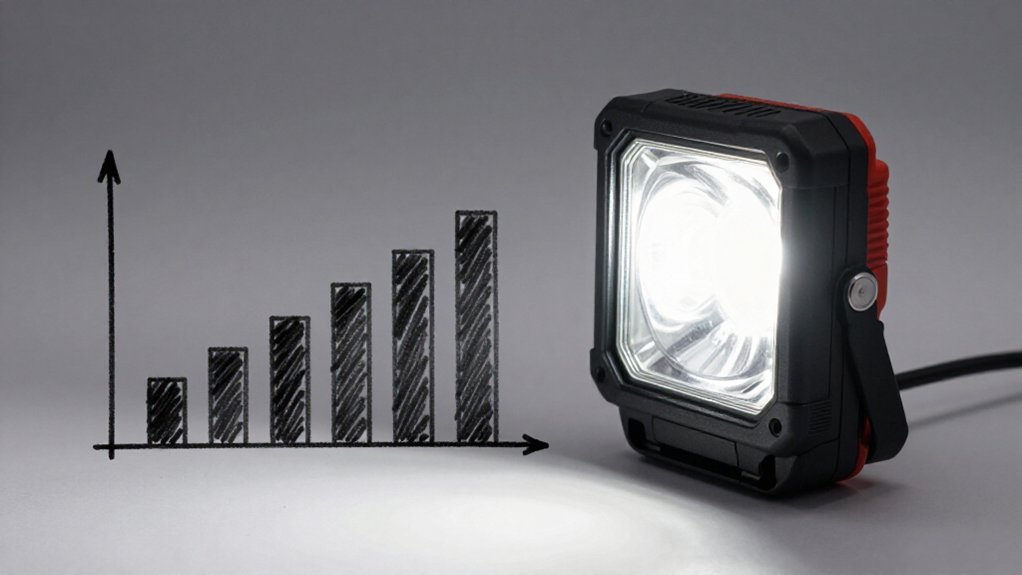
The chart below covers shift planning and factors that can shorten usable runtime.
Runtime by Brightness Mode
When you compare runtime by brightness mode, record how long each light runs on Low, Medium, and High, keeping warning and strobe modes separate from regular white-light output.
For useful comparisons, log each setting under consistent test conditions and report hours to shutdown or a defined dimming threshold. The tested LHOTSE runs about six hours on Low and four hours on High; its Medium runtime isn’t specified, so don’t infer or interpolate it.
Its five listed modes—High, Medium, Front Light, Red Warning, and Strobe Red—don’t all represent comparable white-light output. Include only measured High, Medium, and Low figures in the brightness comparison, and label task modes separately. Treat the advertised runtime of up to eight hours as a marketing claim, not a test result.
When planning your shift, choose the mode you’ll use most: High provides roughly four hours on this tested unit, so schedule charging or mode changes accordingly today.
Runtime by Battery Capacity
Battery capacity sets the energy available for each brightness mode: a 1200 mAh LHOTSE light runs about six hours on Low and four hours on High, while higher-capacity packs generally provide more runtime. Use this comparison to estimate your shift coverage; choose the mode you actually need.
| Capacity | Runtime guide |
|---|---|
| 1200 mAh | Low ~6 h; High ~4 h |
| Larger packs | Generally more hours |
For shift planning, match capacity to the brightness you need. High output consumes energy faster, so your 1200 mAh light gives fewer hours on High than on Low. Choose Low for roughly six hours of coverage or High for about four. Larger mAh packs generally extend runtime with greater mode flexibility.
Rated Versus Usable Capacity
Although LHOTSE advertises up to about eight hours of runtime, its tested usable runtime is roughly six hours on Low and four on High. That gap shows why you should distinguish advertised runtime from capacity you can use.
Runtime changes by brightness mode: higher lumen output draws more power and shortens battery time, while Low extends it. The DEWALT DCL077B is rated at 2,000 lumens, but output alone can’t tell you how many hours you’ll get; check its chart.
Treat hours per mode as the usable-capacity measure when you compare lights. Battery mAh describes charge, while “max runtime” is a claim; neither guarantees hours at your setting. Match the chart’s mode to your task and compare usable hours, not headline capacity, to estimate time.
Typical Runtime Benchmarks
You’ll typically get the longest runtime on low mode: one LHOTSE test measured about 6 hours, versus 4 hours on high. Record low-, medium-, and high-mode results separately, since brightness, battery capacity, and real-world conditions affect each measurement.
These benchmarks help you compare tested runtime with advertised “up to” claims and choose a mode that fits your work duration.
Low-Mode Runtime
For sustained work, low mode can extend battery life: the LHOTSE work light runs for about 6 hours in testing, compared with roughly 4 hours on high.
That six-hour benchmark gives you a starting point for planning inspection, equipment checks, or setup tasks where maximum output isn’t continuously necessary. Low mode reduces brightness demand, so you can keep the light operating longer between charges; actual runtime still depends on battery condition, temperature, and use.
For a full-shift estimate, compare the stated low-mode hours-per-mode figure across models rather than treating a marketing claim as a guaranteed result. If your work requires sustained illumination, use the LHOTSE result as a reference, then allow a reserve for interruptions or conditions that may shorten the usable battery window.
Medium-Mode Runtime
Medium mode typically delivers about 6 hours of runtime, balancing usable brightness with battery life for steady work. Use this benchmark to estimate whether a rechargeable work light can cover your shift without frequent recharging. In typical tests, Medium serves as the practical middle-brightness setting, providing consistent visibility for routine inspection, assembly, and repair tasks.
When your model lists High, Medium, and specialized front, red, or strobe modes, select Medium when you need sustained illumination rather than a brief output boost. Manufacturers may report this runtime as a useful reference for ongoing work. Treat the labeled figure as an estimate, not a guarantee: battery age and operating conditions can change actual results.
Cold temperatures, charging history, and workload may affect how long your light maintains Medium output. Check the product specifications and verify runtime under your own working conditions before your shift.
High-Mode Runtime
At full output, the LHOTSE rechargeable work light ran for about 4 hours on its built-in 1200 mAh battery, making that tested figure a practical benchmark for high-mode runtime.
High mode typically lasts less than low mode because the brightest LED setting produces the most light. LHOTSE is rated up to 1000 lumens on the pack, so its roughly four-hour result gives you a useful full-strength comparison point.
When you compare rechargeable work lights, use high-mode hours to judge how long each can support maximum-brightness tasks. If you’ll need peak output through a shift, treat four hours as a baseline and plan to switch to lower modes as needed. Real-world conditions can change runtime, so rely on bench tests rather than marketing claims.
Battery Capacity Effects
Because a 1200 mAh cell stores limited energy, the LHOTSE typically runs for about 6 hours on low and 4 hours on high; larger-capacity batteries generally last longer at the same brightness. Treat capacity in milliamp-hours as a useful runtime indicator, not a direct hours rating: at fixed output, a larger cell can supply current longer. High mode draws more current than low, so the same battery reaches cutoff sooner; the LHOTSE’s roughly two-hour difference illustrates that tradeoff.
When you compare models, check both rated lumens and battery capacity rather than judging runtime from brightness claims alone. A higher-capacity pack should extend hours within a given mode, while selecting medium or low reduces output and conserves stored energy. Compare capacity, mode-specific runtime, and your planned operating time.
Real-World Runtime Factors
In practice, rated capacity sets only a baseline: a fully charged 1200 mAh LHOTSE battery typically runs about 6 hours on low and 4 hours on high, where greater LED power draw shortens runtime. Treat those figures as typical benchmarks, not guarantees: your actual hours depend on battery chemistry, pack condition, and how you use the light. High output draws more current than low mode, so advertised “up to” runtime may exceed results from continuous testing.
Start with a fully charged Li-ion pack to compare modes consistently; partial charging or battery wear can reduce run time. Sustained high brightness also heats the LEDs and driver, which can shorten runtime compared with intermittent bursts. Mounting and task conditions also affect output stability during site work.
Match Runtime to Shifts
Match runtime to the shift before work starts: High lasts about 4 hours for short shifts, while Low runs about 6 hours for longer ones.
For a multi-shift schedule, use the runtime chart to select brightness before each shift, not after the battery begins to fade. The light’s five modes let you balance output against operating time.
Avoid running High continuously when a lower setting can support the task; doing so preserves runtime for later work periods. If you need full-shift reliability, compare High with Medium and Low runtimes, then choose the lowest mode that provides adequate illumination.
Base that choice on the shift’s duration and required visibility, rather than defaulting to maximum brightness. Track observed runtime and adjust mode selection for later shifts.
Cold-Weather Runtime Effects
Cold temperatures reduce rechargeable work-light runtime by slowing battery chemistry and increasing internal resistance, so expect High and Medium modes to run for less time than they do under test conditions.
A chart value such as four hours on High or six hours on Low isn’t a cold-weather guarantee. When temperatures drop substantially, your usable hours can fall, especially on higher output.
The light may deliver full brightness briefly after startup, then taper sooner as cells warm under load and voltage behavior changes.
To limit losses, use a lower mode when the task allows. Keep the battery out of direct freezing wind, and avoid exposure across hot-cold boundaries. Let your light warm between tasks; this can preserve runtime across your shift.
Emergency Roadside Repairs
On a roadside repair, choose a work light with mode-specific runtime and hands-free mounting so you can illuminate the vehicle without repeatedly repositioning it. Check the runtime chart before departure: the LHOTSE two-pack is rated for about four hours on high and six hours on low. Its five modes, High, Medium, Front Light, Red Warning, and Strobe Red, let you direct light at a tire or engine bay while remaining visible on the shoulder. For a brightness-dependent task, the DEWALT DCL077B delivers 2,000 lumens and IP54 water- and dust-protection, useful in wet or dusty conditions.
Select low or medium when the repair may exceed the high-mode window. Use a magnet or hanging hook to secure the light; hands-free placement keeps both hands available and reduces repositioning.
Unexpected Mid-Shift Shutdowns
A work light that shuts off mid-shift may have exhausted its charge sooner than expected, overheated, or lost power through a strained connection. Compare the shutdown time with measured runtime for the selected mode: the LHOTSE runs about four hours on high and six on low. A brighter setting can explain an apparent early failure.
- Confirm you selected High, Medium/Low, front, red, or strobe; output choice changes draw.
- Check for heat during continuous high-output use; restricted airflow can trigger protection.
- Before work, verify a full Type-C charge; an underfilled 1,200 mAh battery won’t cover the planned shift.
Inspect magnetic mounting and vibration: movement can strain contacts and interrupt power. If runtime falls short, test the light in stable, ventilated conditions before the next shift.
Account for Battery Age
As a rechargeable battery ages, its runtime declines, so a chart based on a fresh pack may overstate how long each mode will last. Capacity declines across charge cycles, reducing runtime in each mode. A LHOTSE rated for about eight hours on low may deliver closer to six with its older 1200 mAh built-in battery. Fresh packs might run about four hours on high; age can shorten that noticeably.
- Log shutoff hours on high, medium, and low.
- Compare results with fresh-pack ratings.
- Recalculate estimates as cycles accumulate.
Compare replaceable DeWalt 12V/20V MAX packs with built-in batteries; aging affects service life differently. Track the same mode and conditions each test so your chart reflects battery age, not changing settings or workload.
Conclusion
Use the runtime chart to match brightness mode and battery capacity to your shift length. You can’t treat rated capacity as an upper reference; usable runtime can fall with temperature, battery age, and power regulation.
For roadside repairs or continuous work, choose a mode that preserves reserve rather than relying on maximum output. Check charge before shifts, monitor performance during use, and recharge or replace the pack before unexpected shutdowns interrupt essential work or safety.